There is no doubt at all that the “Greenhouse Effect” is operating.
Feldman and others measured infrared radiation that was reflected in the atmosphere by greenhouse gas molecules and sent back to the surface. This was measured over some years and after adjusting to remove the effect of water vapor (also a greenhouse gas (GHG)) showed the relationship between CO2 concentration and the amount of IR sent back to the surface on the north slope of Alaska (NSA:)
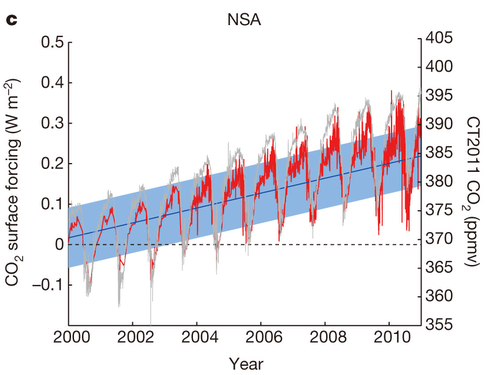
Notice there was a number of years of observations during the course of which CO2 concentration increased. Within each year we have the carbon cycle changing the CO2 content in the atmosphere. What is measured is not temperature but the amount of infrared. Since we know CO2 is a GHG what we see is not correlation = causation as roach keeps tiresomely crapping on about, it is cause and effect: increase GHGs you increase IR received back at the earth.
It will come as no surprise that spectrometers on satellites detect decreasing amounts of IR at the spectral locations in the IR band relating to each GHG: more IR cannot leave the earth, warming it.
This graph, incidentally, shows JoNova lied saying only the first 20% of CO2 caused warming. JoNova and all professional AGW deniers are frauds.
Alright, let us look at the radiation that comes in (overwhelmingly from the sun) and what is radiated back by earth as part of the process of cooling by the surface of the planet.
Quote:The electromagnetic spectrum covers a wavelength range of about 24 orders of magnitude, from the shortest, most energetic, high frequency gamma rays to the longest, very low energy, low frequency radio waves). The range of interest for climate science and atmospheric warming is approximately in the middle of this spectrum from about 0.1 to 100 μm (10
–1
to 10
2
μm). This includes the visible region of the spectrum (0.4 to 0.7 μm) and the adjacent higher energy (shorter wavelength) near ultraviolet (UV) and lower energy (longer wavelength) infrared (IR), including much of the “thermal infrared”. Incoming solar radiation is in the shorter wavelength (higher energy) part of this range from UV through near IR, between about 0.1 to 4 μm. Radiation from the warmed Earth is mainly in the thermal IR region between 4 and 30 μm.
OK, let us look at this again:
Quote:Incoming solar radiation is. . .in near IR, between about 0.1 to 4 μm. Radiation from the warmed Earth is mainly in the thermal IR region between 4 and 30 μm.
The higher energy part of the solar radiation, visible light, some UV etc, warms the earth, exciting the molecules forming the surface. This sees IR, infrared or heat if you like, being radiated by the molecules making up the surface, the soil, rocks, water, manmade structures etc.
So, how does this IR emanating from the surface and heading away from it get reflected back to the surface?
Quote:Molecular vibrations and some energetic rotations have energy level spacings that correspond to energies in the IR region of the electromagnetic spectrum (most rotations are in the microwave range which runs between thermal IR and radio wavelengths). Thus IR radiation absorbed by molecules causes increased vibration. Collisions between these energized molecules and others in the sample transfer energy among all the molecules, which increases the average thermal energy and, hence, raises the temperature. Conversely, molecules that emit IR radiation lose their vibrational energy and their collisions with other molecules decrease the average thermal energy and lower the temperature.
So GHG molecules can absorb IR causing the molecules to speed up, which is heat. When they lose the IR, re-emit it, they go back to the previous lower energy state (sounding a bit like silly Aqua here

) So how does this happen.
Quote:All molecules have positive (nuclei) and negative (electron clouds) regions, A molecule is dipolar and has a permanent dipole moment, if the averaged centers of its positively and negatively charged regions do not coincide. If a vibrational motion of the molecule disturbs these averages, its dipole moment can change and an appropriate energy of IR radiation can be absorbed to cause this molecular vibration.
Molecules of oxygen and nitrogen, which make up most of the atmosphere, have a more or less uniform density of electrons around them and are not GHGs. It is what deniers call “trace gases”

that are the GHGs and they have three of more atoms in each molecule: water vapor H2O, carbon dioxide CO2, CH4 (methane) and N2O (nitrous oxide) plus CFCs we put there and ozone (O3.)
A GHG molecule as we have seen has parts of the molecule with a lower density of electrons (the H2 of H2O) and a somewhat positive charge while other parts have a higher electron density and a somewhat negative charge. So we have positive and negative areas, bipoles. We can write CO2 as OCO and see the molecule has two dipoles. CH4 has four such dipoles.

Let us have a look at water vapor:
Cont’d

 Forum
Forum
 Pages: 1


