For those with a real interest here is an animation of temperatures in the years 1850–
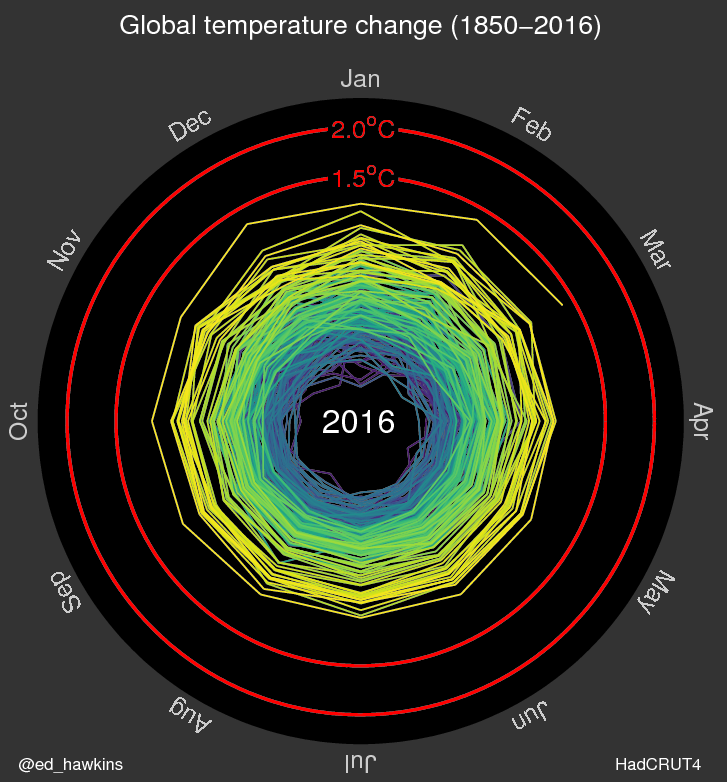
It is clear that temperatures are increasing: any statistical test of the null hypothesis that temperatures are stable in this period will end with the null hypothesis being falsified. Clearly temperatures are increasing.
Why are they increasing? Not due to the sun being more active, it varies but has not steadily increased 1850–.
A cessation of volcanic activity may have caused a mid 1900s spike in temperatures: volcanoes cool the earth because they spew aerosols into the upper atmosphere where they reflect sunlight back into space, cooling the earth. Have been some, just cause a little bit of noise in the temperature graph 1980– so not an explanation for the increase 1850 to present.
We know GHGs in the atmopsphere are increasing, that we are putting them there by mass burning of fossil fuels. Could they be the cause of the increasing global temperatures? Volcanoes do add CO2 to the atmosphere but it is negligible compared to our contribution.
Spectrometry, both terrestrial, i.e. from the ground looking up and from satellites looking down shows that there are gaps corresponding to the GHGs at the black body temperature corresponding to our world. That is how GHGs warm the world.
It is nothing as crude as mere correlation: there is a known, measured mechanism whereby GHGs absorb infrared radiation, preventing it from escaping to space and so warming the earth.
The Arctic warms by another mechanism: as the sea ice extent shrinks in the NH summer sunlight hits dark ocean and is absorbed, warming the ocean. This is called “warming due albedo change” and is why the Arctic is warming at twice the rate of the rest of our planet. Any so–called “pause” in AGW is based on temperature series that ignore the poles.
There are other minor ways the globe warms but these are third order effects (e.g. land clearing etc) but these are pretty minor and just slightly accelerate AGW.
What are the GHGs? These are the “non–condensing” gases like carbon dioxide and the more minor, if much more potent, gases like methane and nitrous oxide: more about these later.
There is another GHG: water vapor. Unlike CO2 water vapor does condense and fall as rain, hail or snow. We call it a reinforcer. As the non–condensing GHGs increase in concentration more water vapor joins them. The water vapor leaves a small window for infrared to escape to space and the GHGs act to further close the window, trapping more and more heat.
Now, methane (CH4) and nitrous oxide are minot GHGs. However, as the Arctic tundra thaws larger and larger amounts of these two GHGs can escape the tundra and end up in the atmosphere—especially nitrous oxide—and increase the rate AGW quite a bit.
So, that is the story. AGW is happening and is likely to increase rapidly as NO2 increases in concentration in the atmosphere.
Sea levels are rising due to AGW in two ways: as the oceans warm they increase in volume. Land based ice from Greenland which is shedding 200,000,000 tons of ice each year due to melting on the surface and where glaciers calve: this has picked up speed as the ice shelves that used to surround Greenland have melted away so warmer ocean currents now lap directly onto the glaciers at sea level. Will not be long before the balance between the East Antarctic plateau (gaining mass) and the West Antarctic ice sheet (losing ice) tips into net ice loss from Antarctica as well.
All of this is documented in the threads here—I will try to put up a list of links. But there is evidence for it.

 Forum
Forum
 Pages:

 Action on AGW, is it enough? (Read 8993 times)


