"The NSIDC website, IPCC’s reports and some scientific papers have announced that the Arctic Sea ice extent, when it is lowest in September month, in recent years has declined dramatically, and in few decades the sea ice is supposed to disappear completely in the summer. In that way new and shorter ships routes will open up north of the continents.
The facts are, that the Arctic Sea ice extent measured by satellites since 1978 expresses annual variations and it has declined considerably from 1997 to 2007. However, before that time period, from 1978 to 1996, the downward trend was minimal, and in the last 17 years from 2007 to 2023 the downward trend has also been about zero. Therefore, there is no indication that we should expect the Arctic Sea summer ice to disappear completely, as predicted, in one or two decades.
Regarding the extent of the summer (February) sea ice at the Antarctic, the downward trend during the years 1979-2021 was very small but in 2022 and 2023 a considerable decline was observed, and a decline was also clearly observed for the whole period of 2007- 2023. That was in contradiction to what happened in the Arctic. The pattern of the annual levels was not the same for the Arctic and Antarctic, indicating different drivers in the North and the South.
These data show that there is no apparent correlation between the variable extent of the Arctic and the Antarctic Sea ice and the gradually increasing CO2-concentrations in the atmosphere as proposed by NSIDC, IPCC and others, also for these areas of cold climate."
https://scienceofclimatechange.org/wp-content/uploads/Astrup-Jensen-2023-Time-Tr...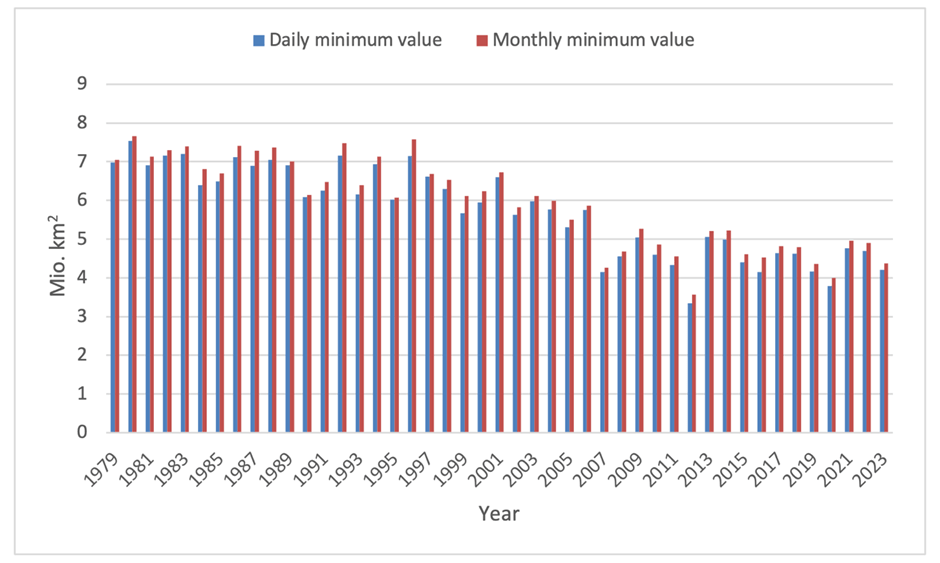
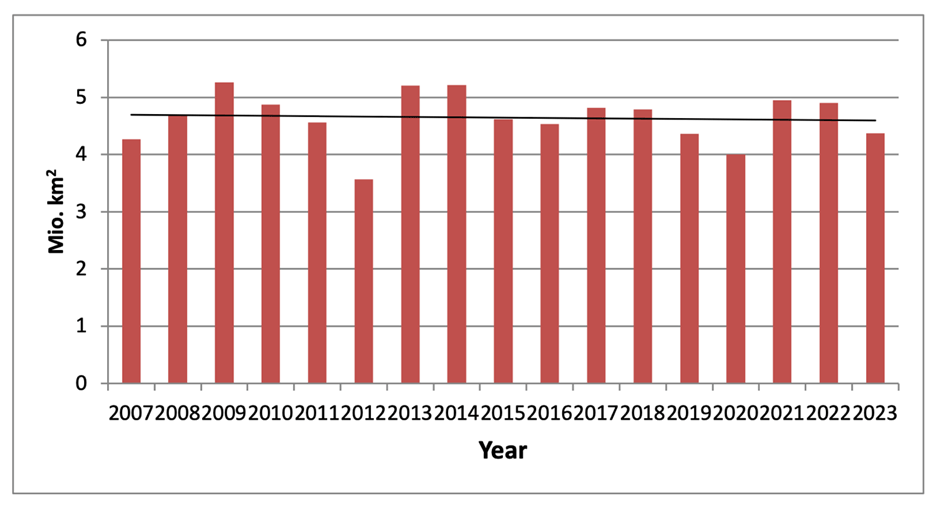
And then of course the one from the IPCC -1990 and 2001.
...
These data shows that there is no apparent correlation between the variable extent of the Arctic and Antarctic Sea ice and the gradually increasing CO2-concentrations in the atmosphere, as proposed by NSIDC, IPCC and others."
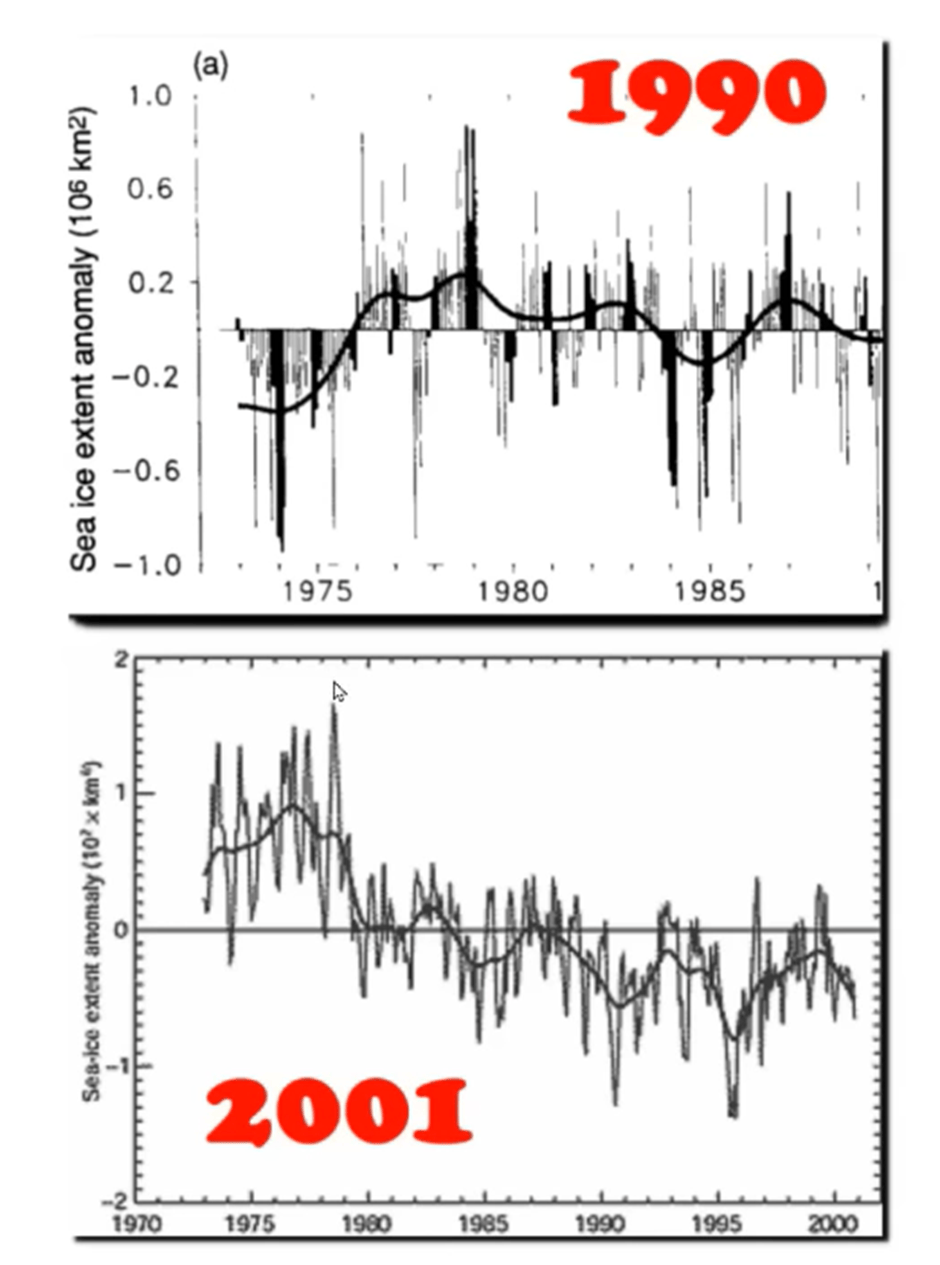
Isn't the truncation of the timeseries good?

"Jensen is a distinguished scientist of long standing with over 300 publications to his name. He is the Research Director of the Nordic Institute of Product Sustainability, Environmental Chemistry and Toxicology, and sits on the editorial board of the Springer publication, Environmental Science and Pollution Research."

 Forum
Forum
 Pages: 1


 Arctic sea ice levels no linear trend (Read 63 times)


