From John’s excellent link:
Quote:Most of the tracks were made by Acrocanthosaurus, which weighed nearly seven tons as an adult and stood 4.5 metres tall.
Another dinosaur, Sauroposeidon, also left tracks in the park. It measured more than 18 metres tall and weighed 44 tons in adulthood.
Imagine coming face to face with a carnivorous lizard that weighed SEVEN TONS and was 4.5m/11.6' tall!

You can tell from those teeth this little beauty was no grass eater!
Quote:Acrocanthosaurus was a bipedal predator. As the name suggests, it is best known for the high neural spines on many of its vertebrae, which most likely supported a ridge of muscle over the animal's neck, back, and hips.[1] Acrocanthosaurus was one of the largest theropods, with the largest specimen reaching 11 meters (36 ft) in length and weighing approximately 3.6–4.4 metric tons (4.0–4.9 short tons).[2][3][4] Large theropod footprints discovered in Texas may have been made by Acrocanthosaurus, although there is no direct association with skeletal remains.
A lizard weighing 44 tons could not move fast enough to catch prey! Which is good because a lizard 18m/59' tall would be a heart stopping sight!
Quote:Paleoecological analysis indicates that Sauroposeidon lived on the shores of the Gulf of Mexico, in a river delta. Extrapolations based on the more completely known Brachiosaurus indicate that the head of Sauroposeidon could reach 16.5–18 m (54–59 ft) in height with its neck extended, which would make it one of the tallest known dinosaurs. With an estimated length of 27–34 m (89–112 ft) and a mass of 40–60 t (44–66 short tons), it also ranks among the longest and heaviest. However, this animal may not be as closely related to Brachiosaurus as previously thought, so these estimates may be inaccurate.
While initially described as a brachiosaurid closely related to Brachiosaurus and Giraffatitan, the discovery of additional remains in the Cloverly Formation of Wyoming suggested that it was in fact more closely related to the titanosaurs, in the group Somphospondyli. Analysis of these remains and comparison with others from Texas supported this conclusion, and demonstrated that the more completely known sauropods from the Twin Mountains Formation (including a partial skull and fossil trackways) previously named Paluxysaurus jonesi also belonged to Sauroposeidon.[5] It is the state dinosaur of Texas.[6]
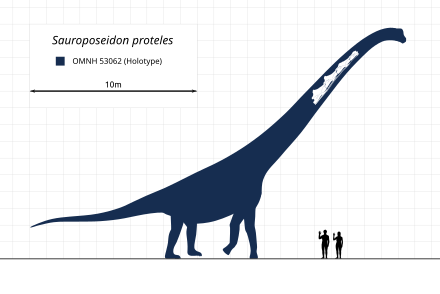
(both extracts from wiki)

 Forum
Forum
 Pages:


