Quote:This paper tests the validity of the FUND model’s energy impact functions, and the hypothesis that global warming of 2 °C or more above pre-industrial times would negatively impact the global economy. Empirical data of energy expenditure and average temperatures of the US states and census divisions are compared with projections using the energy impact functions with non-temperature drivers held constant at their 2010 values. The empirical data indicates that energy expenditure decreases as temperatures increase, suggesting that global warming, by itself, may reduce US energy expenditure and thereby have a positive impact on US economic growth. These findings are then compared with FUND energy impact projections for the world at 3 °C of global warming from 2000. The comparisons suggest that warming, by itself, may reduce global energy consumption. If these findings are correct, and if FUND projections for the non-energy impact sectors are valid, 3 °C of global warming from 2000 would increase global economic growth. In this case, the hypothesis is false and policies to reduce global warming are detrimental to the global economy. We recommend the FUND energy impact functions be modified and recalibrated against best available empirical data. Our analysis and conclusions warrant further investigation.
https://www.mdpi.com/1996-1073/12/18/3575/htm#B4-energies-12-03575A robust economy would help the poorer countries, No?
The world won't end in
10 8 years.
Zeke Hausfather often writes of Climate change and ocean warming etc.
Here he looks at RCP8.5 -
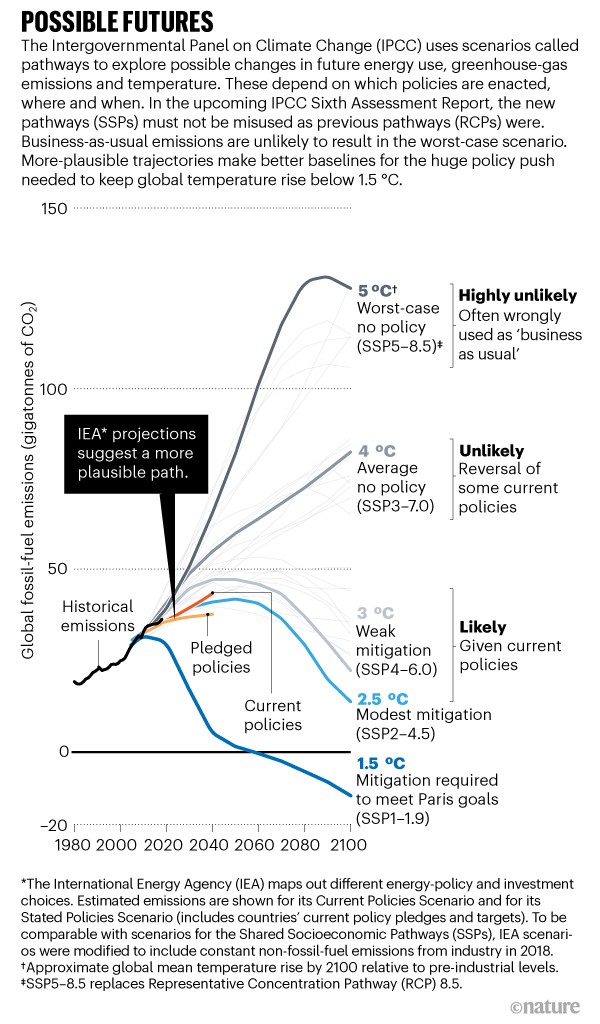
Quote:RCP8.5 was intended to explore an unlikely high-risk future2. But it has been widely used by some experts, policymakers and the media as something else entirely: as a likely ‘business as usual’ outcome. A sizeable portion of the literature on climate impacts refers to RCP8.5 as business as usual, implying that it is probable in the absence of stringent climate mitigation. The media then often amplifies this message, sometimes without communicating the nuances. This results in further confusion regarding probable emissions outcomes, because many climate researchers are not familiar with the details of these scenarios in the energy-modelling literature.
This is particularly problematic when the worst-case scenario is contrasted with the most optimistic one, especially in high-profile scholarly work. This includes studies by the IPCC, such as AR5 and last year’s special report on the impact of climate change on the ocean and cryosphere4. The focus becomes the extremes, rather than the multitude of more likely pathways in between.
Happily — and that’s a word we climatologists rarely get to use — the world imagined in RCP8.5 is one that, in our view, becomes increasingly implausible with every passing year5. Emission pathways to get to RCP8.5 generally require an unprecedented fivefold increase in coal use by the end of the century, an amount larger than some estimates of recoverable coal reserves6. It is thought that global coal use peaked in 2013, and although increases are still possible, many energy forecasts expect it to flatline over the next few decades7. Furthermore, the falling cost of clean energy sources is a trend that is unlikely to reverse, even in the absence of new climate policies7.
Assessment of current policies suggests that the world is on course for around 3 °C of warming above pre-industrial levels by the end of the century — still a catastrophic outcome, but a long way from 5 °C7,8. We cannot settle for 3 °C; nor should we dismiss progress.
 https://www.nature.com/articles/d41586-020-00177-3
Unfortunately he doesn't describe why 3 °C would be bad.
So it would seem that we ain't gunna die.


 Forum
Forum
 Pages:


