Forum

 
  Back to OzPolitic.com   Welcome, Guest. Please Login or Register
  Forum Home Album HelpSearch Recent Rules LoginRegister  
 

Page Index Toggle Pages: 1
Send Topic Print
Now for some REAL Climate Change - not Greeny bull (Read 434 times)
juliar
Gold Member
*****
Offline


Australian Politics

Posts: 22966
Now for some REAL Climate Change - not Greeny bull
Apr 2nd, 2019 at 12:47am
 
Real Climate Change and not just fabricated lying Greeny bulldust designed to fill the empty minds of the uneducated and gullible - like Greenies and Lefties.


What Changed The Green Sahara Into A Desert?
MessageToEagle | December 21, 2015 | Earth Changes, New Science

The Sahara, which is the world’s largest desert covers one third of the African continent. In ancient times, some thousand years ago, this vast area was fertile grassland.

Then something happened and the Green Sahara turned into a desert.

Today there is enough evidence to show that the Sahara desert had once a grassland ecosystem and was a much wetter place than it is today.

So, what caused this major climate change?
Most scientists believe the Sahara dried up due to a change in the Earth’s orbit, which affects solar insolation, or the amount of electromagnetic energy the Earth receives from the Sun. Or to use simpler words, insolation refers to the amount of sunlight shining down on a particular area at a certain time. It depends on factors such as the geographic location, time of day, season, landscape and local weather.

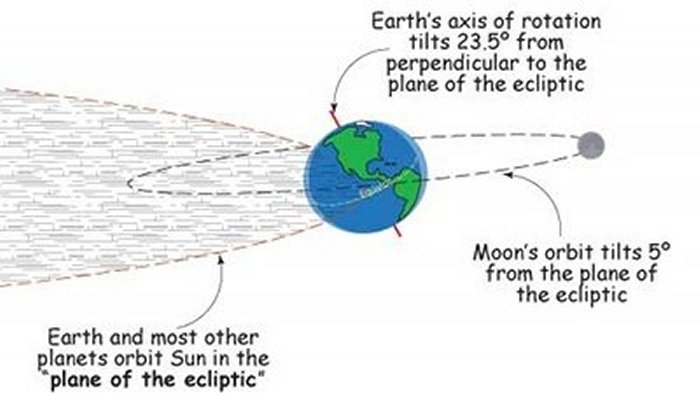
Climate scientist Gavin Schmidt, of NASA’s Goddard Institute for Space Studies, explained that around 8,000 years ago, the Earth’s orbit was slightly different to how it is today. The tilt changed from around 24.1 degrees to the present-day 23.5 degrees.

“Additionally, the Earth had its closest approach to the Sun in the northern hemisphere (with) summer in August,” Schmidt said.

“Today, that closest approach is in January. So, summertime in the north was warmer back then than it is now.”
...
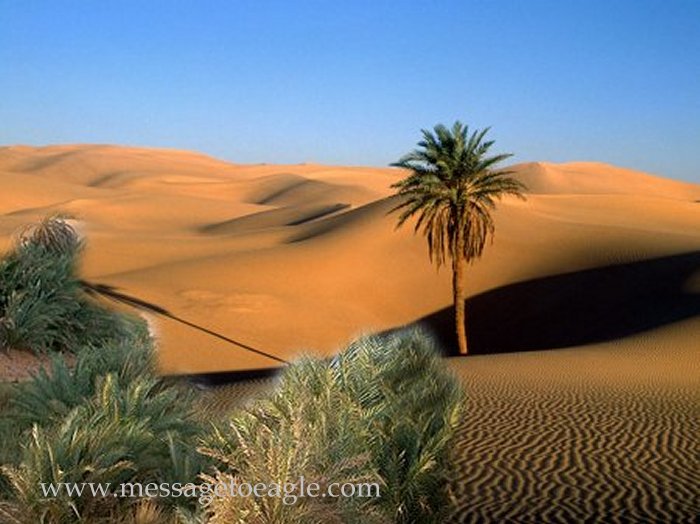
Green Sahara. There was a time in ancient past when Sahara was green.

The changes in the Earth’s orbital tilt and precession (or the wobbling motion) occur because of gravitational forces emanating from other bodies in the solar system.

To understand exactly what happens, picture a spinning top when it is slightly disturbed. Just like a top, the Earth too wobbles slightly about its rotational axis. This tilt changes between roughly 22 and 25 degrees about every 41,000 years, while the precession varies on about a 26,000-year period. These cycles have been determined by astronomers and validated by geologists studying ocean sediment records.

“If you get a long enough time series that can be well dated, you should be able to see frequencies in the data that correspond to the periods predicted by theory,” Schmidt explained.

Although scientists agree that the Sahara was once a green place, it is still widely debated how the transition occurred.

Due to the lack of paleo-environmental records, scientist must often resort to climate modeling.

In 1999, a group of German scientists used computer simulation to create a model of the Earth’s climate thousands of years ago. They concluded that the climatic transition of the Sahara took place abruptly, within a possible span of about 300 years.
...
Earth tilt

There are however other scientists who disagree with those calculations. New evidence show that the eastern region of the Sahara desert, especially the area near Lake Yoa in Chad, dried up slowly and progressively since the mid-Holocene period.

“The findings of this study are that the sedimentological and geochemical properties of the lake sediments confirm that the Sahara has been drying slowly from six thousand years ago to reach the present day conditions around 1,100 years ago,” said Pierre Francus, professor at the National Institute of Scientific Research in Quebec, Canada.

Gavin Schmidt belongs to the group of scientists who think there is enough evidence for sudden changes in the Sahara.

“Given the very strong dependence of vegetation on water availability, the end of the ‘Green Sahara’ came about quite suddenly around 5,500 years ago,” Schmidt said. “Thus, a very slow change in the orbit (led) to an abrupt collapse in that ecosystem.”

The Sahara is a vast area and we should not dismiss the possibility that parts of the land dried up abruptly while it took other regions a longer period of time to transform into a desert.

“It seems that drying was progressive in our area, but it does not automatically mean that it was the case in other areas such as Western Sahara,” said Francus. “We cannot rule out completely the possibility of abrupt drying. Understanding the regional differences in climate change is the next challenge for climate scientists.”

As an example, Francus mentions the Younger Dry as where an abrupt climate change took place between 12,800 and 11,500 years ago.

According to the National Oceanic and Atmospheric Administration, the end of this period was particularly abrupt when, for example, in Greenland, temperatures increased 18 degrees Fahrenheit in about a decade.

“Many scientists think that abrupt climate changes are possible in the future, but the nature, direction and intensity of these changes will most probably be region-dependent,” Francus said.

Francus also noted that there are some models that cannot predict an abrupt climate shift at all. Some scientists feel that there is not enough knowledge to understand the processes driving these changes primarily because it is difficult to model the soil moisture and cover.

[url]http://www.messagetoeagle.com/changed-green-sahara-desert/[/url

Back to top
 
 
IP Logged
 
juliar
Gold Member
*****
Offline


Australian Politics

Posts: 22966
Re: Now for some REAL Climate Change - not Greeny bull
Reply #1 - Apr 2nd, 2019 at 1:03am
 
While everyone knows the Greenies flipped years ago is there any possibility that the earth might flip its magnetic poles ?


Earth’s Magnetic Poles Could Start To Flip. What Happens Then?
MessageToEagle.com | December 10, 2018 | Astronomy, Earth Changes

As Earth’s magnetic shield fails, so do its satellites. First, our communications satellites in the highest orbits go down. Next, astronauts in low-Earth orbit can no longer phone home. And finally, cosmic rays start to bombard every human on Earth.

This is a possibility that we may start to face not in the next million years, not in the next thousand, but in the next hundred. If Earth’s magnetic field were to decay significantly, it could collapse altogether and flip polarity – changing magnetic north to south and vice versa. The consequences of this process could be dire for our planet.

...
The magnetic field protecting our planet originates deep in the Earth’s core but fluctuates in strength over time. Image credit – ESA/ATG medialab

‘The geomagnetic field has been decaying for the last 3,000 years,’ Dr Nicolas Thouveny from the European Centre for Research and Teaching of Environmental Geosciences (CEREGE) in Aix-en-Provence, France, said in a press release.

‘If it continues to fall down at this rate, in less than one millennium we will be in a critical (period).’

Cosmic rays
Our planet’s magnetic field is predominantly created by the flow of liquid iron inside the core. It has always been a feature of our planet, but it has flipped in polarity repeatedly throughout Earth’s history. Each time it flips – up to 100 times in the past 20 million years, while the reversal can take about 1,000 years to complete – it leaves fossilised magnetisation in rocks on Earth.

By taking cores – or columns – of sediments from the sea floor, like a long straw that can extend down up to 300 metres with the help of a drill, we can look back in time and see when these reversals occurred. Dr Thouveny and his team looked at two particular forms of elements that allowed them to probe the history of our planet’s magnetic field in greater detail.

For a polarity reversal to occur, the magnetic field needs to weaken by about 90% to a threshold level. This process can take thousands of years, and during this time, the lack of a protective magnetic shield around our planet allows more cosmic rays – high-energy particles from elsewhere in the universe – to hit us.

When this happens, these cosmic rays collide with more and more atoms in our atmosphere, such as nitrogen and oxygen. This produces variants of elements called cosmogenic isotopes, such as carbon-14 and beryllium-10, which fall to the surface. And by studying the quantities of these in cores, we can see when polarity reversals took place.

The last reversal occurred between 772,000 and 774,000 years ago. Since then, the field has almost reversed 15 times, called an excursion, dropping in strength significantly but not quite reaching the threshold needed before rising again. This is when we are most at risk – as the field decays and then recovers its strength. The last excursion occurred 40,000 years ago, and evidence suggests we are heading in that direction again.

...
The Earth’s magnetic field has been weakening over the South Atlantic (blue region). Image credit – ESA/DTU Space

‘The geomagnetic field has been losing 30 percent of its intensity in the last 3,000 years,’ said Dr Thouveny. ‘From this value, we predict it will drop to near zero in a few centuries or a millennia.’

The effects of a weakened magnetic field are seen on our satellites in orbit. In the Atlantic Ocean between South America and Africa, there is a vast region of Earth’s magnetic field that is about three times weaker than the field strength at the poles.

This is called the South Atlantic Anomaly (SAA), and  the CoreSat project led by Professor Chris Finlay from the Technical University of Denmark (DTU) near Copenhagen is trying to figure out what is causing the SAA.

‘This is a region where we see that satellites consistently (experience) electronic failures,’ said Prof. Finlay. ‘And we don’t understand where this weak field region is coming from, what’s producing it, and how it might change in the future.’

Scientists first noticed the SAA in the 1950s, and since then it has decreased in strength by a further 6%, as well as moving closer to the west. ‘(There) hasn’t really been any convincing explanation of it,’ said Prof. Finlay, adding that scientists haven’t been able to predict how it’s going to alter.

The CoreSat project is hoping to change all that, using the most detailed data available yet to study the properties of the magnetic field here and how it shifts over time. By probing the SAA, the team are hoping to see what’s going on inside Earth’s core that might be causing it.

http://www.messagetoeagle.com/earths-magnetic-poles-could-start-to-flip-what-hap...
Back to top
 
 
IP Logged
 
Page Index Toggle Pages: 1
Send Topic Print