And Australia is looking forward to generating hydrogen, converting it to ammonia, and exporting HUGE quantities to Japan and Sth Korea and anywhere else.Bullet Train Thinking: How Japan Hopes to Lead a Global Hydrogen Revolutionby Ross Hastie, Spintelligent August 8, 2018
 “Japan will present hydrogen to the rest of the world as a new energy choice and will lead global efforts for establishing a carbon-free society taking advantage of Japan’s strong points,” read a statement from Japanese Ministry of Economy, Trade and Industry as it unveiled the country’s ground-breaking Basic Hydrogen Strategy last December.
Two months later, the message was echoed in front of a packed keynote session at the World Smart Energy Week 2018* in Tokyo, as it was explained that Japan will “aggressively” pursue a policy of promulgating hydrogen worldwide.
Japanese Prime Minister Shinzo Abe has made hydrogen a symbol of the country’s ability to innovate. Indeed, the technical difficulty involved in making fuel cells is part of their attraction for Japan.
If the plan to spread the technology succeeds, Japan’s position as a leader in the global smart energy space will be assured. If it fails, another era of self-imposed isolation is likely on the cards.
When necessity meets opportunityIn an age where the needs for clean energy and energy security are becoming national priorities globally, hydrogen’s energy density has ensured that the technology is also receiving plenty of attention, especially in Germany, the USA and even China.
What makes Japan unique is that a large-scale industrial strategy has been combined with environmental and energy security ambitions.
Although positioned to take advantage of Japan’s status as a global leader in fuel cell technology, the hydrogen strategy — like most great schemes and initiatives – was born out of necessity in unforeseen circumstances.
The fallout of the great earthquake of 2011 saw Japanese public opinion turn staunchly against nuclear, shaking Japan’s energy policy to its foundations and pushing alternative energy solutions to the fore.
Now, the objective is to combine necessity with future opportunity.
Tokyo 2020: The Olympic launchpadThe Tokyo Olympic Games in 2020 have been dubbed the ‘Hydrogen Olympics’ and the Japanese government plans to use the event to showcase the advantages of hydrogen technologies, thus spreading the fuel-cell gospel.
The hope is that the effect will be similar to the launch of the famed ‘bullet train,’ which became the blueprint for high-speed railway systems worldwide.
“The 1964 Tokyo Olympics left the Shinkansen high-speed train system as its legacy. The upcoming Olympics will leave a hydrogen society as its legacy,” the Tokyo Metropolitan Government (TMG) said in a statement back in 2016, when plans for transforming the Japanese capital were announced.
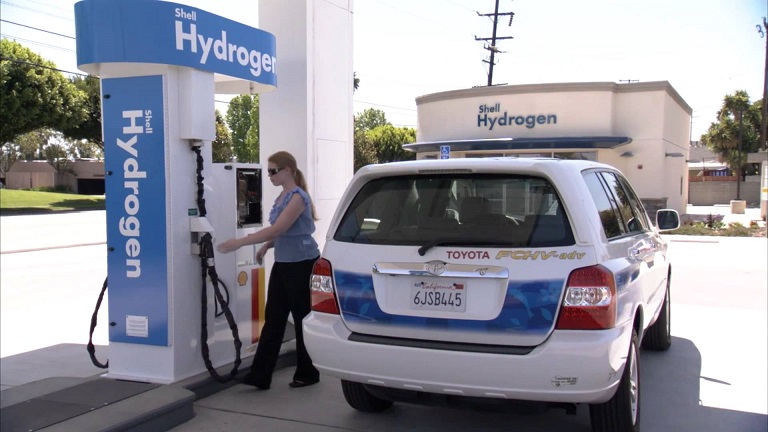
The infrastructure dilemmaFuel cell vehicles (FCV) are a major component of the larger Japanese strategy but FCV proponents worldwide face the same chicken-and-egg dilemma: increased infrastructure requires additional vehicles to support it, and vice versa. And the costs of the infrastructure required are significant.
The TMG plans to have over 100 fuel cell buses and 35 hydrogen fuelling stations operating in Tokyo in time for the games, aided by a 40 billion Yen ($348 million) fund. By 2025 it aims to have 80 stations and 100,000 fuel cell cars on the roads of the capital.
The situation is further complicated by Japan’s strict safety regulations. It costs about ¥500 million (US $4.5 million) to build a refueling station in Japan, more than double the cost in the U.S. or Europe, and five times the cost of a ‘traditional’ fossil fuel station.
The difficulties and grey areas in the regulations around how to handle hydrogen are not unique to Japan. But while Prime Minister Abe has made a priority of overhauling some of the regulations — hydrogen is still regulated as an industrial gas, with standards designed for large-scale chemical plants — some industry experts are concerned that government efforts are neither going far enough nor moving quickly enough to make Japan competitive internationally.
Industry convergenceJapanese companies such as Honda, Toyota and Kawasaki are at the forefront of hydrogen technology and the Japanese government has identified that industry convergence is critical for the hydrogen strategy to become feasible and sustainable.
Given the high-associated costs of producing hydrogen and the necessary infrastructure required, there is opportunity for beneficiary sectors to group and develop hydrogen stations – key being transport and battery storage.
In March, an alliance of 11 Japanese firms called Japan H2 Mobility LLC, including automakers and energy firms, pledged to build 80 FCV fuelling stations by 2022 to help accelerate take-up of the technology.
The group includes Toyota Motor Corp, JXTG Nippon Oil & Energy, Honda, Nissan Motor, Idemitsu Kosan, Iwatani Corp, Tokyo Gas, Toho Gas and Air Liquide Japan Ltd.
Read the rest herehttps://www.renewableenergyworld.com/articles/2018/08/bullet-train-thinking-how-...

 Forum
Forum
 Pages:

 World rushes to the Hydrogen Energy Revolution (Read 31043 times)


