Jovial Monk wrote on Apr 27
th, 2018 at 6:12am:
Bobby, we talked about thorium before.
Once thorium is treated to make it radioactive it is little different from uranium. There is a bit less waste, a slight advantage but that is it.
https://en.wikipedia.org/wiki/Thorium_fuel_cycleThorium fuel cycleFrom Wikipedia, the free encyclopedia
A sample of thorium
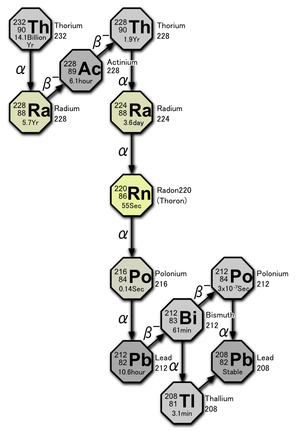
The thorium fuel cycle is a nuclear fuel cycle that uses an isotope of thorium, 232
Th, as the fertile material. In the reactor, 232
This transmuted into the fissile artificial uranium isotope 233U
which is the nuclear fuel. Unlike natural uranium, natural thorium contains only trace amounts of fissile material (such as 231
Th), which are insufficient to initiate a nuclear chain reaction. Additional fissile material or another neutron source is necessary to initiate the fuel cycle. In a thorium-fueled reactor, 232Th
absorbs neutrons to produce 233U
. This parallels the process in uranium breeder reactors whereby fertile 238U
absorbs neutrons to form fissile 239Pu
. Depending on the design of the reactor and fuel cycle, the generated 233U
either fissions in situ or is chemically separated from the used nuclear fuel and formed into new nuclear fuel.
The thorium fuel cycle has several potential advantages over a uranium fuel cycle, including thorium's greater abundance, superior physical and nuclear properties, reduced plutonium and actinide production,[1] and better resistance to nuclear weapons proliferation when used in a traditional light water reactor[1][2] though not in a molten salt reactor.[3][4]

 Forum
Forum
 Pages: 1


 Environment of forums. (Read 3219 times)


