Quote:2016: a record in surface temperatures and in CO2 concentration
The activities of human beings are increasing their impact in the planet year after year. In 2016, the annual global surface temperature increased for third year in a row, becoming the hottest year in recorded history – for now.
And why should that matter to us? Because it means ice melting, sea levels rising, freshwater shortages for agricultural productivity and lack of food, which will arise more conflicts and emigration. We may survive to a temperature increase, but that’s useless if we don’t have enough food and water.
As the map below shows, in most of the planet regions, the 2016 average temperature was between 2-4 ºF higher than the average from the period 1981-2010.
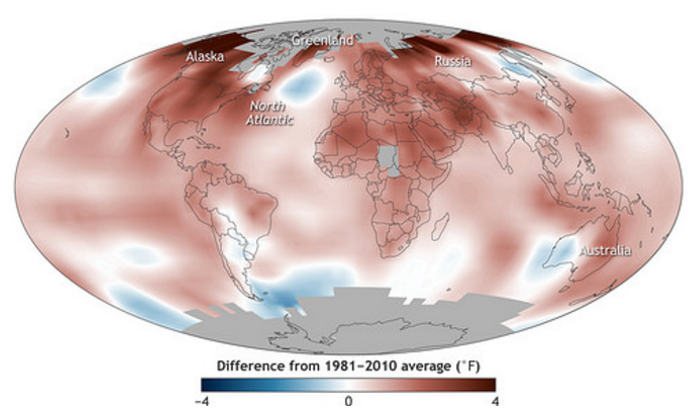 Quote:
Moreover, year 2016 has registered the largest annual raise of global atmospheric carbon dioxide (CO2). From 2015 to 2016 this value increased by 3.5 ppm, surpassing the boundary of 400 ppm for the first time ever: 402.9 ppm.
The CO2 level will be rising again as the NH moves into fall and winter.
Quote:Besides the global surface temperatures, the sea level also rose to a record: it increased for sixth year in a row, being 3.25 inches (83 mm) higher than it was in 1993. But the alarming statistics of the State of the Climate 2016 are on the Arctic surface temperatures, both in land and sea.
See that, Booby the Gullible? Alarming Arctic surface temperatures—alarmingly warm, not cold. I thought the ice sheets were forming again? Doesn’t look like it!
Quote:The average land surface temperature at the Arctic was 3.6°F (2.0°C) above the 1981-2010 average, while in other regions at sea this increase was much higher. In August 2016, regions of the Chukchi Sea and the west of Greenland showed an increase of 13 to 14 ºF (7 to 8ºC) above 1981-2010 average. However, that is still below the extraordinary register in the Barents Sea during the same month: 20 ºF (11ºC) above average. In fact, the rate of warming in the Arctic is twice the rate of the world average, and that is originating serious consequences for the rest of the planet.
Wow! 3.6°F (2.0°C) above average with 14 ºF (7 to 8ºC) above average and an amazing 20 ºF (11ºC) above average in the Barents sea.
Funny old ice age, Booby!
http://www.greenism.com/areas-of-the-barents-sea-reached-20of-above-average-in-2...

 Forum
Forum
 Pages:


