"When it comes to global warming, carbon dioxide is the 800-pound gorilla: it’s the most abundant of the long-lived greenhouse gases that human activities generate. But ounce for ounce, methane (CH4) traps more heat, and it accounts for about 20% of the greenhouse gases produced by human activities. Strangely, though, global methane levels “flat lined” from 1999 to 2006.
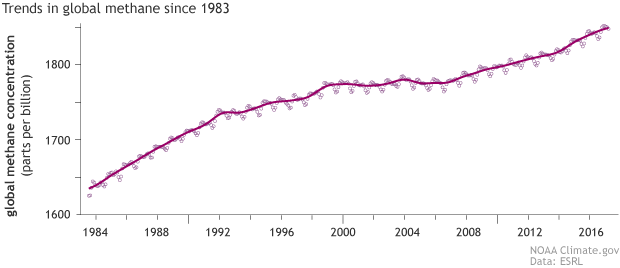
Monthly methane concentrations (small circles) since 1983, with the running average as a solid line. NOAA Climate.gov graph, based on data from NOAA ESRL.
The plateau didn’t last, however, and in recent years, global methane levels have been hitting new highs. Figuring out what’s going on with methane is a high priority for carbon cycle experts at NOAA and other institutions around the world. Possibly the most important clue: air samples collected at different latitudes around the world show that the amount of methane carrying carbon-13—a rare, heavy isotope of carbon—has dropped significantly since 2007."
"The carbon isotope analyses, carried out for NOAA by the Stable Isotope Laboratory at the University of Colorado Boulder's Institute of Arctic and Alpine Research, are consistent with an increase in microbial emissions from both natural wetlands and agricultural sources.
Agricultural sources of methane include rice farming and belching from ruminant livestock. Rice farming depends on periodic flooding of growing areas. Drowned soils and animal stomachs favor species of microbes that can survive without oxygen. These microbes respire methane (CH4) instead of carbon dioxide (CO2).
With respect to geography, both sources are plausible. The world’s largest population of ruminant livestock is in India (Northern Hemisphere tropics), and other tropical countries in Africa and South America have large populations as well. Most rice cultivation takes place in the Northern tropics, in India, China, and Southeast Asia. The tropics of both hemispheres are home to the world’s largest wetlands."
https://www.climate.gov/news-features/understanding-climate/after-2000-era-plate...natural wetlands and tropical agriculture. Who woudda thunk.
Proudly brought to you by NOAA.

 Forum
Forum
 Pages: 1


