Jovial Monk wrote on Mar 21
st, 2017 at 8:15am:
So now to calculate the change in temperature, we just need to know the climate sensitivity. Studies have given a possible range of values of 2-4.5°C warming for a doubling of CO2 (IPCC 2007). Using these values it's a simple task to put the climate sensitivity into the units we need, using the formulas above:
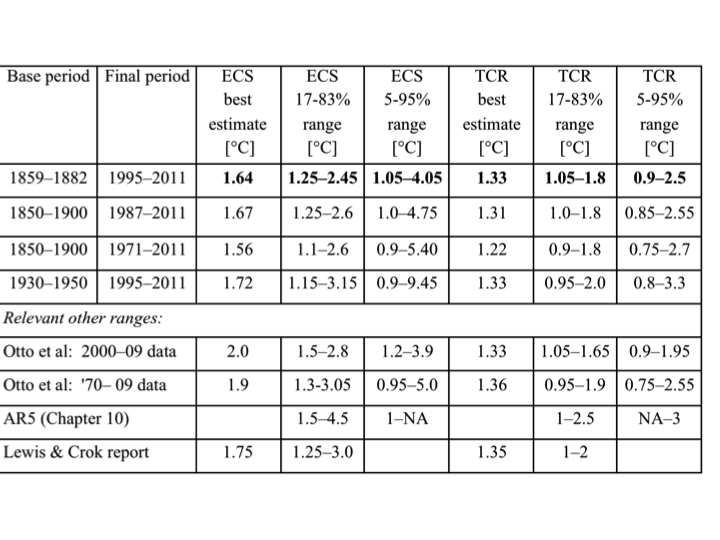
"For the Fifth Assessment Report (AR5), the ECS estimate was revised, reducing the lower limit of the likely range to 1.5°C, with no best estimate given."
And remember we're talking about doubling from 278ppm to 566ppm.
Your figures are all over the shop.
"Fortunately, the negative and positive forcings are roughly equal and cancel each other out,"
And of course they provide empirical evidence? /sarc.
Jovial Monk wrote on Mar 21
st, 2017 at 8:26am:
and the natural forcings over the past half century have also been approximately zero (Meehl 2004
So the CSIRO lied about greening of the deserts. For shame.
 Jovial Monk wrote
 on Mar 21
st, 2017 at 8:26am:
If we were to get massive “burps” of methane—a VERY powerful GHG, just look at the spectrometry graphs—as the tundra melts then methane forcing will also force warming.
What about the termites, the largest methane producers on the planet. Where did they account for them?
BTW - with your lovely greenhouse that warms, how much does the CO2 increase to give that warming.
Jovial Monk wrote on Mar 21
st, 2017 at 10:36am:
Quote:
Around 80 per cent of the additional energy accumulated by the climate system is accounted for by the warming of the upper 2000 m of the ocean.
But don't they adjust the buoys because they have a "cool bias"?
 Jovial Monk wrote
 on Mar 21
st, 2017 at 10:36am:
So most of the extra warming goes into the sea. No wonder sea ice extent is decreasing.
But according to Trenberth it is going into the deep ocean, and will one day come back to bite us on the bum. Who knew the sea ice went that deep?
Jovial Monk wrote on Mar 21
st, 2017 at 8:26am:
Quote:
Figure 3: Time series of anthropogenic and natural forcings contributions to total simulated and observed global temperature change. The coloured shadings denote the 5-95% uncertainty range.
5–95% confidence. Hmmmm must be a two tailed test, eh Lees? Wink
Are you sure 5-95% uncertainty range equates to 5-95% confidence? If so would you rely on a test being true if you only had 5% confidence?

 Forum
Forum
 Pages:

 Tired of stupid AGW denialism? (Read 9725 times)


