What I noticed when looking through the list of hits is that deniers (and not just JoNova) have now accepted CO2 causes warming and have retreated to saying that more CO2 won’t cause more warming. Yeah, just like in winter putting another blanket on your bed doesn’t keep you warmer

Let us have a look at a real paper (Booby, you might as well stop reading because it will be above your limited comprehension. Will be above Lees’ too but he will make a silly one liner to pretend to understand and refute it.
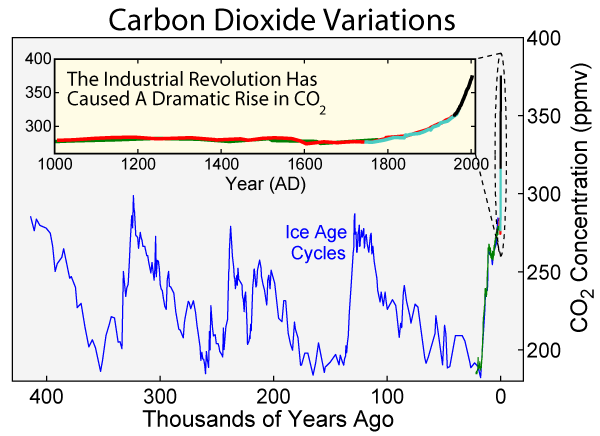
Note the 100K year cycle of major ice ages? No cooling for quite a while yet!
Quote:Humans have increased the amount of carbon dioxide (CO2) in the atmosphere by about 40% over the past 150 years.
Now let us look at the spectrometry:
 Quote:
 Figure 2: Spectrum of the greenhouse radiation measured at the surface. Greenhouse effect from water vapor is filtered out, showing the contributions of other greenhouse gases (Evans 2006).
(Booby, you see how Yogi was wrong about NO? GREAT discussion about your videos at PA by the way, just great!)
Lees could not answer how the absorption and re-emission of IR by CO2 (etc) heated the earth. I even gave him a clue! The IR that a molecule of GHG absorbs is headed outwards. When the IR is re-emitted it can go in any random direction so at least half will be emitted back down and that is how GHGs warm the globe. My 4yo great niece understands this.
Now let us look at the IR spectrum from space:
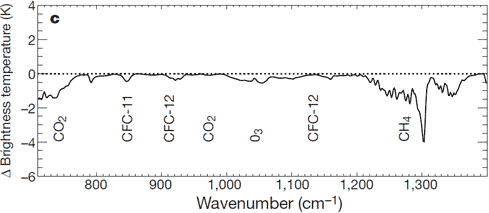 Quote:
Figure 3: Change in spectrum from 1970 to 1996 due to trace gases. 'Brightness temperature' indicates equivalent blackbody temperature (Harries 2001).
The increased energy reaching the Earth's surface from the increased greenhouse effect causes it to warm. So how do we quantify the amount of warming that it causes?
Radiative Transfer ModelsRadiative transfer models use fundamental physical equations and observations to translate this increased downward radiation into a radiative forcing, which effectively tells us how much increased energy is reaching the Earth's surface. Studies have shown that these radiative transfer models match up with the observed increase in energy reaching the Earth's surface with very good accuracy
(Puckrin 2004). Scientists can then derive a formula for calculating the radiative forcing based on the change in the amount of each greenhouse gas in the atmosphere
(Myhre 1998). Each greenhouse gas has a different radiative forcing formula, but the most important is that of CO2:
dF = 5.35 ln(C/Co)
Where 'dF' is the radiative forcing in Watts per square meter, 'C' is the concentration of atmospheric CO2, and 'Co' is the reference CO2concentration. Normally the value of Co is chosen at the pre-industrial concentration of 280 ppmv.
Now that we know how to calculate the radiative forcing associated with an increase in CO2, how do we determine the associated temperature change?
BTW, ln() is the natural logarithm. You can look it up.
Quote:Climate sensitivity
As the name suggests, climate sensitivity is an estimate of how sensitive the climate is to an increase in a radiative forcing. The climate sensitivity value tells us how much the planet will warm or cool in response to a given radiative forcing change. As you might guess, the temperature change is proportional to the change in the amount of energy reaching the Earth's surface (the radiative forcing), and the climate sensitivity is the coefficient of proportionality:
dT = λ*dF
Where 'dT' is the change in the Earth's average surface temperature, 'λ' is the climate sensitivity, usually with units in Kelvin or degrees Celsius per Watts per square meter (°C/[W/m2]), and 'dF' is the radiative forcing.
So now to calculate the change in temperature, we just need to know the climate sensitivity. Studies have given a possible range of values of 2-4.5°C warming for a doubling of CO2 (IPCC 2007). Using these values it's a simple task to put the climate sensitivity into the units we need, using the formulas above:
λ = dT/dF = dT/(5.35 * ln[2])= [2 to 4.5°C]/3.7 = 0.54 to 1.2°C/(W/m2)
Using this range of possible climate sensitivity values, we can plug λ into the formulas above and calculate the expected temperature change. The atmospheric CO2 concentration as of 2010 is about 390 ppmv. This gives us the value for 'C', and for 'Co' we'll use the pre-industrial value of 280 ppmv.
dT = λ*dF = λ * 5.35 * ln(390/280) = 1.8 * λ
Plugging in our possible climate sensitivity values, this gives us an expected surface temperature change of about 1–2.2°C of global warming, with a most likely value of 1.4°C. However, this tells us the equilibrium temperature. In reality it takes a long time to heat up the oceans due to their thermal inertia. For this reason there is currently a planetary energy imbalance, and the surface has only warmed about 0.8°C. In other words, even if we were to immediately stop adding CO2 to the atmosphere, the planet would warm another ~0.6°C until it reached this new equilibrium state
cont’d

 Forum
Forum
 Pages:

 Tired of stupid AGW denialism? (Read 9659 times)


