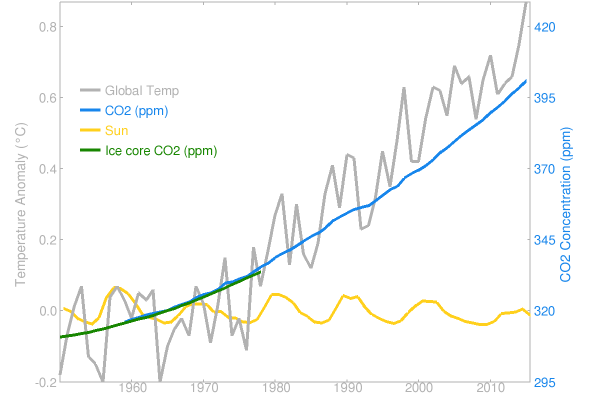
The last solar minimum occurred between 2008-2010 during a period of rising temperatures. Furthermore, the solar maximum ending in 2015 was lower than previous solar maximums in 1981,1990 and 2002.
 Quote:
Global temperature goes from heat record to heat record, yet the sun is at its dimmest for half a century.
For a while, 2010 was the hottest year on record globally. But then it got overtopped by 2014. And 2014 was beaten again by 2015. And now 2016 is so warm that it is certain to be once again a record year. Three record years in a row – that is unprecedented even in all those decades of global warming.
Strangely, one aspect of this gets barely mentioned: all those heat records occur despite a cold sun (Figs. 1 and 2). The last solar minimum (2008-2010) was the lowest since at least 1950, while the last solar maximum (2013-2015) can hardly be described as such. This is shown, among others, by the sunspot data (Fig. 1) as well as measurements of the solar luminosity from satellites (Fig. 2). Other indicators of solar activity indicate cooling as well (Lockwood and Fröhlich, Proc. Royal Society 2007).
As climate scientists we are by no means surprised at this development, as there has been clear evidence that the variations of the sun’s activity have played a completely subordinate role in climate change over the last 65 years. We’ve covered this issue many times, e.g. here, here and here. Global warming is driven by greenhouse gases, which is a long-standing consensus in science.
The current IPCC report, for example, limits the natural contribution to global warming since 1950 to less than plus or minus 0.1 ° C (it might have been negative e.g. because of the fading sun). However, some unsupported claims by “climate skeptics” about the importance of solar variability are now clearly falsified.
Global temperature goes from heat record to heat record, yet the sun is at its dimmest for half a century.
For a while, 2010 was the hottest year on record globally. But then it got overtopped by 2014. And 2014 was beaten again by 2015. And now 2016 is so warm that it is certain to be once again a record year. Three record years in a row – that is unprecedented even in all those decades of global warming.
Strangely, one aspect of this gets barely mentioned: all those heat records occur despite a cold sun (Figs. 1 and 2). The last solar minimum (2008-2010) was the lowest since at least 1950, while the last solar maximum (2013-2015) can hardly be described as such. This is shown, among others, by the sunspot data (Fig. 1) as well as measurements of the solar luminosity from satellites (Fig. 2). Other indicators of solar activity indicate cooling as well (Lockwood and Fröhlich, Proc. Royal Society 2007).
As climate scientists we are by no means surprised at this development, as there has been clear evidence that the variations of the sun’s activity have played a completely subordinate role in climate change over the last 65 years. We’ve covered this issue many times, e.g. here, here and here. Global warming is driven by greenhouse gases, which is a long-standing consensus in science.
The current IPCC report, for example, limits the natural contribution to global warming since 1950 to less than plus or minus 0.1 ° C (it might have been negative e.g. because of the fading sun). However, some unsupported claims by “climate skeptics” about the importance of solar variability are now clearly falsified.
Climate skeptics have repeatedly predicted an imminent global cooling because of the weak sun. Attributing global warming to the sun has become untenable, because solar activity has not increased for the last 65 years. It has been essentially constant, except for the well-known 11-year Schwabe cycle (which also has little effect on global temperature) and a slight downward trend .
Misunderstood thermal inertia
The excuse of the skeptics here is usually that global warming is a time-delayed reaction to an increase in solar activity before 1950. The basic idea is not entirely wrong: the climate system has a certain inertia. If the solar luminosity were to be increased in a sudden step, the temperature would not rise immediately, as it would take a while to heat up the oceans. This inertia effect can be quantified with the help of model simulations. Caldeira and Myhrvold (ERL 2013) have shown that 60% of the temperature reaction occurs within the first 20 years.
However, around 80% of global warming since the 19th century has only taken place after 1970. It is therefore unthinkable that the slight and gradual increase in solar activity before 1950 could have contributed significantly to the strong warming since the 1970s. Further evidence for this is the comparison of temperatures of land and sea. Everyone knows: when the sun rises in the morning, it takes only a few hours (certainly not decades) to heat the air strongly. Over 90% of the thermal inertia resides in the ocean, while the air over land quickly heats up. If the global warming since 1970 were a delayed response to a previous increase in solar luminosity, then we would now observe above all a catch-up warming of the oceans. The opposite is the case: the continents heat up more quickly and the ocean temperatures are lagging behind...

 Forum
Forum
 Pages: 1


 Record heat despite solar minimum (Read 1594 times)


