perceptions_now
Gold Member
 Offline

Australian Politics
Posts: 11694
Perth WA
Gender: 
|
woof woof wrote on Sep 25 th, 2012 at 4:54pm: Given that the labor lovers on here see no problem with our level of debt, At what point do they feel that we'd have too much debt.
Do we go to levels such as Greece and Spain to keep our economy afloat.
I'd be interested knowing how much becomes too much.
Now they'l come out and say that our debt is 5% of GDP which equates to a 100K salary earner only owing $5000, Ok that seems ok.
But the 100K salary earner is repaying the debt the bank wont allow him to just let it grow like the government allows its debt to grow.
And given we are borrowing billions more than we earn, what happens when we can't borrow any more?? what happens then, do we then become like Greece and Spain???? The proper & usually acceptable answer is, that depends!
It depends on the Global & Local Economic cycle and at what point in the cycle we find ourselves.
For example, in the decline phase of the Local & Global Economy, it would be usual (in line with standard Economic practices) to increase Debt, in order to stimulate the Economy, which is what has been happening.
Whilst, at the other end of the cycle, when the Economy is in an upswing, Debt should be paid down, thus reducing the Debt to GDP ratio, to lower & more acceptable levels, which is what happened under the Liberals during 1995-2007.
To provide some background, the following is a chart of US Debt to GDP % between 1900-2012. As can be seen, the early part of the 1900's saw a ratio of around 10% as usual. After that the usual range is between 30-50%, with the WW2 period Peaking at 120% and the current rise between 2001-2012 is nudging 100% now. However, those recent figures are certainly fudged & muddied by the involvement of the Federal Reserve Bank and there are strong expectations that the real US Debt to GDP ratio is already well over 100% & it will continue to escalate for quite some time. In short, they will emulate "the Don", they will get a ton & go on with it!
http://www.usgovernmentspending.com/spending_chart_1900_2012USp_11s1li011mcn_H0f...
Following is another chart, which provides a comparison with a few other countries, notably the USA, UK, Japan & Italy. 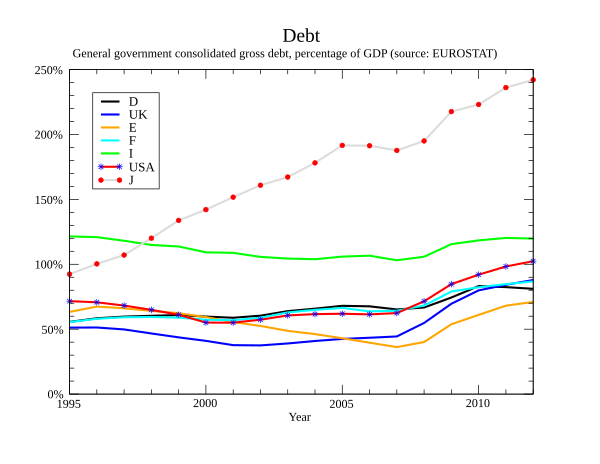 Japan is a basket case, at well over 200% Debt to GDP. Japan is a basket case, at well over 200% Debt to GDP.
Italy is at 140%, accord to the chart, but it is now higher.
The UK is at 80%, accord to the chart, but it is also now higher.Now, I've shown all this to highlight that Debt is part of the Global and not only is it an accepted part, it is actually an integral part, particularly in the modern era.
So, how much is too much Debt & how much is OK?
Well, as I said, that depends on what point we are at in the Economic cycle. That said, most reasonably run countries will aim at 30% in good times, but if the Debt to GDP ratio starts heading North of 80-90%, then they know they are in for some serious problems or at least they should know.As can be seen in the following, Australia has had a maximum rate of 31.7% in 1995, which is at the lower end of what most countries would be happy with. It got as low as 9.7% in 2008 and is now back up to 22.9% now, as the effects of the GFC has enter into the OZ Economy.http://www.tradingeconomics.com/australia/government-debt-to-gdpSo, both Liberal & Labor have certainly done better than their counterparts in most other countries, BUT they all should have done better!
I hope this gives some helpful guidance, on the rightful position of Debt in the Economy.Btw, those usual Economic remedies are now "Null & Void", given some major events now under way -
1) Demographic Change - Baby Boomer Retirements
2) Energy - Demand outstripping Supply.
3) Debt - Levels already at historic highs & continuing to climb
4) Climate Change - Raising Debt, lowering Food Supply & increasing Prices and lowering levels of fresh water, for irrigation & drinking.
Nearly forgot, the following, may provide some further confirmation where Australia sits, in comparison to other countries in the Debt race.
http://www.indexmundi.com/g/r.aspx?c=as&v=143
|

 Forum
Forum
 Pages:


