Forum

 
  Back to OzPolitic.com   Welcome, Guest. Please Login or Register
  Forum Home Album HelpSearch Recent Rules LoginRegister  
 

Pages: 1 ... 51 52 53 54 55 56
Send Topic Print
Global Economic Downturn to Continue? (Read 97543 times)
perceptions_now
Gold Member
*****
Offline


Australian Politics

Posts: 11694
Perth  WA
Gender: male
Re: Global Economic Downturn to Continue?
Reply #780 - Feb 22nd, 2012 at 2:04pm
 
Europe Passes the Last Exit. A Great Crisis Lies Ahead


The German people drew the wrong conclusion from their post-WWI experience.  They saw the damage from the Weimar hyperinflation of 1921-1924, probably an inevitable result of the WWI settlement.  They suffer amnesia about the Weimar deflation which brough Hitler to power (see A lesson from the Weimar Republic about balancing the budget).  It’s sounding a fire alarm while the ship sinks.  Now they repeat in different form Weimar’s mistakes of 1929-32, imposing a crippling austerity on the PIIGS while striving to balance their own budget — almost certain to result in recession and deflation (for description of this process see Debt – the core problem of this financial crisis, which also explains how we got in this mess).

The PIIGS nations grow weaker, the eurozone economy slows, and the centrist political parties lose support to extremists.  Greece leads this parade, but the other PIIGS – and France — follow in its path.  We can only guess at how this plays out, but it probably ends badly.

Today’s meeting of Europe’s Finance Minsters looks like the last chance to change course.  Like all previous opportunities, they will almost certain drive by this last exit.  They are ill-equipped to do otherwise, much like 13th century priests treating the Plaque on the basis of Scriptural precepts.
    Myopically focused on the need to protect politically powerful banks,
    seeing Europe as a morality play rather than the product of cold laws,
    believing in a mixture of pseudoeconomic economic myths (eg, confidence fairies, invisible bond vigilantes and the curative power of austerity), and
    unwilling to recognize their own role in creating this crisis.

The series of posts last Fall forecast a resolution –  a crisis-driven policy change — in the near future.  Three months later nothing has happened.  Europe leaders continue to improvise with sh0rt-term measures, while Europe — especially the PIIGS – grow weaker. Each passing month reduces their ability to avoid a crash.

The devotion of Europe’s leaders — both in the North and South – to the unification project exceeds my expectations, but no longer appears rational.  Perhaps they do not see the cost in broken lives.  Perhaps they do, but do not care.  Perhaps they value the shining dream of a future Europe more than blasted lives of proles.  Collateral damage.

Next are several articles report from the Greece, the front lines of Europe, watching their society crack under the stress.

“Can a return to the drachma save Greece as unemployment soars?“, Ambrose Evans-Pritchard (Business Editor), The Telegraph, 19 February 2012 — “Greece’s unemployment bomb has detonated. After a deceptive calm, the surge in job losses since last summer is shocking even for those who never believed that combined fiscal and monetary contraction could possibly lead to any result other than ruin.” Excerpt:

    A variant of this lies in store for Portugal as its “internal devaluation” starts in earnest. The young Schumpeterians in charge of the Portuguese economy insist otherwise — cocksure that shock therapy will triumph without the cushion of debt relief and devaluation — but events have a habit of  demolishing dreams.

    In November alone 126,000 Greeks lost their jobs in a country of 11 million, equivalent to three and a half million Americans in a single month. The unemployment rate jumped from 18.2pc to 20.9pc.  This has not yet fed through into social breakdown. Greeks receive unemployment support for an average of thirty weeks, with a ceiling of €454 a month,
according to Professor Manos Matsaganis from Athens University.   Those with civil service tenure are placed on labour reserve for two years at half their basic pay, or a third of their actual pay.  Once these cushions are exhausted, Greeks are on their own. The monthly ratchet effect will then become painfully evident.

Dimitra Noussi, who runs two homeless shelters and a soup kitchen for the City of Athens, said the crunch comes once people have been unemployed for five or six months and cannot pay the rent. Most fall back on the kinship network   but there comes a point when critical mass overwhelms even this cultural backstop.
[/b

… [b]One can see why the high priests of the EU Project wish to prevent elections   taking place in April. The political centre is disintegrating, with the once triumphant PASOK party down to 9pc in the polls and New Democracy at 18pc – each party reduced to a pro-Memorandum rump after the mass expulsion of   dissidents, and each stunned almost senseless.


The latest best-seller is the Greek translation of Heinrich Winkler’s “Weimar   1918-1933: History of the First German Democracy”, narrating how an   indebted Germany pursued the same deflation policies under the Gold Standard as Greece is now pursuing under EMU — with the same results. The book culminates in the Reichstag elections of July 1932 when the Nazis and Communists between them won half the seats, and Weimar died. Such parallels are always inexact. The radical parties of Syriza and the Democratic Left are not authoritarian. Yet their ascendancy surely threatens to shatter the existing order. “If we achieve a Left-dominated government, we will politely tell the Troika to leave the country, and we may need to discuss an orderly return to the Drachma,” said Syriza MP   Theodoros Dritsas, choosing his words carefully.

Mr Papademos warns that default and EMU-exit would lead to “uncontrollable economic chaos”. But is that not already the case? No Greek bank has   been able to issue a letter of credit accepted anywhere in the world since November. Large Greek companies are having to relocate their headquarters to Bulgaria in order to conduct basic trade.

The “drachma risk” has already killed investment. Greece is suffering the anticipated consequences of EMU exit without the benefits, so it might as well lance the boil, impose capital controls, and create a new   banking system (as Iceland did).

Link -
http://www.economonitor.com/blog/2012/02/europe-passes-the-last-exit-a-great-cri...
==================================

Good luck & watch the Debt!
Back to top
 
 
IP Logged
 
perceptions_now
Gold Member
*****
Offline


Australian Politics

Posts: 11694
Perth  WA
Gender: male
Re: Global Economic Downturn to Continue?
Reply #781 - Feb 25th, 2012 at 3:16pm
 
Oil Caps Longest Rally in Two Years on Iran


Oil capped its longest rally since January 2010 as escalating tension with Iran threatens supplies and on signs of a global economic recovery.

Futures advanced above $109 a barrel for the first time in nine months as sanctions against the Persian Gulf nation make it more difficult to sell oil. Iran dismissed UN atomic inspectors’ concerns that nuclear-weapon work is occurring, a document acquired by Bloomberg News showed. American, French and South Korean consumer confidence gained, reports showed today.

“Everyone is looking at $110 oil,” said Stephen Schork, president of the Schork Group in Villanova, Pennsylvania. “The tension between Iran and the West has risen to an incredible level. We’re trading on fear that this will deteriorate into a new war in the Middle East.”

Crude oil for April delivery rose $1.94, or 1.8 percent, to $109.77 a barrel on the New York Mercantile Exchange, the highest settlement since May 3. The front-month contract increased 6.3 percent this week. Crude’s seven-day advance was the longest since the period ended Jan. 6, 2010.

Brent oil for April settlement gained $1.42, or 1.1 percent, to $125.04 a barrel on the London-based ICE Futures Europe exchange. Earlier, it touched a nine-month high of $125.55 a barrel.

Iran “dismissed the agency’s concerns” about its nuclear program, the International Atomic Energy Agency said today in the 11-page restricted document. The Persian Gulf nation tripled its quarterly rate of producing 20 percent-enriched uranium, the according to the report from the IAEA, the United Nations’ nuclear arm.

Nuclear Program
While Iran has said its nuclear program is for civilian purposes, the U.S. and its allies have alleged Iran is developing the capacity to produce nuclear weapons. Iran, the second-biggest producer in the Organization of Petroleum Exporting Countries, pumped about 3.5 million barrels of oil a day last month, according to Bloomberg News data.

Turkiye Halk Bankasi AS, the Turkish bank that handles payments for Iranian oil, may stop processing transactions for supplies to Turkey starting in July, according to an official at Tupras Turkiye Petrol Rafinerileri AS, which operates four plants. Tupras won’t be able to use the bank after June 30 without a U.S. waiver, the official said yesterday.

“There’s an undercurrent of fear about the Iranian nuclear situation and what that will mean for global supplies as people scramble to replace Iranian barrels,” said Gene McGillian, an analyst and broker at Tradition Energy in Stamford, Connecticut.

The U.S. has offered to help India, which also uses Halk for payments to Iran, get alternative oil supplies, according to three people with knowledge of the matter.

Financial Sanctions
U.S. sanctions against financial institutions that deal with Iran take effect at the end of June, while the European Union plans to ban imports of Iranian oil from the beginning of July. Swift, the global bank-transfer service, said last week it is prepared to impose sanctions against Iranian financial institutions once the EU sets out implementation rules.

“If Swift imposes sanctions on Iran, the country will be squeezed,” Schork said. “There’s a risk they will lash out.”


Israel and the U.S. have said all options are on the table in ensuring Iran doesn’t acquire atomic weapons. The Islamic republic has threatened to block shipments through the Strait of Hormuz, a transit route for about 20 percent of the world’s globally traded crude, if its exports are blocked.


“Iran is a bullish factor that isn’t going away anytime soon,” said Peter Beutel, president of trading advisory company Cameronhanover.com in New Canaan, Connecticut. “We’re waiting for a resolution of some kind, be it negotiations or an attack by Israeli planes.”

Goldman Projection
Goldman Sachs Group Inc. said on Feb. 22 that West Texas Intermediate oil will rise this year, even as the highest U.S. oil output level in nine years threatens to increase stockpiles.

Sales of new homes in the U.S. slipped 0.9 percent to a 321,000 annual pace in January from a 324,000 rate the prior month that was stronger than previously reported, figures from the Commerce Department showed. The median estimate of 77 economists surveyed by Bloomberg News was 315,000.

The Thomson Reuters/University of Michigan final index of consumer sentiment for February rose to 75.3 from 75 in January. A measure of French consumer sentiment rose to 82 from 81 last month, national statistics office Insee said today. South Korea’s sentiment index rose to 100 in February from 98.

IMF Warning
Group of 20 finance ministers and central bank governors meet in Mexico City tomorrow after euro-area governments sanctioned a 130 billion-euro ($175 billion) aid package for Greece this week and the International Monetary Fund warned that debt concern could drag the world into another recession.

“Downside risks from a complete macroeconomic meltdown are receding fast,” said Paul Horsnell, London-based head of commodities research at Barclays Plc. “However, geopolitical risks are on the rise, with the escalating tension about Iran manifesting itself in a series of proxy wars.”

Link -
http://www.bloomberg.com/news/2012-02-24/crude-oil-rises-for-a-seventh-day-as-ir...
=================================

A few observations -
1) Oil Prices are set to rise substantially, over the next few years, due to Peal Oil!
2) But, if the Iran situation gets out of hand, then the Oil Price rise would be much larger and possibly, much quicker!
3) The following chart on US Housing provides one very clear example of how much the US Economy has Declined in recent years, with new housing construction Peaking at around 1.4 million in 2006, it has now slipped to 321,000 and the existing homes market is absolutely clogged with massive numbers of repossessed homes or where the owners have simply walked away from them, for which no buyers can be found!


...
Back to top
 
 
IP Logged
 
perceptions_now
Gold Member
*****
Offline


Australian Politics

Posts: 11694
Perth  WA
Gender: male
Re: Global Economic Downturn to Continue?
Reply #782 - Feb 29th, 2012 at 5:25pm
 
An Epic Australian Bust


The Australian economy today

What the bulls will tell you:
The Australian economy is a true success story compared to those of other developed countries. It almost completely escaped the "Great Recession" and with its GDP slightly dipping for only one quarter in late 2008, its unemployment stands today at an enviable 5.1%. Real estate is booming. Until recently, the Reserve Bank of Australia was raising rates to fight inflation and "economic overheating."

Reality:
The reality is starkly different: Australia has a very vulnerable economy where upcoming bad news has not been "priced in" at all. The country suffers from an epic real estate bubble that greatly exceeds those of US, Ireland, and Spain. The average Australian consumer is completely tapped out. Take out a "consumer credit" punchbowl and reduce the Chinese voracious appetite for iron ore and coal, and the Australian economy will collapse like a house of cards.

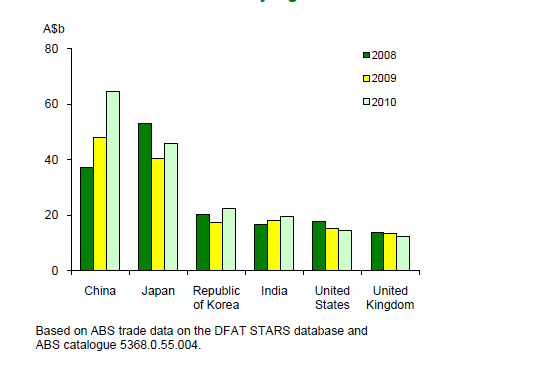
Dependence on exports to China
Australia today suffers from a classic case of "Dutch Disease." Its reliance on natural resource exports for its GDP growth stunts the rest of the economic development, especially manufacturing. Australian manufacturing has been declining in relative and absolute terms at a faster rate than it is in the USA and Europe. Today, it imports most of its manufactured goods.
...

Until several years ago, Australia had thriving tourist and wine industries. The appreciated Australian dollar put a severe dent in their growth.

Australian bulls like to talk about their low debt of 22.3% of GDP and a manageable budget deficit of 3.6% (2011). They, however, completely ignore overall indebtedness, which is on par with other "indebted" developed economies (USA and Italy).

Australia has an unusually high household debt of 105% of GDP, the highest in the developed world (much due to the astronomical real estate prices). The consumer will need to deleverage sooner or later. It's almost certain that, in a crisis, the government will transfer much of the consumer debt to its balance sheet via various "stimulus" programs.

Why the economy is bound to slow down
Looking at the data above, one can see that the Australian GDP is very dependent on two commodities, coal and metal ore, for its economic growth, with most of it going to China.

Should the Chinese economy slow down, there will be few palatable options left. Devaluing the currency may not work because Australia has little manufacturing left to pick up the slack. Lowering rates may not be enough to encourage Australian consumers to spend as the falling real estate prices will force deleveraging. Also, the falling exports would create an immediate current account deficit leading to capital flight, currency collapse, and likely inflation. The Reserve Bank of Australia will not have an option of monetary easing at all.

Australian Real Estate Bubble
What the bulls will tell you:
We hear bubble warnings all the time today as many people see bubbles everywhere where a price has appreciated. You can hear about "commodity bubbles", "treasury bonds bubbles", "new dot.com bubbles", etc.

Australian housing is built on solid fundamentals due to economic and population growth. There is not enough land in large cities to build houses to meet ever-increasing demand.

Reality:
It's always instructive to take a look at historical trends and plot a "mean-reversion" graph before concluding that something is significantly overpriced.

Optimist's claims are not supported by any other data such as high GDP growth rate, rising rates, or increasing construction costs

House prices are grossly overvalued
...

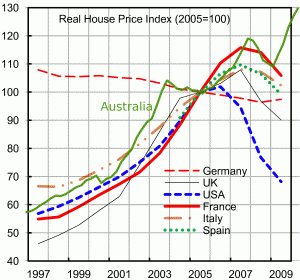
Australian prices matched some of the other country's bubbles until 2008. But while the real estate process elsewhere has been deflating, the Australian prices marched higher after a brief respite:
...

...

What may "pop" the bubble
The Australian real estate bubble has run longer and deeper than recent property bubbles in the USA, Ireland, and Spain. Heavily indebted Australian consumers, just like those in America, have a large portion of personal wealth tied-up in real estate. The price correction has not yet run its course (the mortgage defaults hover around 2%). When it does, it will certainly plunge the Australian economy into a severe recession.

Australian Banking System
Australia has four major banks: The Commonwealth Bank of Australia (CBA), The Australian New Zealand Banking Corporation (ANZ), The National Australia Bank (NAB) and Westpac (WBC in Australia, WBK ADR in USA). While all of these banks are international, the vast majority of their lending and assets are in Australia, with 86% share of all domestic lending in 2012.

Reality:
The banks look well-capitalized today but they heavily rely on a wholesale market (i.e. they issue bonds sold to foreign investors). There isn't enough deposit money from indebted Australians to cover all loans. While everything seems stable today, the foreigners may dump Australian bonds in a panic just like they did with Italian and Spanish bonds, pushing the yields up to prohibitive levels. The Australian banks will look healthy when the economy is good, but they are subject to a large "tail" risk if Australia stumbles, as the capital flow will dry up at the worst possible time.

Interest rates/currency conundrum
Australian currency is strongly correlated with the commodity prices and the health of the emerging markets (the exact opposite of the USA and Japan). Should emerging markets slow down (especially China), the Australian dollar will quickly depreciate.

Australia, which heavily relies on imports of most manufactured goods, will find itself with a sudden inflation problem. It may be unable to introduce a zero interest rate policy (ZIRP) to re-flate local asset prices and save its banks.

How the banks may fail
Australian banks seem safe today sporting low default rates, high ratings from credit agencies, and strong capital adequacy ratios. They will remain safe as long as the Australian economy keeps expanding and real estate prices remain stable. However, once the music stops, I expect a "perfect storm": loan defaults will spike, funding will disappear, but interest rates will still stay high.

Epilogue
The Australian economy seems to be doing well today: the external debt is small, the unemployment is low, and the currency is strong. Yet, in many ways, it's very similar to the US economy in 2007 where much of the economic "wealth" was created by real estate boom and over-leveraged banks. Australia is likely to face its own "Great Recession" in the upcoming years, perhaps when commodity exports slow down. In many ways, this recession may be worse than the American one of 2008, as Australia neither enjoys the benefit of "reserve currency" that would allow it to easily "print" money nor a strong manufacturing base that would benefit from a currency devaluation.

Link -
http://seekingalpha.com/article/394831-an-epic-australian-bust?source=email_macr...
==================================
A few observations -
1) There is more to the article.
2) I may not agree with all of the assertions, but there is enough there to give reason to pause & have some serious considerations!
3) Certainly the Global situation (including the USA, Europe & China), has a long way to run and that will continue to bear down on OZ, for many years.

Back to top
 
 
IP Logged
 
perceptions_now
Gold Member
*****
Offline


Australian Politics

Posts: 11694
Perth  WA
Gender: male
Re: Global Economic Downturn to Continue?
Reply #783 - Mar 1st, 2012 at 12:18pm
 
Construction sector reels as sales of new homes tumble


NEW home sales in Victoria have collapsed, compounding the State Government's woes as it battles heavy job losses and a slowing stream of tax income.

Sales of new houses tumbled almost 20 per cent in January compared with the previous month and are floundering well below their levels a year ago, according to research released yesterday.

Economists said the figures provided fresh evidence that despite consecutive interest rate cuts late last year, would-be home buyers remain reluctant to enter the property market.

The Victorian market pulled the rug from beneath the national house-building industry, with sales across the country diving 7.3 per cent to their lowest level in more than a decade.

Nationally, new home sales halved to less than 4000 in January, from more than 9000 a year earlier
, the Housing Industry Association report shows.

Association chief economist Harley Dale said: "Victoria for a long time propped up new home building in Australia and now the reverse is occurring.

There were also declines in detached house sales in NSW and South Australia in the first month of 2012, so the overall update is a weak one."

Mr Dale said the Reserve Bank's two rate cuts in November and December have not worked and the official cash rate should be lowered to 4 per cent to boost flagging household confidence.

He conceded the central bank board was likely to "sit on its hands" next week.

Official figures released yesterday revealed the decline in the construction industry was not just confined to new homes.

Australia Bureau of Statistics figures showed the value of construction work carried out in the December quarter fell 4.6 per cent - a steeper fall than economists had forecast.

The value of construction work had soared 11.7 per cent in the previous three months.

Treasurer Wayne Swan said the fall in construction work in the three months to December was not surprising given the record performance in the previous quarter.

HSBC Australia chief economist Paul Bloxham echoed the Treasurer's comments, saying "some retreat is not too surprising".

Link -
http://www.news.com.au/money/property/construction-sector-reels-as-sales-of-new-...
==================================
The comparison from January this year to January last year, is of particular interest.

But, as is often said, it's the trend that is important, so let's see what happens in the months to come?

That said, the government, any government & the RBA, may be caught on the horns of a Gordian Knot type dilemma, where they have little or no room to move.

However, I would venture a comment here and that is, could you imagine the repercussions, IF government/s were to go into a general AUS-terity program, as housing & the general Economy started to slip away?
Back to top
 
 
IP Logged
 
perceptions_now
Gold Member
*****
Offline


Australian Politics

Posts: 11694
Perth  WA
Gender: male
Re: Global Economic Downturn to Continue?
Reply #784 - Mar 10th, 2012 at 4:25pm
 
Is Demography Destiny?


Economists assume that people attempt to smooth consumption over time. The data are consistent with this assumption. If you follow a cohort of people over a number of years, you will observe that their income will fluctuate a lot more than does their consumption. Income generally rises sharply early in peoples’ careers, peaks out in middle age, declines gracefully toward retirement and then falls off substantially in retirement.

Meanwhile, people go into debt when they are young to finance the purchase of education, durable goods (like a car) and a house. Then they begin saving a higher proportion of their income as income grows and they build a portfolio that is used to supplement income in retirement. This income supplement includes income off the portfolio and proceeds of the sale of assets.

If a generation is particularly large, like the baby boom generation, this consumption smoothing can have important effects on financial markets and economic activity.

Large generations will tend to bid up the prices of assets during their accumulation years and then push asset prices down as they attempt to liquidate portfolios in later years.


Economists have indeed found strong correlations between demographic measures and economic activity and stock prices. For example, the baby boom spike in birthrates in the 1950s was followed 40 years later by a booming stock market and solid economic growth in the 1980s and 1990s (the 30-40 lag allowed the boomers to grow up to be big spenders and investors). Most early studies along this line have used a simple measure of the age distribution, like the ratio of the number of middle-aged people (40-49 years) to the number of older (>60 years) people (this is called the M/O factor) or the ratio of middle-aged to young (<30) (this is called the M/Y factor). Investigators have found strong positive correlation between the level of stock prices and M/Y or M/O.

One problem with this analysis is that the number of data points is pretty small. Major shifts in birthrate occur only every twenty years or so; therefore we have just a few useful data points over the past 100 years. It is hard to make a convincing argument using such a small sample. But, in an interesting piece recently published in the Financial Analysts Journal1, investment researchers Robert Arnott and Denis Chaves attempt to address this data weakness by examining data on more than 200 countries. In addition to looking at many countries, Arnott and Chaves attempt to obtain a richer measure of the age distribution than using the simple M/Y or M/O ratios. While they would like to use the full set of age group variables (that is, the percentage of the population aged 20-29, 30-39, etc), they recognize that doing so would not enable precise estimates due to the high degree of correlation between the various age categories. So, they represent the age distribution using a low degree polynomial.

Specifically, Arnott and Chaves run regressions of five-year average growth and returns against measures of initial conditions and the age distribution as represented by a polynomial. The purpose of using five-year averages is to filter out transitory or so-called “high frequency” effects on growth and returns. The purpose of including a set of initial conditions (current growth for the growth equation, current bond yield for the bond equation and current price earnings ratio for the equity return equation) is to control for the state of the business cycle and current asset valuations.

Results
The major conclusions are consistent with prior research. The most favorable demographics conditions for economic growth are large numbers of people in their 30s and 40s. The most favorable demographic conditions for bond and stock returns are large numbers of people in their 50s. These results suggest that the impact of an aging population is first to slow the rate of economic growth, and subsequently to reduce investment returns.

Based on their regressions, Arnott and Chaves project dismal prospects for economic growth for Japan and much of Europe over the next decade or two. The growth outlook is not so good for the U.S. as well.


On the other hand, growth prospects are pretty solid for much of Africa and South America. Likewise, return prospects are poor in Western Europe and Japan and solid in Mexico, South America and Northern Africa.

Caveat
A major caveat is that there are many factors that affect economic growth and investment returns. The researchers attempt to adjust for these by using low frequency data and measures of initial conditions. But still, the results may easily be diluted by left out variable bias. Don’t bet the ranch on these results. However, they do support the narrative that investment returns in the U.S. over the intermediate horizon (next ten to twenty years) are likely to be lower than historical returns. This means you have to save more. It also suggests that investors should consider expanding their investment horizon to include emerging markets.

Link -
http://seekingalpha.com/article/419041-is-demography-destiny?source=email_macro_...
=================================
I prefer the 50 year rule, which simply means that 50 is the average bewteen the years from 45 to 55, which are the largest Income Earning years for any generation & their largest spending years.

This can be verified by taking 1933, which was actually the bottom of the Global birth rate, which happened to co-incide with the Great Depression, then move forward by 50 years to 1983, which saw the start of a long upswing in Economic activity & Global Stockmarkets, but still within the confines of the usual Business cyclic periods.

This reached a crescendo during the period 1995-2006, which co-incides with the great Baby Boom, from 1945 to 1956. The Baby Boomer era was actually 1945-1964, but the peak year was 1956 and after that the Baby Boom start to decline.

I also agree that there are caveats abd that there are many other factors that affect economic growth and investment returns. However, these factors may be either positive or negative & on this occasion the other factors are similar to this Demographic issue, in that they are also mainly negative and they include -
1) Peak Energy
2) Peak Debt
3) Climate Change

So, good luck & watch the Debt!
Back to top
 
 
IP Logged
 
perceptions_now
Gold Member
*****
Offline


Australian Politics

Posts: 11694
Perth  WA
Gender: male
Re: Global Economic Downturn to Continue?
Reply #785 - Mar 11th, 2012 at 11:00am
 
Oil shale is not a viable fuel source, study says


Scientists’ best estimates of the Energy Return on Investment (EROI) of oil shale suggest it is very inefficient compared to conventional fuel and emits up to 75% more greenhouse gases (GHGs. However, differences in the way energy efficiency is calculated can cause confusion over its potential use, according to the US study.

Shale is a sedimentary rock containing kerogen, which is heated to produce synthetic crude oil (oil shale). Liquid fuel derived from oil shale has been suggested as an alternative to conventional oil and gas. However, the energy inputs or 'costs' associated with oil shale are not always fully accounted for, leading to overestimates of its value relative to other fuel sources.

The study evaluated estimates of the energy efficiency of oil shale, using a method known as 'Energy Return on Investment' (EROI). In its most complete form, this is the ratio of the energy content of the fuel produced to the energy used over the full 'well to wheels' life-cycle of the product, including exploration, mining, processing, refining, transportation and combustion.

The most comprehensive study indicates an EROI of 2 to produce oil shale, meaning that 2 units of energy are produced for every unit consumed. This is very low compared to the EROI for conventional crude oil of around 20. Including the refining step, the EROI of producing gasoline from crude oil is around 4.7 compared to 1.4 for producing liquid fuel from oil shale.

Fully accounting for all energy used is also vital in assessing GHG emissions. Emissions from oil shale, which result from the direct energy input and as a product of the extraction reaction, are estimated to be 1.25 -1.75 times higher than for conventional crude oil. Oil shale production also requires large amounts of land and up to three barrels of water per barrel of oil produced. These environmental costs together with the low EROI lead the researchers to conclude that, although the energy accounting process needs rigourous review, there is little economic or environmental incentive to use oil shale as a fuel source.

Link -
http://ec.europa.eu/environment/integration/research/newsalert/pdf/276na3.pdf
================================
So, aside from the likelihood that Oil Shale is virtually an Energy sink, it is also likely that the processes involved will also cause -
1) The contamination of underground water acquifiers, with cancer causing chemicals.
2) More GHG's than Conventional Oil.
3) Earthquakes.
Back to top
 
 
IP Logged
 
ItsAllaLie
New Member
*
Offline


Australian Politics

Posts: 15
Gender: male
Re: Global Economic Downturn to Continue?
Reply #786 - Mar 14th, 2012 at 4:06am
 
The current economic paradigm of continuous growth operates in a manner which is in direct opposition to the reality of life on this planet as a closed loop system with finite resources.  It will be challenging to shift our society to a sustainable one with major shifts in education, the built environment, green technology and renewable energy without major changes to the way the present economic system works.  Economic reform is desperately needed to reformulate economics to replace the woefully inadequate and incomplete GDP measure with a holistic human well being measure and  install the necessary checks and balances to prevent greed from destabilizing our society.

Our existing global economic / monetary system is one of those things that is ubiquitous and yet a complete mystery at the same time. Daily we hear the financial rhetoric as we glance by the financial section of the news. We glean reports about falling or rising interest rates and stock markets, even though we may be clueless to their true meaning.

We all use money in our day-to-day life. Indeed, it has become such an indespensible part of modern life that most of us cannot live without it. Yet, very few of us have bothered to look beyond our basic daily functions such as spending it, paying off a loan or receiving our paycheque. Quite frankly, the common man and woman are too busy staying afloat to pay attention to any issues beyond survival. We do not even understand the most basic things about money…..such as how it is made. Many still have a tacit assumption that the monetary system is operated by decent and smart people who are looking out after our best interests and may be surprised to learn the truth.

This ignorance of the actual nuts and bolts of the financial system by the common man and woman works in favor of the financial elite. As long as the majority remain silent and complacent, we cannot fight for freedom and financial, economic and monetary reform. If we cannot clearly see our own enslavement to debt, fighting to be free will never even cross our minds. Fortunately, movements such as Occupy Wallstreet  are like an alarm bell waking up the giant 99% at the bottom of the debt-based money system, which some have described as a 300 year old Ponzi scheme.

It is critical that we demystify money now. We all need to have a clear understanding of how the current economic system, combined with weaknesses that do not safeguard against the darker side of  human behavior has led to our current crisis. It is even more important to know that if we do not reform it, it can lead to a collapse of the global economy and plunge humanity into a crisis of unparalleled magnitude. We stand at a crossroads; we have the ability to create a prosperous and democratic world but we must arm ourselves with knowledge and act with compassion.

The startling truth is that our economic system is fatally flawed and the continuous exploitation of this flaw by those elite few who have worked their way to the top of the heap have resulted in a system about to implode upon itself, leaving the entire world population as casualties. How can governments claim to be responsible when they allow Trans National corporations, banks and financial institutions to gamble in Derivatives where losses of these bets can accumulate and exceed the GDP of the entire planet? There is simply no logic to explain this and no policy that can excuse it.

These same systems have not been reformed and the citizens of this global community need to urgently understand the economic system so that we can predict the great changes coming our way if we are to survive them.  We need to know our enemy if we are going to defeat it. Economic evolution cannot solve a problem when the system itself is fundamentally flawed; it will require an economic revolution, a paradigm shift which will replace the current monetary system with a new and more just one.

To really understand the depths of the power structure we are fighting against, it is important for every citizen of the world to educate him or herself on the way the international monetary system works. Knowledge is power and ignorance is NOT bliss. In fact, it is precisely due to the ignorance and apathy of the 99% that we have allowed the 1% to do as they please while it is due to the ignorance and unbriddled greed of the 1% which has caused them to make the mistakes that have  precipitated this global crisis.

Simply we will continue to go into recessions and global economic collapses as long as this monetary system of greed is in place.
Back to top
« Last Edit: Mar 14th, 2012 at 4:53am by ItsAllaLie »  
 
IP Logged
 
Ex Dame Pansi
Gold Member
*****
Offline


Australian Politics

Posts: 24168
Re: Global Economic Downturn to Continue?
Reply #787 - Mar 14th, 2012 at 6:41am
 
    The few who understand the system will either be so interested in its profits or so dependent upon its favors that there will be no opposition from that class, while on the other hand, the great body of people, mentally incapable of comprehending….will bear its burden without complaint

    - Rothschild Brothers, 1863


http://ingienous.com/?page_id=2563
Back to top
 

"When the power of love overcomes the love of power, the world will know peace." Hendrix
andrei said: Great isn't it? Seeing boatloads of what is nothing more than human garbage turn up.....
 
IP Logged
 
perceptions_now
Gold Member
*****
Offline


Australian Politics

Posts: 11694
Perth  WA
Gender: male
Re: Global Economic Downturn to Continue?
Reply #788 - Mar 14th, 2012 at 6:57pm
 
Housing unlikely to support growth


Something may come along to give the economy the boost it needs, but it won't be housing construction.

Not for a while anyway.


The latest figures on dwelling unit commencements - the awkward expression the Australian Bureau of Statistics (ABS) uses to describe what everyone else calls housing starts -
warn against optimism.


The figures for the December quarter, released on Wednesday, showed a fall of 6.9 per cent in the quarter and 13.4 per cent from a year before.

It was the third sizeable quarterly fall in a row and left the level of commencements 14 per cent below the recent peak in the September quarter of 2010.

It is now not far above the lows seen in such episodes of weakness as the global financial crisis, the slump associated with the introduction of the GST in 2000, and the mid-1990s housing slump associated with the sharp tightening of monetary by the Reserve Bank of Australia (RBA) in the second half of 1994.

Signs from the bureau's building approvals data suggest the slide might flatten out, at least temporarily.

The level of building approvals in the first two months of 2012 was four per cent higher than in the December quarter, but that was a sad little bounce after declines since early 2010 totalling 28 per cent.

More recent housing finance figures this week showed no sign of a recovery.

They showed loans approved for new housing fell by 12 per cent in January.

This data includes the construction or purchase of new housing by both home-buyers and investors.

The fall was possibly influenced by an end of government incentives in NSW, but most likely also marked the end of a short-lived boost provided by interest rate cuts in November and December.

In any case, the fall completely reversed a rise in December and restored what the ABS estimates to be a trend that has been drifting down since August.

With housing process flatlining at best and giving investors little reason to take the plunge, and employment growth stalling and uncertainty over interest rates giving homebuyers no incentive either, there is no reason to expect the demand for new housing to pick up.

New dwelling construction might stagnate for a while, or it might contract further over the first half of 2012 but, the way the numbers are stacking up, they appear to be the only two plausible outcomes.

Link -
http://news.ninemsn.com.au/article.aspx?id=8435169
==================================
Whilst there will no doubt be occasional us, I would suggest the trend will no doubt follow a similar trend to the US market, where new housing construction has already trended down and is now down around two thirds on 2006.
...
http://www.forecast-chart.com/chart-housing-starts.html

Unless OZ went into another round of artificially bailing out the new housing market, we will most certainly follow the US trend, in both new & existing housing, over the next 5-10 years.

I highly recommend against another bailout, as that will be a waste of Public funds, as in the longer term the market will follow the Macro trends anyway.

We should bite the bullet and go with the trend, even knowing the likely effects that will generate!
Back to top
« Last Edit: Mar 14th, 2012 at 7:43pm by perceptions_now »  
 
IP Logged
 
Ex Dame Pansi
Gold Member
*****
Offline


Australian Politics

Posts: 24168
Re: Global Economic Downturn to Continue?
Reply #789 - Mar 15th, 2012 at 8:44am
 
It seems to be a trend of late. I wonder why people are getting a conscience all of a sudden.
......................................................................

Goldman Sachs exec leaves sinking ship in disgust

One of the most notorious Wall Street firms that became a symbol of corporate greed and disdain to its own clients in the wake of the 2008 financial crisis is in hot water again. This time it’s after a Goldman Sachs top executive resigned in disgust.

In a bombastic editorial published in The New York Times on Wednesday, an outgoing executive from Goldman Sachs blasts the investment bank as a heartless company that he says thrives in a culture he calls both “toxic” and “destructive.” Greg Smith, most recently a top exec at the London office of Goldman Sachs, writes in the Times on Wednesday that moral corruption behind the scenes of the legendary Wall Street institute came close to causing the collapse of the firm over nearly a century and a half.

Having spent nearly 12 years himself working in both the US and abroad from the firm, Smith says the deterioration of the financial sector was easily noticeable along the way, and he blames it on the mismanagement and moral decay continuing to eat away at what’s within the firm’s walls.

Smith cautions that, should Goldman continue on the path it is currently on, their future will once without a doubt be threatened once again.

“I believe I have worked here long enough to understand the trajectory of its culture, its people and its identity,” Smith writes in the op-ed, “And I can honestly say that the environment now is as toxic and destructive as I have ever seen it.”

For two pages, Smith dives into how from inside the company he managed to view first-hand the ways higher-ups grew to dissociate themselves from clients and put profits over people. From within the firm, Smith says the well-being of the company’s clients was as good as forgotten and that he quickly learned there that, more or less, cheating clients was key to climbing the top of the corporate ladder.

“Today, many of these leaders display a Goldman Sachs culture quotient of exactly zero percent,” writes Smith. “I attend derivatives sales meetings where not one single minute is spent asking questions about how we can help clients. It’s purely about how we can make the most possible money off of them. If you were an alien from Mars and sat in on one of these meetings, you would believe that a client’s success or progress was not part of the thought process at all.”

Smith adds, “Over the last 12 months I have seen five different managing directors refer to their own clients as ‘muppets,’ sometimes over internal e-mail.”

Within hours of Wednesday’s edition being published on paper and online, Smith’s snarky send-off has already gone viral. Nelson Schwartz of the Times writes a response of his own in Wednesday in which he celebrates Smith’s “flair” and says that the soon-to-be former-Goldman top-gun “is saying publicly what others whisper privately, which is why his cri de coeur may be so provocative.”

“Even on Wall Street — where making money is good, and making more money is better — a few shibboleths still command respect, including the one that the customer should come first, or at least second, not dead last,” Schwartz responds to Smith’s claims.

Max Keiser, the host of RT's Keiser Report calls Smith's diatribe an "embarrassing confession of the firm's wrong doings" and asks, "Will Goldman destroy another European country with Credit Default Swaps like they did Greece? Will they bankrupt another municipality in America with exploding debt obligations?"

Goldman Sachs have offered a rebuttal of their own since the editorial was published, telling the Times, “We disagree with the views expressed, which we don’t think reflect the way we run our business.”

“In our view, we will only be successful if our clients are successful. This fundamental truth lies at the heart of how we conduct ourselves,” explains a Goldman spokesperson.

Smith seems to think otherwise, however, and Schwartz cautions that his openness could once again cause Wall Street to teeter.

“Mr. Smith’s criticism, much more than stories about bonuses or brickbats from the likes of Occupy Wall Street, could be especially painful for Wall Street now,” writes Schwartz. “Memories are still fresh of the Securities and Exchange Commission lawsuit filed in April 2010 accusing Goldman of fraud, after it sold clients complicated mortgage backed securities that later soured, and never mentioned that it had bet against them.”

Smith himself explains, “If clients don’t trust you they will eventually stop doing business with you. It doesn’t matter how smart you are,” and suggests that others could learn from his editorial. “I hope this can be a wake-up call to the board of directors. Make the client the focal point of your business again. Without clients you will not make money. In fact, you will not exist,” he suggests. “People who care only about making money will not sustain this firm — or the trust of its clients — for very much longer.”

http://rt.com/usa/news/goldman-sachs-smith-times-571/print/

Back to top
 

"When the power of love overcomes the love of power, the world will know peace." Hendrix
andrei said: Great isn't it? Seeing boatloads of what is nothing more than human garbage turn up.....
 
IP Logged
 
perceptions_now
Gold Member
*****
Offline


Australian Politics

Posts: 11694
Perth  WA
Gender: male
Re: Global Economic Downturn to Continue?
Reply #790 - Mar 25th, 2012 at 11:24am
 
China Reaches Peak Coal


Coal presently supplies about 67% of China's commercial energy but its National Energy Administration, 21 March, released its five-year 2011-2016 plan for Chinese coal, which features a near-term peak, and then decline of coal in the energy economy.

The world’s largest user and producer of coal intends to limit domestic output and consumption of the commodity by 2017, to reduce pollution and to curb reliance on this fuel, which also faces a rising number of supply problems from reserve depletion to coal import costs, infrastructure and transport needs.

The NEA announced that coal demand growth will be restricted to zero, and consumption to a maximum of around 3.9 to 4.1 billion metric tons a year by or before 2017.

China's coal consumption
, including a growing amount of imports estimated at about 25 million tons this year but forecast to increase to 200 million tons a year by 2015, totaled about 3.75 billion tons in 2011.

At that rate and for China's estimated 1.33 billion population, this is a consumption rate of 2.8 tons per person a year, which we can compare with the coal consumption peaks attained by early industrializing Europe in the late 19th and early 20th centuries. In 1913 for example, the UK attained its all-time coal peak at about 215 million tons a year. For its 1913 population this was close to 5 tons per person a year. Current US coal consumption of almost exactly 1 billion tons per year yields about 3.3 tons of coal per person each year.

China is the world’s biggest producer of carbon emissions and coal-related pollutants, and its authorities intend cutting both of these by as much as 17% per unit of GDP through the period to 2017, but its coal path remains locked-on to its economic growth.

Throughout the period since 2000, Chinese coal demand growth has tracked the economy with a 1-for-1 relationship, resulting in coal demand growing at more than 8% a year, doubling the nation's need for coal every 7 years.


The main problem is therefore China's vast coal energy-dependence, and growing coal import dependence comparable to the OECD group's heavy dependence on declining and high-priced supplies of imported oil.

CHINA MULLS COAL ALTERNATIVES
China's coal demand growth will definitely slow, and reach a set limit, not only because of environmental concerns but also because of China's value-added and technology-based industrial and economic strategy. Coal remains cheap, is basic to iron and steel production, and for electricity production, but has nothing like the flexibility, ease of use and lower environmental impact of oil and gas energy. However, due to China's massive dependence on coal, achieving zero growth for coal by or before 2017 is a difficult goal unless the government substantially trims economic growth and accelerates its programme for phasing out energy-intensive industries, which are hard to reconcile.

Simply due to more than 66% of China's current electricity being produced from coal, with little potential for raising China's already impressive hydro output, and with the gas alternative currently based only on high-priced LNG imports, China's coal demand growth is locked-on to its economic growth.

Breaking that link will in no way be easy and the short timeframe for achieving major change may indicate that China will engage a massive energy transition plan away from coal, and may be constrained to import more oil in the short-term.

The Chinese government is considering a wide range of alternatives to coal, both on the economic structure side, and on the energy supply side. China's annual growth of windpower and solar electric generating capacity is now running at about one-quarter of its annual 90 GW increase in power capacity, this annual increase being equivalent to two-thirds of Germany's total installed power capacity, and may rise further. This however will not be enough to achieve transition away from coal, and the nuclear option remains dogged by very high costs and long lead times.

Under any scenario however, Its now official goal of cutting the role of coal energy “significantly” will have major impacts. Coming adjustments to the nation’s energy economy and energy structure, as well as new and tighter environmental protection measures, will cause impacts that can affect global energy.


The especially include China's rapidly building hopes for shale gas development, its alternate energy industries and its oil demand.

REPLACING COAL
China's NEA says that it is able to expand coal production and import capacity by 750 million tons a year in the short term, and might attain an ultimate peak of 4.1 billion tons a year, by about 2015, of which as much as 200 million tons/year could be imported. The role of China's coal imports, for energy traders, is almost as important as China's ever rising import demand for oil. This is due to both of Asia's giant emerging economies, India and China, being increasingly obliged to import coal due to their overstretched national coal mining and transport industries facing cost and infrastructure limits and their mines facing coal depletion issues. At the same time, coal import demand by Europe is rising, despite its clean energy programmes, and import demand remains strong in developed Asia. Coal export prices, which at oil parity would attain about $500 per ton, may however hit a ceiling due to rising LNG gas availability and declining gas prices triggered by US shale gas development, enabling China and India to import more coal at prices that cease to grow.

While costly high-tech LNG infrastructures like regasification terminals are rapidly being built by China and India, the gas alternative to coal for both countries mainly concerns their hopes for domestic shale gas development, but this is not growing at anywhere near the pace needed to phase out coal, or even cover their annual growth of coal demand. The net result is that both coal and oil import demand, by China, will likely tend to grow faster than previously anticipated and forecast.

Despite the Chinese target of cutting the energy intensity of its GDP by 17% over 5 years, coal demand growth has been running at 8% or more, per year, and this sets the "energy gap" for non-coal alternatives at around 300 million tons a year of coal, equivalent to 1.5 billion barrels of oil energy, by or before 2017.  Replacing this 0.3 Mtce (tons coal equivalent) with either gas or oil will have major impacts on world energy trades, leaving the green energy and energy conservation option as a major rational choice for Chinese planners.

To be sure, Chinese hopes for shale gas are high, with the US EIA crediting China with the world's largest national resources, but without major gas transport infrastructures and shale gas E&P only at a very early stage, Chinese hopes are not matched by results on the ground. LNG import expansion is also problematic for China, for infrastructure reasons and due to present very high LNG prices for Asian destinations, sometimes above $18 per million BTU, driven by sustained import demand from Japan, South Korea, Taiwan and other ASEAN countries.

As a net result, it is likely China's oil import demand may grow more than currently forecast - rather than tend to stagnate - with major impacts on global oil prices, going forward.


Link -
http://www.marketoracle.co.uk/Article33766.html
=================================
What is said by Politicians & others, often does not reflect Reality or the Truth, which Tony Abbott has already confirmed!

What is usually trotted out, is a load of -
Credible
Reliable
Abundant
Paradoxes

Which is again the situation here, with the Chinese Energy forecasting!

Of interest, is the fact that China is the worlds largest producer of Coal (by far), so given their Energy needs and the lack of alternatives, IF their Coal production starts to Decline, you can be assured that it would be because the CHINESE HAVE HIT PEAK COAL PRODUCTION!


...

And, when Chinese Coal production starts to Decline(NOT IF, BUT WHEN), it will transform Global Coal production into this -

...

Which coincidentally is a similar looking BUBBLE to that created by Peak Oil production and in fact, the Global Economy as a whole!
Back to top
 
 
IP Logged
 
Ex Dame Pansi
Gold Member
*****
Offline


Australian Politics

Posts: 24168
Re: Global Economic Downturn to Continue?
Reply #791 - Mar 26th, 2012 at 6:18am
 
<<Which coincidentally is a similar looking BUBBLE to that created by Peak Oil production and in fact, the Global Economy as a whole!>>
..................................................................

It seems that we've reached peak everything, time to reign in what resources we have left and start on plan B.

What do you mean there's no plan B?
Back to top
 

"When the power of love overcomes the love of power, the world will know peace." Hendrix
andrei said: Great isn't it? Seeing boatloads of what is nothing more than human garbage turn up.....
 
IP Logged
 
perceptions_now
Gold Member
*****
Offline


Australian Politics

Posts: 11694
Perth  WA
Gender: male
Re: Global Economic Downturn to Continue?
Reply #792 - Apr 6th, 2012 at 8:40pm
 
Aging population to impact economy: BoC


TORONTO – The aging of Canada’s population will put upward pressure on wages as the pool of available workers shrinks, and global aging might over time lead to lower interest rates, Bank of Canada Deputy Governor Jean Boivin said on Wednesday.

Aging will also affect the potential of the economy, meaning the level of activity at which it can operate without inflationary pressures, and this is something the Bank of Canada needs to assess, he said.

The high level of household debt in the country makes it even more crucial that individuals adjust their savings behaviour and plan over a longer horizon, he said in a speech in Toronto.

“As our society ages, we can either accept a lower standard of living or we can try to be proactive and adjust … The stakes are high and we cannot afford to ignore them,” Mr. Boivin said.

“There is no free lunch in that context ; something will have to give and someone will have to pick up the tab, so the least we can do is accept this fact and ensure that the bill remains small and that the burden is shared fairly.”


The mechanism for upward pressure on wages would be that with relatively fewer people left in the work force, employers will compete to attract talent.

Taken in isolation, he said, the scarcity of labour relative to capital could be expected to lead to higher wages and lower returns on capital in advanced economies, and eventually to persistently lower global interest rates.

Improved productivity, if any, would offset the downward pressure on rates.

But Canada’s tepid growth of productivity and potential output has preoccupied the central bank. Mr. Boivin said the latest estimate was for Canada’s potential output to grow by 2.2% in 2014, and without the decline in working age population it would be 0.2 percentage points higher.

“Aging is projected to continue to subtract from potential output growth until the end of the current decade,” he said.


He said Canada faced three options to avoid drastic declines in living standards or shifting too much burden on the next generations: more work, greater productivity and higher savings.

Without endorsing last week’s federal budget, he said policy steps could foster the needed adjustments and this was the objective of some of the measures in the budget.

The budget raised to 67 from 65 the age of eligibility for payments to seniors under its Old Age Security program, and hiked the age of retirement to 65 from 60 for new federal employees, starting next year.

Mr. Boivin also highlighted the important contribution of immigration to dealing with the aging problem. The budget announced plans to eliminate a backlog of stale applications by foreign skilled workers so that immigrants whose skills are in greater current demand can enter Canada faster.

He said a key challenge was to remove the barriers that keep educated and skilled immigrants from working in their fields.

Link -
http://business.financialpost.com/2012/04/04/aging-population-to-affect-economy-...
==================================
Whilst there is much I can agree with in this article, there are also some areas where I would disagree!

Certainly, IF there is a perception that the burden is not being shared fairly, then that could/would lead to a great deal of Public unrest.

However, to suggest that this Aging event will only affect the Local & Global Economy until the end of this decade is a gross understatement, as it will most likely affect events for 2-3 decades, at least!

When looking at the likely effects of Aging, it must not be forgotten that this Aging event will not happen in isolation and that Peak Energy, Peak Debt & Climate Change will also be adversely influencing Economic events, over that same 2-3 decade period.

So, hold onto your hats, because WE ARE ALL IN FOR A WILD RIDE!

Back to top
 
 
IP Logged
 
Amadd
Gold Member
*****
Offline


Mo

Posts: 6217
Re: Global Economic Downturn to Continue?
Reply #793 - Apr 7th, 2012 at 12:44am
 
muso wrote on Dec 1st, 2010 at 8:17am:
The Irish Treasury found out that they don't have a problem. They're actually €1 billion in the green. Eamon's missus had to go to Bingo that night and Eamon isn't too good with computers. He forgot to multiply by durty tree and a turd.

Quote:
Young Paddy, moved to Roscommon and bought a Donkey from a farmer for
€100.00. The farmer agreed to deliver the
Donkey the next day. The next day he drove up and said, 'Sorry son, but I
have some bad news, the donkey died.'

Paddy replied,
'Well,then just give me my money back.'

The farmer said,
'Can't do that. I went and spent it already.'

Paddy said,
'Ok, then, just bring me the dead donkey.'

The farmer asked,
'What are ya gonna do with him?

Paddy said,
'I'm going to raffle him off.'

The farmer said,
'You can't raffle off a dead donkey!'

Paddy said,
'Sure I can. Watch me.. I just won't tell anybody he's dead.'

A month later, the farmer met up with
Paddy and asked, 'What happened with that dead donkey?'
Paddy said,
'I raffled him off. I sold 500 tickets at two euro's a piece and made
a profit of €898.00.'

The farmer said,
'Didn't anyone complain?'

Paddy said,
'Just the guy who won. So I gave him his two euro back.'

Paddy now works for the Irish Government


Haha  Grin

As Homer (Simpson) would say: It's funny 'cause it's true.

Back to top
 
 
IP Logged
 
perceptions_now
Gold Member
*****
Offline


Australian Politics

Posts: 11694
Perth  WA
Gender: male
Re: Global Economic Downturn to Continue?
Reply #794 - Jun 25th, 2012 at 12:47pm
 
The Mighty US$

Last Report dated 03/12/2012

US$ Index (basket of Currencies):  @ 82.41 (Last Report - 78.68) (2010/06/04 - 87.85)
http://www.goldseek.com/quotes/charts/usdollar/usdollarindex24hour.php

Euro - US$: @ 1.2530 (Last Report - 1.3391) (2010/06/04 - 120.44)
AUD$ - US$: @ 1.0023 (Last Report - 1.0216) (2010/06/04 - 83.17)
AUD$ - GBP: @ 0.6432 (Last Report - 0.6548) (2010/06/04 - 57.04)
AUD$ - EURO:  @ 0.7999 (Last Report - 0.7629) (2010/06/04 - 69.06)
http://www.bloomberg.com/markets/currencies/fxc.html

Gold - @ US$1,574.10 (Last Report - US$1,745.30) (2010/06/04 - $1,207.80)
http://www.kitco.com/charts/livegold.html
Oil WTi -  @ US$80.09 (Last Report - US$100.96) (2011/03/19 US$101.01)  (2010/06/04 - $70.22)
http://www.bloomberg.com/energy/
BALTIC DRY INDEX (BDIY) - @ 978 (Down 42 @ Friday close) (Last Report – 1,866) (2010/06/04 - 3,844)
http://noir.bloomberg.com/apps/quote?ticker=BDIY:IND

DOW @ 12,641 - (@ Friday close) (Last Report - 12,019)  (2010/06/04 - 11,444)
http://au.finance.yahoo.com/echarts?s=^DJI#symbol=^dji;range=1y;compare=;indicat...
ALL ORDS @  4,094 (@ Friday close) (Last Report - 4,346) (2010/06/04 - 4,840)
http://au.finance.yahoo.com/echarts?s=^AORD#symbol=^aord;range=1y;compare=;indic...
SHANGHAI COMPOSITE @  2,293 (@ Friday close) (Last Report - 2,360) (2010/06/04 - 2,553)
http://au.finance.yahoo.com/echarts?s=000001.SS#symbol=000001.ss;range=1y;compar...

Last 5 years DOW -
http://finance.yahoo.com/echarts?s=%5EDJI#chart3:symbol=

THERE was movement at the FED, for the word had passed around, That the US$ was an old Regret and its value had long since passed away
==================
Well, the VOLATILITY continues! 


Since the last report, on December 3, 2011 -
The US$ index rose.
The Euro fell against the US$.
The OZ$ fell slightly against the US$ & the GBP, but gained against the EURO.
Gold fell, as the US$ rose.
Oil (Wti) fell significantly.
The Baltic Dry Index went into a Nose Dive!
The DOW continued to be Schizophrenic, with a rise.
The ALL Ords has continued a negative trend.
The SHANGHAI COMPOSITE is now slightly lower, on recent trends.

On the rise in the US$ Index & the increase in the DOW, all I can say is "GO FIGURE", they certainly don't recognise reality!

Conversely, the downward trends in the Oil & Baltic Dry Index, provides "reality checks"!

Good luck & watch the Debt! 

Back to top
 
 
IP Logged
 
Pages: 1 ... 51 52 53 54 55 56
Send Topic Print