Only 80K New Jobs, But Unemployment Rate Drops To 9.0%
Despite a slightly lower-than-expected 80K new jobs the unemployment rate declined from 9.1% to 9.0%.
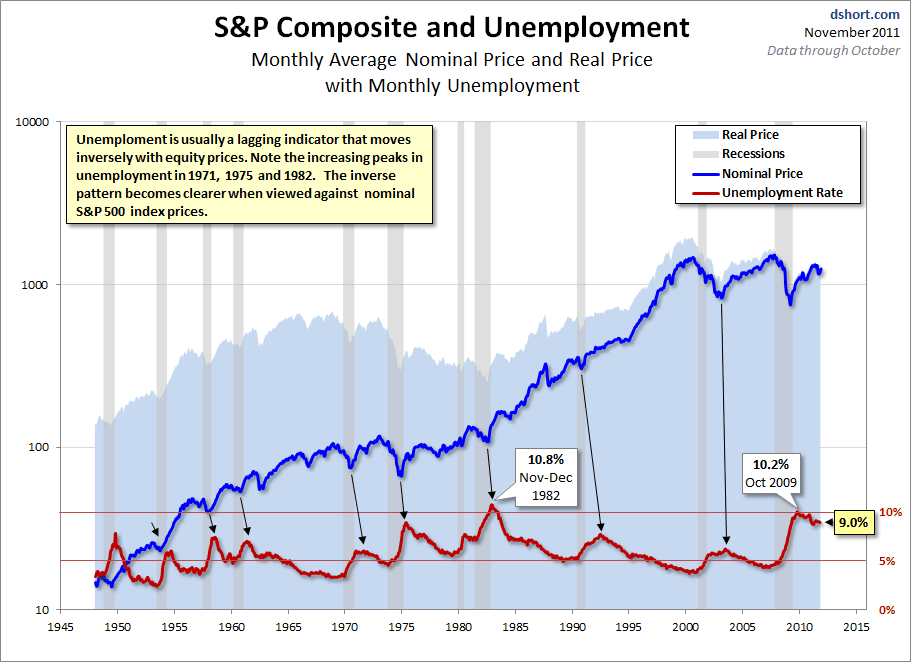
The unemployment peak for the current cycle was 10.2% in October 2009. The chart here shows the pattern of unemployment, recessions and both the nominal and real (inflation-adjusted) price of the S&P Composite since 1948.
Unemployment is usually a lagging indicator that moves inversely with equity prices (top chart). Note the increasing peaks in unemployment in 1971, 1975 and 1982. The inverse pattern becomes clearer when viewed against real (inflation-adjusted) S&P Composite, with its successively lower bear market bottoms. The mirror relationship seems to be repeating itself with the current and previous bear markets.
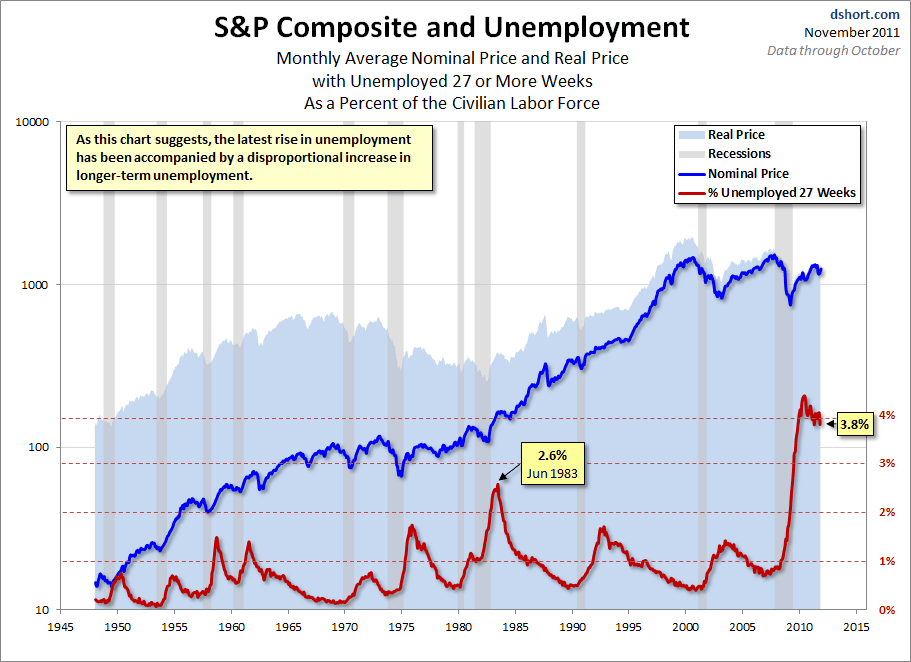
The second chart shows the unemployment rate for the civilian population unemployed 27 weeks and over. The October number is 3.8% - down from last month's 4.1%. This measure gives an alternative perspective on the relative severity of economic conditions. As we readily see, this metric remains significantly higher than the peak in 1983, which came six months after the broader measure topped out at 10.8%.
 The next chart is an overlay of the unemployment rate and the employment-population ratio. This is the ratio of the number of employed people to the total civilian population age 16 and over.
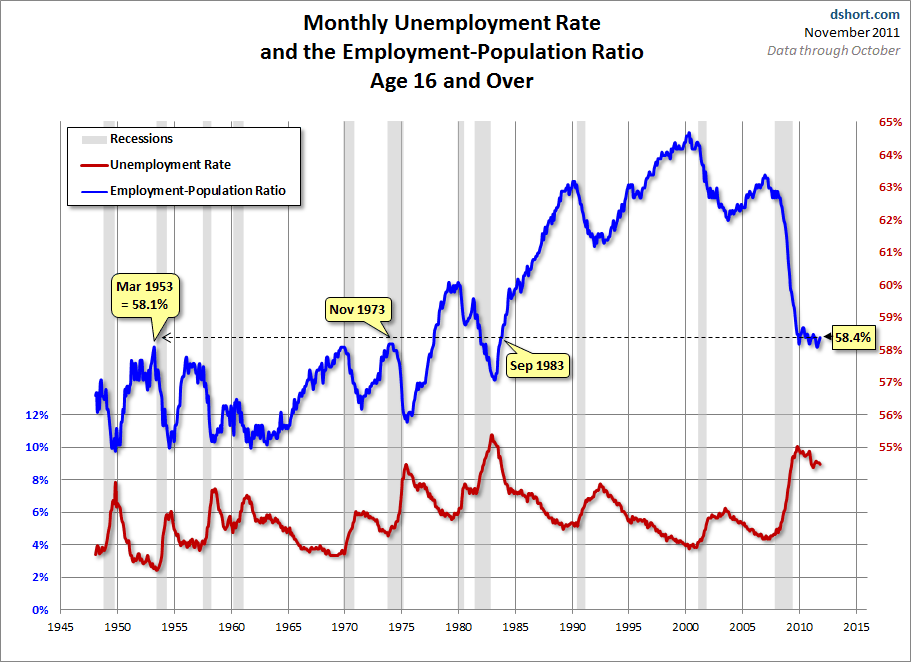 The July 2011 ratio was a modern low of 58.1% - a level not seen since the 58.1% ratio of March 1953
The employment-population ratio will be interesting to watch going forward. The first wave of Boomers will be a downward force on this ratio. The oldest of them were eligible for early retirement when the Great Recession began, and the Boomer transition to retirement will accelerate over the next several years.
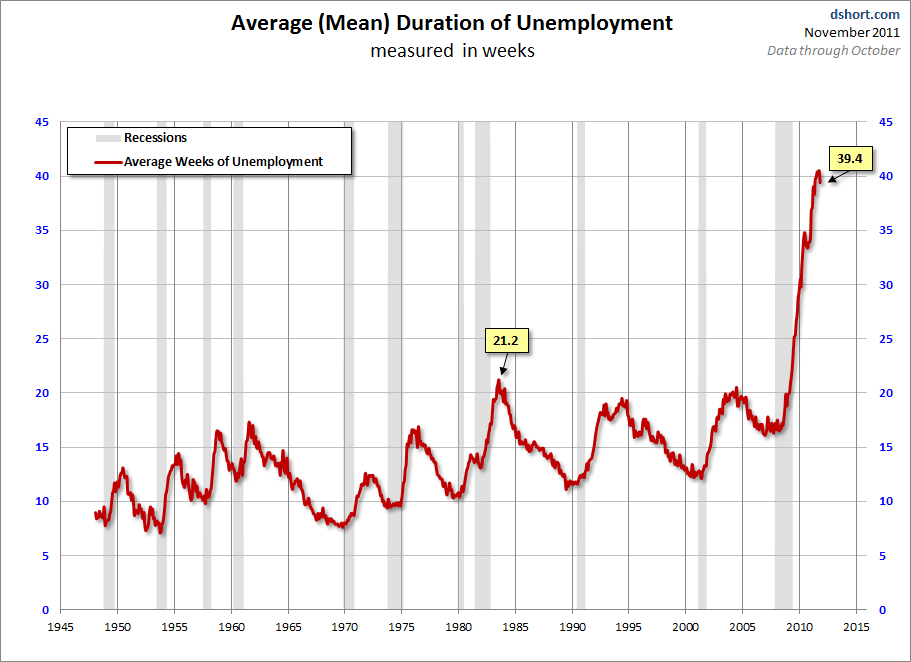
What is the average length of unemployment? As the next chart illustrates, we are perhaps seeing a paradigm shift - the result of global outsourcing and efficiencies of technology. The post-recession duration of unemployment has continued to rise, although the October 39.4 is off last month's all-time high of 40.5. It had approached a level nearly double the peak in 1983 following the 1981-82 recession.
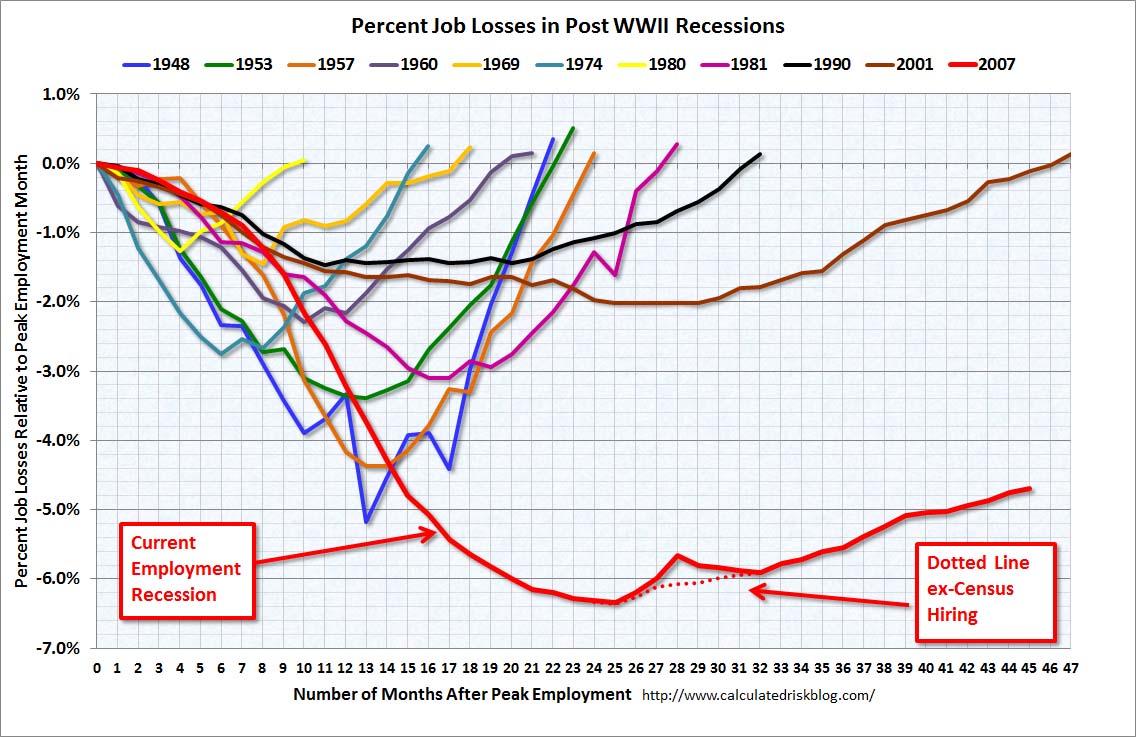
The last chart is one of my favorites from Bill McBride at Calculated Risk. It shows the job losses from the peak employment month since World War II. Note the addition of the dotted-line alternative for the current cycle, which shows unemployment excluding the temporary census hiring
Link -
http://seekingalpha.com/article/305336-only-80k-new-jobs-but-unemployment-rate-d...================================================
A few observations -
One thing that can be observed in a few of these charts, is that
THIS TIME IS DIFFERENT, as I have mentioned to various people, from time to time.
That can be confirmed, by looking at -
1)
The Real Unemployment, which would be at least 13%, if not for the context of the massive Baby Boomer retirements, which have been some 10,000 per day, since the beginning of this year, in the US.
2)
The Unemployed, over 27 weeks, as a % of the Civilian workforce, which is now considerably higher than at any other time, since 1948.3)
The Employment to total Population ratio, is now hovering around a low of 58% and is set to go much lower in coming years, as Baby Boomers are set to exit the US workforce, at an average of 10,000 per day, for some 2 decades.Many, if not most, will be exiting in expectation of receiving long promised government pensions.
However, that may not happen, given that current & past governments have usurped much of what had been allocated to pay these Pensions and used it to pay for past Deficits!
4)
The average Unemployment duration is now much longer and is in fact
almost double previous Recessions. Clearly, there is no Recovery under way, given these facts!But
with the Employment to total Population ratio, set to continue falling, due to Boomer retirements and Peak Oil impacting events, this must increase the strain on government deficits and increase the likelihood of a continuing decline in the Publics disposal income, all of which will contribute to a decline in Demand for many products and thus guarantee that there will be no Recovery in the USA.With a similar criteria applying in Europe and both the US & Europe up to their eyeballs in Debt, neither can fund the usual Keynesian solutions and the Austrian solution will only place greater strains, by ensuring Demand dives even lower.The return of the financial tsunami, in the US & Europe, will also flow thru to all other Global Economies, as product Demand diminishes!
Is THIS TIME DIFFERENT?
YES, you bet it is!
OR, should I say, THEY bet and it is!

 Forum
Forum
 Pages:

 Global Economic Downturn to Continue? (Read 97750 times)


