Well, we were "lucky" enough to dodge that bullet on Thursday, via a "fortuitous & better than expected" Unemployment Report out of the USA.
However, I suspect that the will be more bullets to dodge, in the period going thru to the end of 2012 and future "fortuitous & better than expected" reports, may be less believable?
Whilst on the issue of believability, some of the following article on "Myths & US Politicians", may also ring true locally.=====================================
10 Myths That Politicians Want You to Believe
NEW YORK (TheStreet) -- The financial system is on the brink of collapse after trillions in bad loans were issued by greedy bankers. If you were a U.S. political figure, would you:
A.) Tell everyone to suck a lemon, and (maybe) let the economy implode.
B.) Fire the bankers who made the bad loans, prosecute the guys who broke the law and guarantee a portion of the loans in a grin-and-bear-it show of good faith.
C.) Reward the bankers who made the bad loans with billions of dollars in bonuses and guarantee every loan with U.S. taxpayer money (with interest, because we borrowed the money from China).
If you answered C, then maybe you should run for office, support laws that funnel billions to insolvent companies, retire from politics and start working for one of the companies you helped bail out. Heck, that's what former Republican-senator Judd Gregg did (newly hired by Goldman Sachs).
But don't worry, the revolving door between Wall Street and government is just a "myth", and here are 10 actual myths that politicians want you to believe:
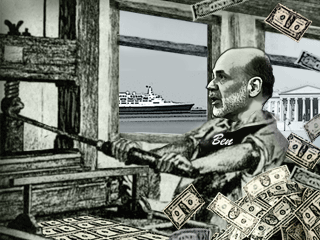 10. Quantitative Easing Helps the Economy
Make no mistake, quantitative easing is a gift to bankers and nothing else. Let's take a deeper look:
Quantitative easing is when the United States' central bank, the Federal Reserve, buys U.S. Treasury bonds.
Treasury bonds are a future obligation of the United States, paid out with Federal Reserve notes (dollars).
Federal Reserve notes are a current obligation of the United States, redeemable for goods and services.
If the Federal Reserve purchases bonds directly from the United States Treasury, they are electronically creating dollars (current obligations) in exchange for future obligations. This is inflationary if the amount of obligations (money) is increasing faster that the amount of capital (goods, services, products and ideas). But the Federal Reserve doesn't buy bonds from the Treasury, it buys them from "primary dealers."
9. Republicans Are Fiscal ConservativesSince 1968, the U.S. national debt accelerated fastest under President Ronald Reagan until President Obama claimed this distinction. The national debt does not take inflation into account, so perhaps we should look at inflation-adjusted deficits instead. According to research by Dave Manuel,
From 1946-2010:
Democratic President
Total Years: 29
Average Inflation Adjusted Deficit: $150.73 billion
Republican President
Total Years: 36
Average Inflation Adjusted Deficit: $202.28 billion
8. President Obama Is an Enemy of Wall StreetPresident Obama is the best friend Wall Street could have.
7. The Financial System Is Safer Today Than in 2008The Federal Reserve, which neglected to use regulatory powers to rein in the last crisis, has been awarded more regulatory powers. The majority of "too big to fail" banks are even bigger. And while the government is guaranteeing fewer mortgages through Fannie Mae(FNMA_) and Freddie Mac(FMCC_), it's made up the difference by guaranteeing mortgages through the Federal Housing Authority. "Good as cash" money market funds are full of mortgage-backed securities backed by the government (who needs to borrow money to back them up).
6. The 'Bush Tax Cuts' Increased Tax RevenueWashington has always had a spending problem, but since the "Bush Tax Cuts," we have a revenue problem as well. From 1990 to 2000, U.S. tax revenue had a period of exceptional growth. Following the 2001 tax cuts, revenue plummeted -- then recovered -- then plummeted again. You can attribute the sustained revenue growth of the 1990s to the fact that the decade didn't have a recession, but if you expand the timeline to 1965, we've had numerous recessions without substantial drops in revenue.
5. 'No One' Could Have Seen the Financial Crisis ComingNo one -- except for everyone who did. TheStreet has interviewed numerous economists and money managers who have been pounding the table for years.
4. If You Support Capitalism, You Support Big Business3. Republicans Are a Bunch of Fat-Cat MillionairesRepublican: 22
Democrat: 28
2. The U.S. Has the Highest Standard of Living in the World1. U.S. GDP Is GrowingU.S. GDP has increased by 4.26% from 2007 to 2010
, according to data compiled by the U.S. Bureau of Economic Analysis.
In the same period of time, the U.S. national debt has increased by 61.6%
, according to the U.S. Treasury. Looking at these numbers, you don't need to be an economist to see that something is very, very wrong.
=============================
Increasing Debt at that rate, to obtain such a GDP growth is not sustainable!
Interesting info?
http://www.treasurydirect.gov/NP/BPDLogin?application=np

 Forum
Forum
 Pages:

 Global Economic Downturn to Continue? (Read 99069 times)


