Forum

 
  Back to OzPolitic.com   Welcome, Guest. Please Login or Register
  Forum Home Album HelpSearch Recent Rules LoginRegister  
 

Pages: 1 ... 42 43 44 45 46 ... 117
Send Topic Print
For the Record (Read 223501 times)
perceptions_now
Gold Member
*****
Offline


Australian Politics

Posts: 11694
Perth  WA
Gender: male
Re: For the Record
Reply #645 - Feb 1st, 2012 at 4:00pm
 
Global home values


One of the stunning aspects of the global housing bubble is the synchronicity in which prices jumped:

...

In the late 1990s to early 2000s all prices began soaring almost in unison.  At the core is the proliferation of easy access to debt and the financial system going fully into a mania with their addiction to derivatives and black box techniques of stealing from the public.  If you look at the chart most bubbles are already in decline.  The US market has been falling for five years now.  Canada is just starting to turn.

Link -
http://www.doctorhousingbubble.com/global-housing-bubbles-collapse-canada-bubble...
=================================
Just in case anyone thinks that the synchronicity was/is purely co-incidental, think again, think DEMOGRAPHICS & look at the Japanese experience!

Back to top
 
 
IP Logged
 
perceptions_now
Gold Member
*****
Offline


Australian Politics

Posts: 11694
Perth  WA
Gender: male
Re: For the Record
Reply #646 - Feb 1st, 2012 at 4:22pm
 
Are We Following Japan Off a Cliff?


The Federal Reserve continues whipping the reluctant economy to push forward with its announcement of keeping rates below 1% -- probably until late 2014. These near-zero interest rates have been tried in the past, with not-so-spectacular results, as illustrated by Japan's "lost decades."

Is our economy following the trail that Japan blazed, and are we headed for a few lost decades of our own?

Japan's "growth"
Following the burst of Japan's property bubble of the 1980s, Japan's Nikkei (INDEX: ^N225) index retreated from its onetime high of 38,957 yen in 1989 to its current value around 8,900 yen. One dollar, or yen, invested at the peak of the market would be worth $0.23. The Dow Jones (INDEX: ^DJI  ) has already shrunk about 10% from its 2007 high of 14,164 to its current 12,670.

Japan's GDP also limped ahead in the '90s, with an average growth rate of about 1.5% compared to the U.S. rate of 3.2%. Since 2000, Japan's growth rate at about 1% remained half of the U.S. rate of about 2%. Any way you slice Japan's GDP growth, it's been anemic and has lagged other developed nations.

Could this slowdown happen to the U.S.? Is it already happening? Let's look at a few similarities.

Central bank rates
Just like Japan's central bank, the Fed has cut interest rates leading to our current zero interest rate policy, or ZIRP for short:
...

The Fed predicts increasing its rate in a few years, but Japan has held its rate at or below 1% since 1995 and failed to spur any meaningful growth. Now, the U.S. flirted with near-zero rates before, but our own housing bubble floated the economy and allowed the Fed to increase rates in 2005, before again cutting them to near zero.

After this failed, both central banks in Japan and the U.S. moved to the next option to pump the economy -- quantitative easing, also known as QE. The Bank of Japan purchased government bonds from the secondary market starting in 2001, while the Fed began purchasing other assets in 2008, which began programs nicknamed QE1 and QE2. Through flooding more money into the market, the central banks hoped to drive lending. Japan's results were mixed, with no clear positive outcome from its quantitative easing. On the effectiveness of the Fed's actions, last September former Fed Chairman Alan Greenspan said, "I find it very difficult to find any significant impact as yet from QE1 and QE2." Many analysts believe current Fed Chairman Ben Bernanke's latest statements point to more actions, or a QE3.

Debt-to-GDP
While the central banks push their economic horses to water, the governments drown in debt to get them to drink. Through beefy stimulus packages, governments spend on infrastructure projects, cut taxes, or do anything else possible to improve the economy and remain in power. The U.S. and Japan ran up quite a tab:
...

Japan's debt continues to climb -- its gross debt-to-GDP now sits at a staggering 234%! Arguments about whether that high of a debt level means anything abound, but the takeaway here is that the U.S. debt growth matches Japan's and could signal potentially similar conditions for low future growth.

Real estate values
From the peak of Japan's housing bubble in 1991, the Urban Land Price Index, which measures Japan's land value trends, has declined every single year. Since the peak of the U.S. housing bubble in 2006, the Case-Shiller Index, which measures price changes in 20 major U.S. metro areas, has trended in a similar direction:
...

Of course, demographics affect demand for real estate and values, and whereas the U.S. population is growing at a rate of 0.963%, Japan's population is actually shrinking -- its growth rate is -0.278%. But for the economy, consumers spend less when they watch what is usually their largest asset -- namely, a home -- shrink in worth.

The Foolish takeaway

These similarities don't mean the U.S. is destined for slow growth. The two countries still have vast differences, like our growing population and political resistance to ever higher debt ceilings. But if these economic markers continue to follow in Japan's footsteps, I'd put my money on a different horse for higher growth.

Link -
[url]http://www.fool.com/investing/general/2012/01/31/are-we-following-japan-off-a-cliff.aspx[/url
=================================
The short answer is YES, we are following Japan off a cliff, but the longer answer of why involves Demographics, Energy, Debt & Climate Change!
Back to top
 
 
IP Logged
 
perceptions_now
Gold Member
*****
Offline


Australian Politics

Posts: 11694
Perth  WA
Gender: male
Re: For the Record
Reply #647 - Feb 1st, 2012 at 4:34pm
 
Austerity mantra doubted while eurozone future still cloudy


What next for the EU and the eurozone? Of the 27 EU states, 25 agreed to join the new fiscal compact at yesterday’s ( Monday 30 ) EU summit. Only the UK and the Czech Republic refused, the Czechs giving constitutional reasons for not agreeing. The agreement ushers in tighter control of national economies at the European level, penalties for breaking the rules and according to most commentators a more German economic style.

The EU and in particular the eurozone’s economic problems were dominant topics at the recent World Economic Forum at Davos. A sense that the global economy is suffering an identity crisis hung over the World Economic Forum and the eurozone’s failure to recover despite the efforts of governments was discussed and referred to constantly. The annual meeting of movers and shakers in the global economy was punctuated with bad news, which provided fresh fuel for what at times seemed like the eurozone’s economic Auto da Fé. Moody’s downgraded eurozone countries, Britain announced economic contraction instead of previously predicted growth, another installment of Greece’s ongoing disaster story, unemployment in Spain exceeded the 5 million mark and warnings of Portugal becoming ‘the new Greece’ all hit headlines while the delegates at Davos talked.

The Romanian government’s way of handling national debt has also been criticized and described as a leftover from the Ceasescu era. Questions about just how governments in Europe handle their interwoven economies have been asked aplenty and economic theory and philosophy debated. Commentators say following Germany’s economic model for closer fiscal union in the eurozone would effectively legislate against Keynesian economics.

Austerity, which has become a mantra for European politicians in recent years, was called into doubt. The negative effect on growth from harsh, unpopular austerity measures now being considered more important than reduction of state deficits, which Europe’s politicians have said time and time again is absolutely essential in recent years. This turnaround has been motivated at least in part by the cold hard facts. The measures simply have not worked in many places. The economic situation in Greece deteriorated despite the implementation of austerity measures. Britain’s economy shrunk after the Conservative/Liberal Democrat coalition promised a return to growth if their policies were implemented. Mariano Rajoy’s new government in Spain is announcing worsening rather than the improving conditions promised when campaigning against then president Zapatero’s enormously unpopular administration. Many are still wondering what’s next for the European economies and more importantly, what will happen to the eurozone.

Link -
http://www.romania-insider.com/austerity-manta-doubted-while-eurozone-future-sti...
=================================
AUS-terity can not work, at this time, it will actually make matters worse!
Back to top
 
 
IP Logged
 
perceptions_now
Gold Member
*****
Offline


Australian Politics

Posts: 11694
Perth  WA
Gender: male
Re: For the Record
Reply #648 - Feb 1st, 2012 at 11:44pm
 
Greek Bondholders May Get GDP Sweetener in Deal


Bondholders negotiating a debt swap with Greece may get a sweetener tied to a revival in economic growth that would ease the impact of accepting a lower interest rate on the new bonds, people with knowledge of the talks said.

In discussions late last week in Athens, creditors lowered their demands for an average coupon on the new 30-year securities they would receive to as little as 3.6 percent from 4.25 percent after European officials demanded they take steeper losses, people familiar with the matter said at the time.

While the lower coupon would lead to an estimated loss of 70 percent or more for investors, adding a so-called gross domestic product warrant -- which would pay bondholders more if the Greek economy rebounds -- would trim the loss in net present value terms by an estimated 0.5 to 3 percentage points, said two people, who declined to be identified because the talks are confidential.

Greece and its creditors are seeking to seal a debt-swap deal three months after private bondholders agreed to a 50 percent cut in the face value of more than 200 billion euros ($262 billion) of debt by voluntarily exchanging bonds for new securities.

The aim is to reduce Greece’s debt burden to 120 percent of GDP in 2020 -- an objective complicated by a deepening economic contraction.

Link -
http://www.bloomberg.com/news/2012-01-31/greek-bondholders-are-said-set-to-get-gdp-revival-sweetener-in-debt-swap.html
=================================
This is just more -
C
redible
R
eliable
A
bundant
P
aradoxes

The Real facts are -
1) Greece is only the tip of the much larger Eurozone & US iceberg.
2) There will be many large Financial institutions that will be taking a massive 70% haircut on their investments in the Eurozone markets, which will cause a flow on effect in financial markets.
3) Many of these institutions will be prevented from recouping their massive losses, UNLESS a default is declared under what investors thought was an insurance cover, granted via the credit default swaps (CDS) market.
4) The CDS market is largely covered by the largest of the US Banks.
5) The US government & the Federal Reserve Bank will use every possible measure to ensure that a default is not declared on Greek Debt or other European countries, as to do so would place the largest US Banks at risk of bankruptcy, via the massive payouts which would flow from such Default Declarations.
6) This is no longer "chicken little" here!
At risk are the CDS & Derivatives markets, which are currently put at over US$1 Quadrillion (US$1,000 Trillion) and flowing from that, the entire Global Economy! 
7) As the Major Macro Economic factors, such as Demographics, Peak Energy & Peak Debt will prevent any recovery to a "normal Growth Economy" for decades, even many decades, what all of this is about, is simply trying to kick the can a little further down the road, UNTIL ONE DAY IT SIMPLY WILL NOT MOVE, BECAUSE IT IS SO LARGE!

Back to top
 
 
IP Logged
 
perceptions_now
Gold Member
*****
Offline


Australian Politics

Posts: 11694
Perth  WA
Gender: male
Re: For the Record
Reply #649 - Feb 4th, 2012 at 3:33pm
 
...

It's apparent that the labor force kept up with population growth until 2007, and then growth rates diverged. The lack of jobs forced the participation rate reduction, whose magnitude has not been observed over the last 20 years. Despite the recent improvement, we have a clear indication that a typical economic turnaround is not in the cards. The spikes in the "Employed" growth rate are the result of the participation rate being higher than the average.

Based on the data published by the BLS, the average participation rate between 1990 and 2011 was 66.26%, and the same average for the pre-crisis period of 1990-2006 was 66.56%. The official participation rate at the end of 2011 was much lower at 63.96%, and although the difference appears small, it delivers some sobering results.

The average unemployment rate for the 1990-2011 period was 6%, and assuming that population will continue to grow at roughly 1% per year, while using a rounded participation rate of 66%, we need 130,000 new jobs every month just to keep up with population growth.

But there's already a current shortage of 8.5 million jobs using the same 6% average unemployment rate, and to close the gap we need another 360,000 jobs every month, non-stop, for the next three years, or close to 500,000 jobs monthly to return to the norm.


One way is to achieve a lower unemployment rate is to freeze job creation and layoffs today, and drop the participation rate to 60%. By the end of 2012, even with population growth at 1%, the official unemployment rate will be 3.55%, or literally full employment.

How did the participation rate increase over time? A paper (pdf) published by the BLS explains.

    As has been well documented, labor force participation rates among married women have increased dramatically in recent decades, rising from 35 percent in 1966 to 61 percent in 1994.

The writing is on the wall, and the expectation of a garden variety economic turnaround is misplaced. The question remains on how to navigate the future, despite the pockets of hope that will emerge along the way. If we must adapt to the current participation rate, or even drop to the 62.86% average for the 1948-2011 period, we are faced with an excess of business capacity.

Furthermore, if the future indicates that more dual-earner households will switch to single "breadwinners," then consumption will decline, and somewhere out there we'll find the balance. But finding that balance will not happen any time soon.

Link -
http://seekingalpha.com/article/337991-why-u-s-unemployment-rate-is-12-1?source=...
=================================
Back to top
 
 
IP Logged
 
perceptions_now
Gold Member
*****
Offline


Australian Politics

Posts: 11694
Perth  WA
Gender: male
Re: For the Record
Reply #650 - Feb 4th, 2012 at 9:53pm
 
The Real Economic Picture

[img]http://d3e11nsse60sj1.cloudfront.net/wp-content/uploads/2012/02/econ-stats-01.gif

This chart (below) shows the behavior of inflation as measured by “our” government’s official measure, CPI-U (bottom line) and John Williams’ measure which uses the official methodology of when I was Assistant Secretary of the US Treasury. The gap between the top and bottom lines represents the amount of money that was due to Social Security recipients and others whose income was indexed to inflation that was diverted by the government to wars, police state, and bankers’ bailouts.
...

Here is nonfarm payroll employment. As you can see, the US economy has been in recession for four years despite the easiest monetary policy and largest government deficits in US history.

...

Here is consumer confidence. Do you see a recovery despite all the recovery hype from politicians and the financial media?
...

Here is housing starts. Do you see a recovery?
...

Here is real GDP deflated according to the methodology used when I was in the US Treasury.
...

Here is real retail sales deflated by the traditional, as contrasted with the current, substitution-based, measure of inflation.
...

These graphs courtesy of John Williams make it completely clear that there is no economic recovery. In place of recovery, we have hype from politicians, Wall Street, and the presstitute media.

Link -
http://www.foreignpolicyjournal.com/2012/02/04/the-real-economic-picture/
================================
Back to top
 
 
IP Logged
 
perceptions_now
Gold Member
*****
Offline


Australian Politics

Posts: 11694
Perth  WA
Gender: male
Re: For the Record
Reply #651 - Feb 5th, 2012 at 11:15am
 
Nonfarm Payrolls Haven't Kept Pace With Population Growth


The Bureau of Labor Statistics employment situation report for January estimates that non-farm payrolls increased by 243,000, with private companies adding 221,000 to their payrolls, while the unemployment rate dropped to 8.3 percent.

While the most recent employment report data has been positive, the reality is that payroll employment and labor force participation in the US has fallen off the pace of working age population growth since the turn of the century. Non-Farm payrolls peaked in December 2007 at 137.8 million, just one month before the beginning of the most recent recession, which lasted from December 2007 - June 2009, according to the National Bureau of Economic Research.
...

With 132.4 million people listed on non-farm payrolls through January 2012, we are roughly 5.4 million jobs short of the previous peak in payroll employment. In fact, payroll employment remains at levels first seen just before the March to November 2001 recession, which lasted only eight months with non-farm payrolls peaking at 132.3 million. Prior to today's report, the last time payroll employment in the US reached 132.4 million people was between December 2004 and January 2005.

The problem with this is there is one thing there is no escape from and that is the growth of our working age population. In January 2000, there were 130.9 million people on non-farm payrolls and 209.3 million people of working age. In the last 12 years the working age population in the US has increased by roughly 31.3 million while non-farm payrolls stand just 1 million higher at 130.9 million people.
...

The above graph illustrates that the growth of the US working age population is relentlessly constant. If jobs are not available for an expanding population, our employment to population ratio will begin to decline and GDP growth has to slow. When was the last time the US had real GDP growth of 4.0% or better? The year 2000.
...

The US has not had annualized GDP growth higher than 3.5% percent since 2000.

Consumption represents 70 percent of US gross domestic product and current income is the most relevant determinant of consumption. Most Americans earn income from employment and wages. Without payroll employment levels resuming its previous strong relationship to working age population growth, the US cannot grow at 4 to 5 percent annually and will stay in a 1% to 2% rate of growth indefinitely.

Link -
http://seekingalpha.com/article/340171-nonfarm-payrolls-haven-t-kept-pace-with-p...
=================================
This time, IT IS DIFFERENT!

A few observations -
1) US Population Growth, is actually starting to slow.
2) The US Unemployment rate will Decline, as there are now some 330,000 Baby Boomers due to retire each month, for the next 20 years, thus making way for those who may be Underemployed or Unemployed.
3) With the working age Population recently Growing at around 217,000 each month, the current high Unemployment rate could quite quickly fall to record lows, even without any Economic recovery!   

But, as I said, this time is different and for a number of reasons, I don't expect to see US Unemployment hit any record lows.

Neither do I expect to see US GDP return to REAL GDP GROWTH!

The same applies to Europe and also flows thru to all Global markets!
Back to top
 
 
IP Logged
 
perceptions_now
Gold Member
*****
Offline


Australian Politics

Posts: 11694
Perth  WA
Gender: male
Re: For the Record
Reply #652 - Feb 5th, 2012 at 11:38am
 
Europe Is On An Ugly Road


At this risk of beating a dead horse, I reiterate that I don't see how the European situation comes to a happy conclusion. Conditions in Greece appear to be deteriorating rapidly. Via Athens News, retail sales are in freefall: 

        Retail sales by volume fell 8.9 percent year-on-year in November after a 10.8 percent drop in October, statistics service data showed on Tuesday.

        Households, burdened by austerity measures to plug deficits and rising unemployment, have cut back on spending.

        Consumer confidence has also been hurt by a climb in the jobless rate to 17.7 percent in the third quarter.

Officially, hope springs eternal:

        "Increasing unemployment and austerity are likely to continue weighing on disposable incomes and consumer demand in the first months of 2012. However, a positive conclusion of the PSI deal and the approval of the second bailout package could provide a kind of positive shock to business and consumer sentiment," he added.

Right, good luck with that, as the next agreement is only about tightening the screws even more. How exactly will consumer confidence get a boost given an acceleration in wage cuts, a late holiday gift from the Troika.

Under conditions of never-ending austerity with no exchange rate release valve, what exactly is the half-life on any new plan to reduce Greece's debt to GDP ratio to 120% by 2020

Call me a pessimist, but I can't help but conclude that unless Greece gets real relief more quickly, the cost of being in the Euro will outweigh the costs of leaving. At this point, I am starting to wonder what was the bigger mistake - to allow Greece into the Euro in the first place, or to force them to stay?

Link -
http://seekingalpha.com/article/340951-europe-is-on-an-ugly-road?source=email_ma...
==================================
Anyone who thinks that "general AUS-terity" programs, at this moment in history, will do anything other than hasten the destruction of the Economy, had best think again!


Whilst you think again, look at the reality of Greece & the UK!


Back to top
 
 
IP Logged
 
perceptions_now
Gold Member
*****
Offline


Australian Politics

Posts: 11694
Perth  WA
Gender: male
Re: For the Record
Reply #653 - Feb 6th, 2012 at 8:32pm
 
World economy’s uncharted territory


It must now be obvious that, economically speaking, we’re in another country. Things we once took for granted no longer apply; things we never imagined occur all the time. We’ve entered a zone of ignorance where familiar experience and ideas count for less. “Thirty years ago, if you’d said that the United States and Europe were going to be the centers of financial crises, people would have thought you were crazy,” says economist Fred Bergsten. The unforeseen is now routine.

Profound changes to the global economy contributed to today’s crisis and make it harder to resolve. Bergsten — director of the influential Peterson Institute for International Economics — cites three shifts.

First is the rise of “emerging market” countries, led by China, India and Brazil. In 1981, when the Peterson Institute was founded, these nations were laggards. “Now, they’re more than half the world economy and are growing three times faster than high-income countries (the United States, Japan and European nations),” Bergsten said in an interview. “They drive the world economy.”

Second, the United States has moved from the largest-creditor to the largest-debtor nation. Through the 1970s, the United States generally ran trade surpluses, and U.S. multinational investment abroad overshadowed foreign investment here. But since 1980, U.S. current account deficits exceed $8.5 trillion. (The current account is a broad measure of trade.) And foreigners have invested trillions in U.S. stocks, bonds, factories and real estate.

Finally, financial crises have mushroomed. After World War II, countries restricted the flow of money across borders. This changed in the 1970s and 1980s, when these controls were gradually dismantled. Unexpectedly, rapid inflows and outflows of foreign money caused booms and busts: first in Latin America in the 1980s; then in Asia and Russia in the late 1990s. And the American and European financial crises, though largely homegrown, have had global repercussions.

Globalization, it turns out, is a double-edged sword. It raises living standards by promoting trade and spreading modern technology around the world. But it also causes disruptions and deepens downturns. The future of the world economy hinges heavily on whether this instability is modest and tolerable or massive and intolerable. As Bergsten asks: “Are we on a path not only of crises but also of crises of increasing frequency and rising severity?”

We don’t know. What we do know is that mutual dependencies have grown. For years, U.S. trade deficits promoted globalization by boosting other countries’ exports. Ideally, emerging-market countries would now return the favor. Their fast economic growth would swell demand for U.S. and European exports, making it easier for these countries to pay their debts and reduce unemployment. The odds of this happening seem no better than 50-50.

What countries see as their narrow self-interest may subvert their collective interest in a stable world economy. Political power has fragmented along with economic power. The currency dispute with China is a case in point. For years, American presidents have failed to persuade China to stop undervaluing its currency and, thereby, subsidizing exports and penalizing imports. Indeed, some economists argue that China’s trade surpluses — converted into dollars and invested in U.S. bonds — fueled America’s financial crisis by driving down interest rates. Low rates then encouraged riskier mortgage loans.

By nature, Bergsten — who will retire as Peterson’s director after a successor is found — is an optimist. Unlike the 1930s, he argues, we have institutions (the International Monetary Fund, the European Union and others) that allow enough cooperation to avoid disaster. Europe will muddle through its crisis, he argues, because its leaders recognize that the alternatives are grim. Joblessness would surge. Political and social cohesion would collapse. So the European Central Bank (Europe’s Federal Reserve) will lend whatever is necessary, and Germany will pay whatever is necessary.

Maybe. Even Bergsten’s optimism is tempered. “The next crisis could be a dollar crisis,” he warns. Foreigners own roughly $23 trillion in U.S. stocks, bonds, real estate and factories; Americans own about $20 trillion in foreign assets. That’s the reality of being the world’s largest debtor. A loss of confidence could trigger a sell-off of American stocks and bonds that — given the dollar’s role as global currency — would reverberate around the world.

Foreign faith in the United States ultimately rests on a belief in America’s political stability and economic vitality. Could huge federal budget deficits shake that faith? “The European crisis has shielded us from our follies,” Bergsten says. Worried investors have channeled funds from European securities into American bonds, reducing U.S. interest rates and making borrowing easier to cover $1 trillion annual deficits. There’s no telling what comes next. We are, after all, in another country.

Link -
http://www.washingtonpost.com/opinions/world-economys-uncharted-territory/2012/0...
===============================
I think, I've already had a few fair value guesses!
Back to top
 
 
IP Logged
 
perceptions_now
Gold Member
*****
Offline


Australian Politics

Posts: 11694
Perth  WA
Gender: male
Re: For the Record
Reply #654 - Feb 17th, 2012 at 1:42pm
 
ANZ chief calls for end to bank bashing


ANZ chief executive Mike Smith says “politics isn't helping” the Australian economy and called for an end of point scoring to focus on the long-term challenges facing the nation.

His comments follow months of sustained political criticism of the banking sector, particularly over the pricing of mortgages in the face of rising funding costs.

Mr Smith also hit out at tough new bank rules that are being rolled out globally, saying they come at the worst possible time for the world economy.

“I have to be blunt here and say politics isn't helping, we need to bring more focus to the long-term opportunities and challenges facing Australia, rather than short-term point scoring,” Mr Smith told an investor briefing.

ANZ this morning reported an unaudited $1.48 billion record cash profit in the December quarter, up 5.7 per cent from a year earlier.

The ANZ result completes the quartet of Australian banks to post big profits in the past week even as funding costs rise and they trim expenses including staff.

Mr Smith echoed other bank bosses in declaring the sector is grappling with a major structural shift. This overhaul will involve the pace of credit growth slowing across Australia and New Zealand, while profit margins will continue to be squeezed on rising funding costs.

Mr Smith remained cautious on the outlook for the global economy saying it had entered “the second and more protracted phase of the global financial crisis.”

And this concern over the economic outlook overseas is prompting a cautious behaviour for both Australian consumers and businesses, he said.

Permanent rise
Meanwhile, Mr Smith said increasing global regulation is permanently increasing the cost of banking.

“I think when looking at changes like Basel 3, whilst these reforms were well-intentioned, some of the changes are coming at the worst possible time for the world economy. I really do worry about the consequences for growth and stability, especially in Europe,” he said.

For their part, bank regulators, including the Australian Prudential Regulation Authority say rules are designed to make banks safer and help rebuild investor confidence in the sector.

Link -
http://m.smh.com.au/business/anz-chief-calls-for-end-to-bank-bashing-20120217-1t...
===============================
When Smith and other senior executives, from the banking industry, start reducing their own remuneration/bonuses and change their profit expectations, to reflect what's happening to other business sectors, their own employees, to the OZ community in general and to the Global Economy, THEN I will start to pay some attention to their bleatings!

Until then, Mike & the rest, can stick their heads where the sun don't shine, which is what they are now doing!!! 
 
Back to top
 
 
IP Logged
 
perceptions_now
Gold Member
*****
Offline


Australian Politics

Posts: 11694
Perth  WA
Gender: male
Re: For the Record
Reply #655 - Feb 18th, 2012 at 11:44am
 
Is This Recovery?


...

...

The thing about GDP is that it is not necessarily a very good measure of economic activity in the sense that it measures what we spend. If you inject more fiat money into the economy it means there will be more spending and a higher GDP. More spending doesn't always mean that those activities will be productive and lasting.

Conclusion

Quantitative easing has only been used once before in U.S. history, and that was during the Great Depression.


You might wish to ponder that bit of information. What that is telling us is that we cannot compare what is occurring now to our experience in prior recessions.

With all due respect to Rogoff and Reinhart, this time is different for the U.S., at least in terms of our modern experience. Fed policies employed in previous recessions which were then thought to work, have failed in our current cycle. Those policies were mainly forms of lowering the Fed Funds rate, reducing bank reserve requirements, and discount window operations. We now have ZIRP and that has done nothing to stimulate the economy as the Fed had hoped it would.

This time we have persistent high unemployment, economic stagnation, a "liquidity trap", high civilian and government debt, low savings, flat to declining wages, and substantial asset devaluation. This has been going on since 2008, a full four years. If it all sounds familiar, these same things happened in the 1930s.


This time is far worse than any other modern recession. What we are seeing now is a depression, despite what the NBER would have you believe. If you are still looking for the "Big One" to happen, you are too late. It happened here and it is still happening here and in Europe. They, like us, have tried to paper over most of the effects of the boom-bust business cycle malinvestment, and they have failed and the piper is at their door.

Within that context, let me sum up my thinking:

1. The economic "good news" is largely based on fiat money steroids and will not last without continuous injections of new fiat money into the economy.

2. The last injection of fiat money (QE2) is already wearing out and money supply is most likely declining.

3. A declining MS will result in further economic weakness (stagnation) and flattening-to-increasing unemployment.

4. This is likely to occur in Q2-Q3 2012.


5. As soon as unemployment goes up again, the Fed will announce QE3.

6. The dollar will continue to be weak.

7. It is likely that price inflation will continue to be "modest" (as the Fed sees it) in light of ongoing real estate related asset devaluation.


Link -
http://seekingalpha.com/article/370771-is-this-recovery-part-ii?source=email_mac...
===============================
This is actually a two part article & it is a lot longer than what shows here, but I think these are the crucial issues!

In essence, the US Government, the US FEDERAL Reserve Bank and to a lesser extent other governments & Central Banks, have injected many $Trillions into the US & Global Economy, both overtly & covertly.


That temporarily raised GDP levels, but also massively raised Debt levels Globally, to levels where further increases will have very serious consequences, for the US, European & Global Economy.

Further attempts to "assist" recovery, via increased Debt,  will also have serious repercussions on Global Currency values, including the Decline of the US$.

We are now between a rock & a hard place, we can not go forward, but neither can we go back.

I believe every effort will be made to kick the can a little further down the road, just long enough to get past the current US elections, due in early November this year.

However, I don't think that is possible and whilst the timing of events of this magnitude are very difficult, I see cracks starting to appear from March/April onward and by the end of this year or early next, the true extent of our current difficulties will start to become apparent!. 

So, Good luck & watch the Debt!
Back to top
 
 
IP Logged
 
perceptions_now
Gold Member
*****
Offline


Australian Politics

Posts: 11694
Perth  WA
Gender: male
Re: For the Record
Reply #656 - Feb 22nd, 2012 at 2:03pm
 
Europe Passes the Last Exit. A Great Crisis Lies Ahead


The German people drew the wrong conclusion from their post-WWI experience.  They saw the damage from the Weimar hyperinflation of 1921-1924, probably an inevitable result of the WWI settlement.  They suffer amnesia about the Weimar deflation which brough Hitler to power (see A lesson from the Weimar Republic about balancing the budget).  It’s sounding a fire alarm while the ship sinks.  Now they repeat in different form Weimar’s mistakes of 1929-32, imposing a crippling austerity on the PIIGS while striving to balance their own budget — almost certain to result in recession and deflation (for description of this process see Debt – the core problem of this financial crisis, which also explains how we got in this mess).

The PIIGS nations grow weaker, the eurozone economy slows, and the centrist political parties lose support to extremists.  Greece leads this parade, but the other PIIGS – and France — follow in its path.  We can only guess at how this plays out, but it probably ends badly.

Today’s meeting of Europe’s Finance Minsters looks like the last chance to change course.  Like all previous opportunities, they will almost certain drive by this last exit.  They are ill-equipped to do otherwise, much like 13th century priests treating the Plaque on the basis of Scriptural precepts.
    Myopically focused on the need to protect politically powerful banks,
    seeing Europe as a morality play rather than the product of cold laws,
    believing in a mixture of pseudoeconomic economic myths (eg, confidence fairies, invisible bond vigilantes and the curative power of austerity), and
    unwilling to recognize their own role in creating this crisis.

The series of posts last Fall forecast a resolution –  a crisis-driven policy change — in the near future.  Three months later nothing has happened.  Europe leaders continue to improvise with sh0rt-term measures, while Europe — especially the PIIGS – grow weaker. Each passing month reduces their ability to avoid a crash.

The devotion of Europe’s leaders — both in the North and South – to the unification project exceeds my expectations, but no longer appears rational.  Perhaps they do not see the cost in broken lives.  Perhaps they do, but do not care.  Perhaps they value the shining dream of a future Europe more than blasted lives of proles.  Collateral damage.

Next are several articles report from the Greece, the front lines of Europe, watching their society crack under the stress.

“Can a return to the drachma save Greece as unemployment soars?“, Ambrose Evans-Pritchard (Business Editor), The Telegraph, 19 February 2012 — “Greece’s unemployment bomb has detonated. After a deceptive calm, the surge in job losses since last summer is shocking even for those who never believed that combined fiscal and monetary contraction could possibly lead to any result other than ruin.” Excerpt:

    A variant of this lies in store for Portugal as its “internal devaluation” starts in earnest. The young Schumpeterians in charge of the Portuguese economy insist otherwise — cocksure that shock therapy will triumph without the cushion of debt relief and devaluation — but events have a habit of  demolishing dreams.

    In November alone 126,000 Greeks lost their jobs in a country of 11 million, equivalent to three and a half million Americans in a single month. The unemployment rate jumped from 18.2pc to 20.9pc.  This has not yet fed through into social breakdown. Greeks receive unemployment support for an average of thirty weeks, with a ceiling of €454 a month,
according to Professor Manos Matsaganis from Athens University.   Those with civil service tenure are placed on labour reserve for two years at half their basic pay, or a third of their actual pay.  Once these cushions are exhausted, Greeks are on their own. The monthly ratchet effect will then become painfully evident.

Dimitra Noussi, who runs two homeless shelters and a soup kitchen for the City of Athens, said the crunch comes once people have been unemployed for five or six months and cannot pay the rent. Most fall back on the kinship network   but there comes a point when critical mass overwhelms even this cultural backstop.
[/b

… [b]One can see why the high priests of the EU Project wish to prevent elections   taking place in April. The political centre is disintegrating, with the once triumphant PASOK party down to 9pc in the polls and New Democracy at 18pc – each party reduced to a pro-Memorandum rump after the mass expulsion of   dissidents, and each stunned almost senseless.


The latest best-seller is the Greek translation of Heinrich Winkler’s “Weimar   1918-1933: History of the First German Democracy”, narrating how an   indebted Germany pursued the same deflation policies under the Gold Standard as Greece is now pursuing under EMU — with the same results. The book culminates in the Reichstag elections of July 1932 when the Nazis and Communists between them won half the seats, and Weimar died. Such parallels are always inexact. The radical parties of Syriza and the Democratic Left are not authoritarian. Yet their ascendancy surely threatens to shatter the existing order. “If we achieve a Left-dominated government, we will politely tell the Troika to leave the country, and we may need to discuss an orderly return to the Drachma,” said Syriza MP   Theodoros Dritsas, choosing his words carefully.

Mr Papademos warns that default and EMU-exit would lead to “uncontrollable economic chaos”. But is that not already the case? No Greek bank has   been able to issue a letter of credit accepted anywhere in the world since November. Large Greek companies are having to relocate their headquarters to Bulgaria in order to conduct basic trade.

The “drachma risk” has already killed investment. Greece is suffering the anticipated consequences of EMU exit without the benefits, so it might as well lance the boil, impose capital controls, and create a new   banking system (as Iceland did).

Link -
http://www.economonitor.com/blog/2012/02/europe-passes-the-last-exit-a-great-cri...
==================================

Good luck & watch the Debt!

Back to top
 
 
IP Logged
 
perceptions_now
Gold Member
*****
Offline


Australian Politics

Posts: 11694
Perth  WA
Gender: male
Re: For the Record
Reply #657 - Feb 29th, 2012 at 5:24pm
 
An Epic Australian Bust


The Australian economy today

What the bulls will tell you:
The Australian economy is a true success story compared to those of other developed countries. It almost completely escaped the "Great Recession" and with its GDP slightly dipping for only one quarter in late 2008, its unemployment stands today at an enviable 5.1%. Real estate is booming. Until recently, the Reserve Bank of Australia was raising rates to fight inflation and "economic overheating."

Reality:
The reality is starkly different: Australia has a very vulnerable economy where upcoming bad news has not been "priced in" at all. The country suffers from an epic real estate bubble that greatly exceeds those of US, Ireland, and Spain. The average Australian consumer is completely tapped out. Take out a "consumer credit" punchbowl and reduce the Chinese voracious appetite for iron ore and coal, and the Australian economy will collapse like a house of cards.

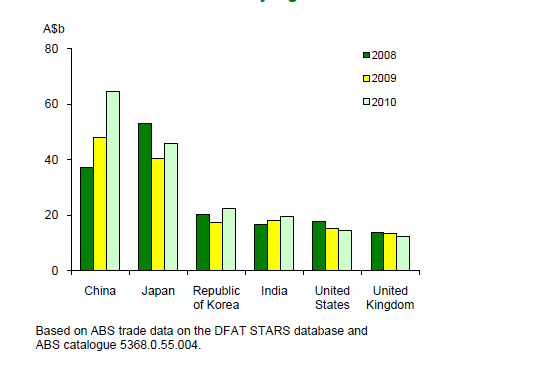
Dependence on exports to China
Australia today suffers from a classic case of "Dutch Disease." Its reliance on natural resource exports for its GDP growth stunts the rest of the economic development, especially manufacturing. Australian manufacturing has been declining in relative and absolute terms at a faster rate than it is in the USA and Europe. Today, it imports most of its manufactured goods.
...

Until several years ago, Australia had thriving tourist and wine industries. The appreciated Australian dollar put a severe dent in their growth.

Australian bulls like to talk about their low debt of 22.3% of GDP and a manageable budget deficit of 3.6% (2011). They, however, completely ignore overall indebtedness, which is on par with other "indebted" developed economies (USA and Italy).

Australia has an unusually high household debt of 105% of GDP, the highest in the developed world (much due to the astronomical real estate prices). The consumer will need to deleverage sooner or later. It's almost certain that, in a crisis, the government will transfer much of the consumer debt to its balance sheet via various "stimulus" programs.

Why the economy is bound to slow down
Looking at the data above, one can see that the Australian GDP is very dependent on two commodities, coal and metal ore, for its economic growth, with most of it going to China.

Should the Chinese economy slow down, there will be few palatable options left. Devaluing the currency may not work because Australia has little manufacturing left to pick up the slack. Lowering rates may not be enough to encourage Australian consumers to spend as the falling real estate prices will force deleveraging. Also, the falling exports would create an immediate current account deficit leading to capital flight, currency collapse, and likely inflation. The Reserve Bank of Australia will not have an option of monetary easing at all.

Australian Real Estate Bubble
What the bulls will tell you:
We hear bubble warnings all the time today as many people see bubbles everywhere where a price has appreciated. You can hear about "commodity bubbles", "treasury bonds bubbles", "new dot.com bubbles", etc.

Australian housing is built on solid fundamentals due to economic and population growth. There is not enough land in large cities to build houses to meet ever-increasing demand.

Reality:
It's always instructive to take a look at historical trends and plot a "mean-reversion" graph before concluding that something is significantly overpriced.

Optimist's claims are not supported by any other data such as high GDP growth rate, rising rates, or increasing construction costs

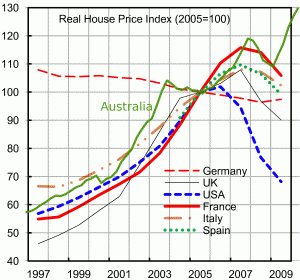
House prices are grossly overvalued
...

Australian prices matched some of the other country's bubbles until 2008. But while the real estate process elsewhere has been deflating, the Australian prices marched higher after a brief respite:
...

...

What may "pop" the bubble
The Australian real estate bubble has run longer and deeper than recent property bubbles in the USA, Ireland, and Spain. Heavily indebted Australian consumers, just like those in America, have a large portion of personal wealth tied-up in real estate. The price correction has not yet run its course (the mortgage defaults hover around 2%). When it does, it will certainly plunge the Australian economy into a severe recession.

Australian Banking System
Australia has four major banks: The Commonwealth Bank of Australia (CBA), The Australian New Zealand Banking Corporation (ANZ), The National Australia Bank (NAB) and Westpac (WBC in Australia, WBK ADR in USA). While all of these banks are international, the vast majority of their lending and assets are in Australia, with 86% share of all domestic lending in 2012.

Reality:
The banks look well-capitalized today but they heavily rely on a wholesale market (i.e. they issue bonds sold to foreign investors). There isn't enough deposit money from indebted Australians to cover all loans. While everything seems stable today, the foreigners may dump Australian bonds in a panic just like they did with Italian and Spanish bonds, pushing the yields up to prohibitive levels. The Australian banks will look healthy when the economy is good, but they are subject to a large "tail" risk if Australia stumbles, as the capital flow will dry up at the worst possible time.

Interest rates/currency conundrum
Australian currency is strongly correlated with the commodity prices and the health of the emerging markets (the exact opposite of the USA and Japan). Should emerging markets slow down (especially China), the Australian dollar will quickly depreciate.

Australia, which heavily relies on imports of most manufactured goods, will find itself with a sudden inflation problem. It may be unable to introduce a zero interest rate policy (ZIRP) to re-flate local asset prices and save its banks.

How the banks may fail
Australian banks seem safe today sporting low default rates, high ratings from credit agencies, and strong capital adequacy ratios. They will remain safe as long as the Australian economy keeps expanding and real estate prices remain stable. However, once the music stops, I expect a "perfect storm": loan defaults will spike, funding will disappear, but interest rates will still stay high.

Epilogue
The Australian economy seems to be doing well today: the external debt is small, the unemployment is low, and the currency is strong. Yet, in many ways, it's very similar to the US economy in 2007 where much of the economic "wealth" was created by real estate boom and over-leveraged banks. Australia is likely to face its own "Great Recession" in the upcoming years, perhaps when commodity exports slow down. In many ways, this recession may be worse than the American one of 2008, as Australia neither enjoys the benefit of "reserve currency" that would allow it to easily "print" money nor a strong manufacturing base that would benefit from a currency devaluation.

Link -
http://seekingalpha.com/article/394831-an-epic-australian-bust?source=email_macr...
==================================
A few observations -
1) There is more to the article.
2) I may not agree with all of the assertions, but there is enough there to give reason to pause & have some serious considerations!
3) Certainly the Global situation (including the USA, Europe & China), has a long way to run and that will continue to bear down on OZ, for many years.

Back to top
 
 
IP Logged
 
perceptions_now
Gold Member
*****
Offline


Australian Politics

Posts: 11694
Perth  WA
Gender: male
Re: For the Record
Reply #658 - Mar 1st, 2012 at 12:17pm
 
Construction sector reels as sales of new homes tumble


NEW home sales in Victoria have collapsed, compounding the State Government's woes as it battles heavy job losses and a slowing stream of tax income.

Sales of new houses tumbled almost 20 per cent in January compared with the previous month and are floundering well below their levels a year ago, according to research released yesterday.

Economists said the figures provided fresh evidence that despite consecutive interest rate cuts late last year, would-be home buyers remain reluctant to enter the property market.

The Victorian market pulled the rug from beneath the national house-building industry, with sales across the country diving 7.3 per cent to their lowest level in more than a decade.

Nationally, new home sales halved to less than 4000 in January, from more than 9000 a year earlier
, the Housing Industry Association report shows.

Association chief economist Harley Dale said: "Victoria for a long time propped up new home building in Australia and now the reverse is occurring.

There were also declines in detached house sales in NSW and South Australia in the first month of 2012, so the overall update is a weak one."

Mr Dale said the Reserve Bank's two rate cuts in November and December have not worked and the official cash rate should be lowered to 4 per cent to boost flagging household confidence.

He conceded the central bank board was likely to "sit on its hands" next week.

Official figures released yesterday revealed the decline in the construction industry was not just confined to new homes.

Australia Bureau of Statistics figures showed the value of construction work carried out in the December quarter fell 4.6 per cent - a steeper fall than economists had forecast.

The value of construction work had soared 11.7 per cent in the previous three months.

Treasurer Wayne Swan said the fall in construction work in the three months to December was not surprising given the record performance in the previous quarter.

HSBC Australia chief economist Paul Bloxham echoed the Treasurer's comments, saying "some retreat is not too surprising".

Link -
http://www.news.com.au/money/property/construction-sector-reels-as-sales-of-new-...
==================================
The comparison from January this year to January last year, is of particular interest.

But, as is often said, it's the trend that is important, so let's see what happens in the months to come?

That said, the government, any government & the RBA, may be caught on the horns of a Gordian Knot type dilemma, where they have little or no room to move.

However, I would venture a comment here and that is, could you imagine the repercussions, IF government/s were to go into a general AUS-terity program, as housing & the general Economy started to slip away?


Back to top
 
 
IP Logged
 
Ex Dame Pansi
Gold Member
*****
Offline


Australian Politics

Posts: 24168
Re: For the Record
Reply #659 - Mar 4th, 2012 at 1:26pm
 
Thanks for keeping us up to date perceptions. I'm not able to participate much at the moment but I read your posts and can see the train wreck emerging.
Back to top
 

"When the power of love overcomes the love of power, the world will know peace." Hendrix
andrei said: Great isn't it? Seeing boatloads of what is nothing more than human garbage turn up.....
 
IP Logged
 
Pages: 1 ... 42 43 44 45 46 ... 117
Send Topic Print