Forum

 
  Back to OzPolitic.com   Welcome, Guest. Please Login or Register
  Forum Home Album HelpSearch Recent Rules LoginRegister  
 

Pages: 1 ... 35 36 37 38 39 ... 117
Send Topic Print
For the Record (Read 224767 times)
perceptions_now
Gold Member
*****
Offline


Australian Politics

Posts: 11694
Perth  WA
Gender: male
Re: For the Record
Reply #540 - Nov 17th, 2011 at 8:40am
 
U.S. Stocks Fall as Fitch Says Europe a Risk to American Banks


U.S. stocks tumbled, erasing yesterday’s gains, as Fitch Ratings said further contagion from Europe’s debt crisis will pose a risk to American banks and amid concern higher oil prices will hamper economic growth.

The S&P 500 slid 1.7 percent to 1,236.91 at 4 p.m. New York time. The Dow Jones Industrial Average fell 190.57 points, or 1.6 percent, to 11,905.59. Oil rose above $100 a barrel.

“There may be more exposure to Europe out there than people really think even if banks think they are covered. It’s going to be a tough market for quite a while,” she said. “Increasing oil prices is a concern because it’s like a tax on the consumer.”

Financial Shares Tumble
Diversified financial companies slumped the most among 24 industries in the S&P 500, losing 3.9 percent as a group. Citigroup decreased 4.1 percent to $26.86. Morgan Stanley (MS) sank 8 percent to $14.66.

JPMorgan Chase & Co. (JPM) and Goldman Sachs Group Inc. (GS), among the world’s biggest traders of credit derivatives, disclosed to shareholders that they have sold protection on more than $5 trillion of debt globally. Just don’t ask them how much of that was issued by Greece, Italy, Ireland, Portugal and Spain, known as the GIIPS.

Link -
http://www.bloomberg.com/news/2011-11-16/u-s-stock-index-futures-slide-as-europe...
=============================================
A few observations -
1) The DOW lost some 200 points, in the last hour & a half of trading.
2) It seems that Energy (particularly Oil) costs are again rising, despite the US$ also rising.
When the linkage between rising Energy costs and Declining Energy Supply becomes APPARENT, then GFC Mk2 will have arrived.
3) It seems some sections of the media are trying for a better spin on European woes, with the Giips comment?
I would be more inclined to go for -


France
Ireland
Greece

Portugal
Italy
Germany
Spain  
Back to top
 
 
IP Logged
 
perceptions_now
Gold Member
*****
Offline


Australian Politics

Posts: 11694
Perth  WA
Gender: male
Re: For the Record
Reply #541 - Nov 19th, 2011 at 3:19pm
 
Payback Time - The Coming Decade Of Deleveraging


Having gorged on the fat pipe of cheap credit for much of the previous few decades, the last few years have rapidly and aggressively slapped the US (and indeed much of the world) from its stupor. All that growth, was it real? The speed of economic leveraging began to gain momentum in the early 1970s and accelerated sharply in the 1980s as the cost of debt began its decades-long decline. That leverage enabled consumption and capex to rise quicker and with less capital but obviously with more risk. With the current balance-sheet recession stymieing monetary policy and fiscal policy hardly supportive, it seems the private deleveraging hole will be difficult to fill with public borrowing excess. It seems that credit markets (the ubiquitous source of all that leverage) have again and again sung from a different song-sheet with regard to the way we escape from the inevitable deleveraging we are currently undertaking. Matt King, of Citigroup, provides a thought-provoking (and all-encompassing) slide-deck on the coming decade of deleveraging and how now is time for payback.

Payback Time: The Coming Decade Of Deleveraging


The current recovery in context...Fine in some respects, but something seems broken
...

Matt King - Citi Investment Research & Analysis

How Much Have We Borrowed? More debt in more sectors in more countries than ever before
...

Ways Of Deleveraging
Balancing Government's Books - Austerity works if offset by private leveraging
...

Growth - Lower, but above all, more volatile
...

Real Estate - Deleveraging + Older Populations = Downward Spiral
...

And In Conclusion...

Debt Needs To Fall...

Asset Prices Likely To Go With It...

and Fixed Returns Beat Uncertain Ones...

Deleveraging Is More Difficult Than You Think


Link -
http://www.zerohedge.com/news/payback-time-coming-decade-deleveraging
==============================================
The last chart on Demographics & Real Estate, will have repercussions last decades!
Back to top
 
 
IP Logged
 
perceptions_now
Gold Member
*****
Offline


Australian Politics

Posts: 11694
Perth  WA
Gender: male
Re: For the Record
Reply #542 - Nov 20th, 2011 at 3:31pm
 
U.S.: $15 Trillion In Debt And Rising


...
Very quietly yesterday the amount of total public debt currently outstanding exceeded $15 Trillion Dollars.
While that may or may not surprise some of you; it is an issue that we have been watching sneak up on us. As the "Super Committee" approaches their deadline for finding $1.2 Trillion in spending cuts over the next 10 years, or just $120 Billion in cuts annually, this becomes an even more pressing and important issue for the economy and the markets. Don't forget that the 20% sell off this past summer was sparked by the political warfare of raising the debt ceiling. That war could be set to rise again.

There are three things of importance to take away from this chart.
First, the rate of growth in debt has ramped up, not surprisingly, due to the onset of the second recession and financial crisis beginning under the Bush administration.

Secondly, while the CBO estimates a leveling off of debt growth beginning roughly today; the current run rate of debt growth will begin to accelerate if some measure of fiscal stabilization is not enacted.

Lastly, this analysis assumes that there will not be another recession or economic slowdown in the next four years which is hardly realistic. IF a recession or economic slowdown occurs these estimations rise sharply.

Which brings us to the main point. When the debt to GDP ratio of a country exceeds 90%, much less broaching 100% by year end, the drag on economic growth begins to rise sharply.

This is one of the main problems facing many of the smaller eurozone countries today which is that they are carrying so much debt that they do not have the ability to "grow" their way out of their debt problems. The U.S. has now also reached that level to where the total indebtedness is robbing future economic growth.

However, the situation is must worse than even these charts show as we are only discussing the total public debt outstanding which is most commonly focused on by the government, media and mainstream analysts. The government has much more indebtedness that is considered "off balance sheet" such as Social Security, Medicaid, Medicare, Fannie Mae, Freddie Mac and Student Loans which we only hope won't be a constituent to the next financial crisis lurking in the shadows.


...

As you can see the current run rate of debt growth the US will be running in excess of $19 Trillion in debt by the time President Obama ends his first term and will be pushing $30 Trillion in debt by the end of his second term should he be re-elected.

Here is the good news. This absolutely WILL NOT happen.

Here is the bad news: This won't happen because either the powers that be will begin to make the massive cuts necessary to reduce the debt growth or the bond market calls "the bluff."

In either event there WILL be another very nasty recession in our not so distant future.


For policy makers this is a time to set aside differences, stop working for your individual interests, shut out the lobbyists and start coming to the realization that the economy is in a debt deleveraging cycle.That requires an entirely different set of policy prescriptions than what has been relied on in the past.  
Cutting spending and reducing debt is critical but it must be done carefully.

Cutting spending arbitrarily will not only plunge the economy into a recession immediately but also exacerbate the situation far more than necessary.


For investors, there is a very dangerous cross-current of events running both above and below the surface.

The eurozone economy is already running at near recessionary levels and since the eurozone makes up 20% of the exports of the U.S. and 20% of the corporate profits; this doesn't bode well for a the economy or the markets in the coming quarters. Lay on top of this rising oil prices, high unemployment, stagnant wages, a depressed housing market and very depressed consumer sentiment and you have an environment that is fraught with economic and market risks.


Link -
http://seekingalpha.com/article/308932-u-s-15-trillion-in-debt-and-rising?ifp=0&...
===============================================
There is a lot more going on, than is generally thought!

Given the Macro factors (Demographics, Peak Energy, Peak Debt & Climate Change), which are in play, the likelihood is that both the USA & Europe are about to re-enter an "official" Recession, which will be deeper & longer than generally thought and that will greatly exacerbate the Local & Global Debt situation!

Arising from that, the "emerging Economies" will suffer due to a greatly reduced Demand for most forms of goods coming out of Europe & the USA and that will then flow thru to countries such as Australia, as the Demand for Natural Resources, including Iron ore & Energy sources such as Coal & Oil will Decline substantially!

I expect, by the end of next year, this trend will become apparent to most and Global equities will take another substantial tumble!!!  
Back to top
 
 
IP Logged
 
perceptions_now
Gold Member
*****
Offline


Australian Politics

Posts: 11694
Perth  WA
Gender: male
Re: For the Record
Reply #543 - Nov 22nd, 2011 at 8:31am
 
U.S. Stocks Decline on Outlook for Budget Talks


U.S. stocks slumped, giving the Standard & Poor’s 500 Index its longest decline since September, as concern grew that $1.2 trillion in automatic federal budget cuts will be triggered if lawmakers fail to reach a deal.

All 10 industries in the benchmark measure declined as 468 out of 500 companies retreated. Bank of America Corp. tumbled 5 percent to pace losses in financial shares.
Today is the deadline for the Congressional Budget Office to receive information for scoring a proposal in advance of the supercommittee’s Nov. 23 target date for reaching a deal. The 12-member bipartisan supercommittee likely will say it can’t reach deal on deficit savings, according to a Democratic aide.
The S&P 500 lost 1.9 percent to 1,192.98 at 4 p.m. New York time. The benchmark gauge has lost 5.2 percent in four days. The Dow Jones Industrial Average declined 248.85 points, or 2.1 percent, to 11,547.31 today as the supercommittee created to cut the deficit is poised to fail to reach a deal.

U.S. shares joined European equities in retreating. The Stoxx Europe 600 Index declined 3.2 percent, the most since Nov. 1. France’s rising financing costs are increasing the nation’s fiscal challenges, according to report issued by Moody’s Investors Service. Germany’s Finance Ministry said the country’s expansion is “noticeably slower” this quarter.

Link -
http://www.bloomberg.com/news/2011-11-20/u-s-stock-index-futures-decline-as-pros...
================================================
It would seem there isn't much chance of a Political agreement, on how to extricate the US from its Debt crisis and even if there were an agreement on this US$1.2 Trillion Debt reduction program, it would be too little, too late & there are too many other complications!

Btw, the overnight fall of US markets, means that the DOW has slumped by over 600 points, since its intra-day highs of 12,163, on November 15th.


http://chart.finance.yahoo.com/zs=%5eDJI&t=5d&q=l&l=on&z=l&a=v&p=s&lang=en-AU&region=AU

That said, Europe fared worse, with falls of 2.62% in the UK, 3.35% in Germany, 3.41% in France, 3.48% in Spain & 4.74% in Italy.
http://www.forexpros.com/indices/world-indices
Back to top
 
 
IP Logged
 
perceptions_now
Gold Member
*****
Offline


Australian Politics

Posts: 11694
Perth  WA
Gender: male
Re: For the Record
Reply #544 - Nov 23rd, 2011 at 1:05pm
 
Monday Madness: Hard Times Ahead, Says Spain's Rajoy


Hard times ahead!

Mariano Rajoy won the biggest majority in a Spanish election in almost 30 years, and told Spaniards to brace for hard times as the nation fights to avoid being overwhelmed by the debt crisis.

Rajoy’s People’s Party swept the ruling Socialists from power after eight years, winning 186 of the 350 seats in parliament, compared with 110 for the Socialists’ candidate Alfredo Perez Rubalcaba.

“Hard times lie ahead,” Rajoy, 56, told supporters outside the PP’s headquarters in Madrid, giving no new details of his plans. “We are going to govern in the most delicate situation Spain has faced in 30 years.”

Spanish borrowing costs continued rising toward euro-era records (6.6% this morning) even as the PP won a mandate to slash the budget deficit, overhaul the stagnant economy and reduce the 23% jobless rate.

Rajoy, who hasn’t given details of his proposals, won’t take over for a month, prompting him to say on Nov 18th he hoped Spain wouldn’t need a bailout before he’s sworn in.

So NO QUICK FIX IN SPAIN IS POSSIBLE - let's face that fact now so we're not endlessly surprised by it as the rumor-mongers can now have a field day attacking the lame-duck outgoing government ahead of the transition. Meanwhile, our own do-nothing Congress looks to be heading toward certain disaster as we have what appears to be a TOTAL FAILURE of the U.S. Deficit Reduction Committee to do anything to actually reduce our deficit.

Let's just say "they" couldn't agree, so now it's going to be Hard Times for America as we, in theory, will kick in $1.2Tn of automatic cuts including (gasp!) over 5% of our nation's trillion-dollar annual Defense budget. Oh, not until 2013, of course because our government doesn't really have the balls to cut anything under any circumstances.

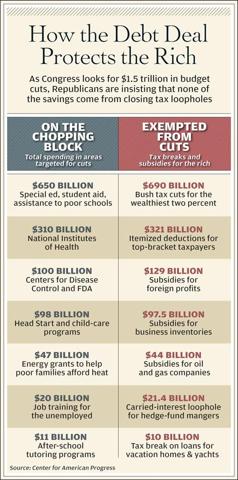
EXCEPT, of course, aid to the poor. THAT they can cut and cut and cut and cut. Payroll tax cuts - terminated. Unemployment extensions - terminated. U.S. AAA rating - terminated ...
...

...

I am not bearish because I think that 11,600 is about the "right" price for the Dow, given the exact same global situation we observed back in July. I thought 12,750 was too high and, when we fell all the way to 10,605, I thought that was too low and we initiated our September's Dozen Buy List on August 27th with 13 (baker's dozen) very aggressive, bullish trade ideas that, of course, had spectacular outcomes for our members as we mostly cashed out on October 27th - another great top call!

Now we're back to cash and we'd LOVE to see another panic sell-off to give us another good round of buying opportunities but I'm not sure we'll get it because there is really nothing going on today that wasn't already obvious to us in July - including the U.S. being unable to fund its own deficit spending - all of this has now been long discussed and no longer has the power to shock the markets like it did in the summer.

So cashy and cautious is how we're playing the space under our must hold lines - especially ahead of the long holiday weekend. We'll take another look at things next Monday but this is a week to kick back and relax.

Link -
http://seekingalpha.com/article/309291-monday-madness-hard-times-ahead-says-spai...
==============================================
I'm not sure, but if you click onto "Hard times ahead!", at the top of this article, I think the band may be suggesting that "Hard times" MAY be ahead?

But, I do wish they were MORE EXPLICIT?

Fun & frivolity aside, there is not way that the Spanish or anyone else, is going to slash budget deficits, overhaul the economy and reduce the unemployment rate, at the same time.

The thing is, unless the burdens are shared equally, then the pain & the duration, could be much greater, than even TPTB may be contemplating?

Finally, I'm not sure about timing, but all equity markets are very likely to go a lot lower, than their current levels, before the end of 2012.


Btw, OZ All Ords currently down 57, at 4147 & DOW Futures currently down 110,at 11337.

Back to top
« Last Edit: Nov 23rd, 2011 at 1:13pm by perceptions_now »  
 
IP Logged
 
perceptions_now
Gold Member
*****
Offline


Australian Politics

Posts: 11694
Perth  WA
Gender: male
Re: For the Record
Reply #545 - Nov 23rd, 2011 at 7:56pm
 
Australian sharemarket ends sharply lower after weak China manufacturing data


AUSTRALIAN shares ended with sharp losses after a preliminary Chinese manufacturing survey fell into contractionary territory, adding to concerns about the future trajectory of global economic growth.

The S&P/ASX 200 index ended the day with a 1.98 per cent loss  to close at 4051, marking the fourth straight session of losses for a market that is trading back at levels last seen in early October. The broader All Ordinaries index fell 78.4 points (1.86 per cent) to 4125.8.

HSBC issued the preliminary “flash” version of its monthly manufacturing purchasing managers index survey, which is a closely watched non-government view on how China’s economy is faring.

The survey fell to a reading of 48 for November, compared to a 51 last month. A reading of 50 separates expansion from contraction.

"It’s not a great number,” said Michael Turner, strategist at RBC Capital Markets.

"China is really a key part of the global growth mix for next year...if China starts to show signs of weakness then you have to question where the growth is going to come from,” he said.

Oil, copper and platinum futures all lost ground in electronic trading following the Chinese data.

“It’s quite clear [that the debt crisis] is starting to emit to European growth – which is starting to fade somewhat,” said Stephen Roberts, economist at Nomura. “Obviously there’s concern that [Europe] limits global growth,” he added.

The US Commerce Department yesterday cut its estimate of gross domestic product to 2 per cent from an earlier estimate of 2.5 per cent. Economists surveyed by MarketWatch had been expecting a reading of 2.3 per cent and US stocks ended the day with moderate losses.

Link -
http://www.theaustralian.com.au/business/markets/australian-stocks-edge-lower-ah...
===============================================
All of which says that there are a number of issues pending, which can & will, impact on the Australian Economy and a slowing Chinese Economy is one of those factors, but it is only one of many!
Back to top
 
 
IP Logged
 
perceptions_now
Gold Member
*****
Offline


Australian Politics

Posts: 11694
Perth  WA
Gender: male
Re: For the Record
Reply #546 - Nov 24th, 2011 at 8:27am
 
Germany’s Auction ‘Disaster’ Stirs Crisis Concern


Germany failed to get bids for 35 percent of the 10-year bonds offered for sale today, propelling borrowing costs in Europe higher and the euro lower on concern the region’s debt crisis is driving away investors.

“This auction is nothing short of a disaster for Germany,”
Mark Grant, a managing director at Southwest Securities Inc. in Fort Lauderdale, Florida, said by e-mail. “If the strongest nation in Europe has this kind of difficulty raising capital, one shudders concerning the upcoming auctions in other European nations.”

Turmoil that began more than two years ago in Greece and snared Ireland, Portugal, Italy and Spain has closed in on France and now risks engulfing Germany, the region’s biggest economy.

Economic Shocks
France will have difficulty absorbing further large economic shocks without putting its top credit rating at risk, Fitch Ratings said today.

Link -
http://www.bloomberg.com/news/2011-11-23/germany-fails-to-receive-bids-for-35-of...
=============================================
As money continues chasing its own tail, it will eventually disappear, up its own ass, which was again reflected in the DOW (down 236 points)  & other European bourses overnight!

http://chart.finance.yahoo.com/zs=%5eDJI&t=1d&q=l&l=on&z=l&a=v&p=s&lang=en-AU&region=AU

http://www.forexpros.com/indices/world-indices
Back to top
 
 
IP Logged
 
perceptions_now
Gold Member
*****
Offline


Australian Politics

Posts: 11694
Perth  WA
Gender: male
Re: For the Record
Reply #547 - Nov 26th, 2011 at 8:22am
 
Biggs Cuts Bullish Stock Bets on Recession Risk

Barton Biggs, managing partner and co-founder of Traxis Partners LP, talks about the U.S. stock market and recession risk. Biggs, speaking with Betty Liu on Bloomberg Television's "In the Loop," also discusses investment strategy and the congressional deficit-reduction supercommittee

http://www.bloomberg.com/video/80865706/
=======================================

Stiglitz Sees Significant Risk of Europe Recession

Nobel Prize winner Joseph Stiglitz talks about the risk of a recession in Europe and fiscal policy. He speaks from Helsinki with Francine Lacqua on Bloomberg Television's "Countdown."

http://www.bloomberg.com/video/81345378/
========================
2012 May See the 'Death of Europe,' Says Shugg

James Shugg, a senior economist at Westpac Banking Corp., talks about the outlook for the euro zone in 2012 and the role of the European Central Bank in backing indebted nations.

http://www.bloomberg.com/video/81442070/
===================================
U.K. Teetering on Brink of Recession, Says Barclays

Simon Hayes, chief U.K. economist at Barclays Capital, talks about the possibility of a recession in Britain.

http://www.bloomberg.com/video/81538748/
=======================================
Take your pick of the embedded videos!


Overnight, after being up a hundred points, in a short trading day, the DOW again lost steam towards the end and finished down 25!

11,231.94  
Down 25.61

http://chart.finance.yahoo.com/zs=%5eDJI&t=1d&q=&l=&z=l&a=v&p=s&lang=en-AU&region=AU
Back to top
 
 
IP Logged
 
perceptions_now
Gold Member
*****
Offline


Australian Politics

Posts: 11694
Perth  WA
Gender: male
Re: For the Record
Reply #548 - Nov 27th, 2011 at 3:29pm
 
House prices at risk from Europe crisis


As outgoing Commonwealth Bank chief Ralph Norris has told BusinessDay, the sovereign debt crisis in Europe is threatening to descend into a fully-fledged credit crisis where banks stop lending to each other.

The implications of another meltdown in credit markets are dire. Roughly a third of the funding for Australian mortgages comes from overseas bond markets. Were a third of the big banks' sources of capital to suddenly dry up so would credit for housing markets here. Ergo, price drops.

This is the government's greatest fear, that the great Aussie dream becomes a nightmare.

This credit market squeeze is, as they say, the worst case scenario - and one which was narrowly averted in 2008 at the time of the Lehman Brothers collapse and the Wall Street bailout.

Then, the US banks were way over-geared. Now it is the European banks; with their leverage of 25-times only a modest fall in asset prices renders them technically insolvent. Many say a large swathe of them are already insolvent.

Most are not in a position to lend - especially since their sovereign governments are battling to raise money themselves on bond markets. What chance does an Australian bank have of selling bits of paper (bonds) to investors if the government of Germany itself failed to get a bond issue away this week?

Euro zone rescue
The consensus on markets is that this encroaching credit crisis Mark II won't be averted until European leaders get their act together with a rescue plan for the euro zone, or commit US-style to printing trillions of dollars in new money.

Germany, with its haunting memories of the Weimar Republic, rampant inflation and the rise of fascism, is holding off on the printing-press option.

Lest mortgage holders here fear a credit squeeze, and consequently falling house prices if conditions sharply deteriorate, there is also impending relief.

If banks do continue to lend to each other, and Europe gets its act together, rates should fall.

Downbeat view
The upbeat outlook for interest rates is squarely and proportionately due to the downbeat outlook for world markets.

There are few better indicators of the health and direction of the global economy than the Australian dollar. The Aussie dollar is a proxy for China, for global growth, for optimism itself, and it is now changing hands at 97.35 US cents, down 12 per cent from its July highs.

As the crisis in Europe deepened this week, and the deadlock over the US debt reduction plans remained unresolved, further economic releases from China spurred concerns that economic growth was slowing there as well (while fears flared anew over property price falls).

Vice-Premier Wang Qishan was quoted by China's official news agency Xinhua that global recession was a certainty. "The one thing that we can be certain of, among all the uncertainties, is that the global economic recession caused by the international financial crisis will be chronic".

Poll: How will house prices change over the next 12 months?

Fall by 10% or more     44%
Fall by 0-10%     26%

Little changed     21%
Rise by 0-10%     4%
Rise by 10% or more     5%

Total votes: 15913
Poll closed 27 Nov, 2011

Link -
http://www.smh.com.au/business/property/house-prices-at-risk-from-europe-crisis-...
==============================================
A few observations -
1) The Germans would be correct, if they are thinking that the "printing press" option would lead to rampant inflation.
It would also lead to an unmitigated Global Economic disaster!
2) It seems from the Housing Poll that the Public MAY be catching on, that there is change in the wind?  


Back to top
 
 
IP Logged
 
perceptions_now
Gold Member
*****
Offline


Australian Politics

Posts: 11694
Perth  WA
Gender: male
Re: For the Record
Reply #549 - Nov 28th, 2011 at 11:28am
 
The Economy Is In Jeopardy


The economy is at one of those crossroads where something is going to happen. Whether that will be a positive or a negative is often difficult to tell because at any time one of those "Black Swans" could land in our midst and change everything. Plans are fluid and and forecasting can be quixotic. That said I believe that we are at a critical point and the U.S. economy is heading for a fall.

Industrial production is continuing a flat to declining trend that has been going on since Q2 2010. Manufacturing has shown recent growth but it mirrors the negative to flat trend.

Prices are starting to decline both at the producer and consumer level. Oil prices are likely to decline as worldwide economic activity slows. But, as we know, political shocks from producers can alter this forecast dramatically.

Retail sales, adjusted for price inflation continue to be flat to declining.

Credit conditions are still tight at the consumer level, and business credit still suffers from lack of demand.

Exports have been a primary driver of the economy and have rebounded substantially post-Crash as a result of a devalued dollar.

European economic problems have caused a significant influx of money into the U.S. and that has been parked in Treasurys.

Unemployment is high. At 9% there are 13.9 million unemployed, while the broader measure of unemployed (U-6) is 25 million. While unemployment has been dropping at a snail's pace, jobs are not being created at a sufficient rate to substantially reduce unemployment.

Real disposable income is falling.

Personal savings have fallen from a post-Crash high of 5.8% in June, 2010, to 3.6% as of Sept., 2011 because consumers are using savings to fund consumption.

GDP is static rather than growing and the latest Q3 boost will likely not continue.

Auto sales are related to pent-up demand and are not likely to be sustained.

The top 5% of earners account for 37% of all consumer spending and it they who are supporting consumer spending. There is no broad based consumer spending rally.

Household debt ($13.9 trillion) is still historically very high and has not been substantially reduced.

U.S. sovereign debt is 100% of GDP ($15 trillion and growing).

All government spending (federal, state, and local) comprises 45.6% of GDP.

The euro crisis will have a substantial impact on the rest of the world, including the U.S. According to recent data, the world is heading into recession in almost all economies.

The federal government is currently running a $1.3 trillion annual deficit.

Unfunded liabilities for Social Security, Medicare, and prescription drug (Part D) are $116.4 trillion and growing. This does not include the pending problem with student loans (Sallie Mae) or obligations to GSEs.

The MF Global problem is indicative of a declining economy. In a declining economy, company weaknesses tend to be revealed, as with Lehman.

Oil price have risen from $40 bbl post Crash to $110 bbl in April, 2011, and presently are at $97 bbl. Such oil price increases are associated with and often presage recessions.

Bank balance sheets are still weak because they do not book asset values at market,
they seems to not properly book troubled loans, and they are encumbered by a substantial amount of malinvested assets that have not been liquidated.

47 million Americans (15%) are on Food Stamps. 48.5% of the population lived in a household that received some type of government benefit in the first quarter of 2010.

Americans' are pessimistic about their future and the future of America according to almost all recent polls.

An angry and disaffected population in America is potentially politically dangerous.

What is important when looking at the data is to spot trends rather than specific numbers. I have what I believe is a healthy skepticism about the reports from the multitude of federal agencies that I follow on a regular basis. They are often revised and probably understate the negatives. That is especially so with price inflation.

Crossroads Always Are Difficult
We are at a crossroad because with the world sliding into recession/depression, with the U.S. economy living off of exports, with a high level of unliquidated malinvestment, with a dearth of productive capital, and with money supply set to decrease, we are headed for economic decline which will impact the U.S. economy by Q2-2012 at the latest.

Outcomes
Recent indicators show that most major economies are slowing down, perhaps heading into recession.

The EU is in crisis and weak governments threaten to jeopardize the EMU and the euro. The remedies proposed by the eurozone require bankrupt states to cut spending and increase taxes. This will create economic disruption and economic decline in the countries being bailed out. Greece may withdraw from the EMU.

If the EMU chooses to inflate (print money through sovereign debt monetization), the euro will continue to decline as the result of price inflation. But, it is likely that will only temporarily relieve the pressure on bankrupt countries and their creditors.

Back to top
 
 
IP Logged
 
perceptions_now
Gold Member
*****
Offline


Australian Politics

Posts: 11694
Perth  WA
Gender: male
Re: For the Record
Reply #550 - Nov 28th, 2011 at 11:28am
 
The Economy Is In Jeopardy (Cont)


U.S. exporters will face declining sales as a result of economic slowdowns in their markets. Pressures on the euro may give the dollar a temporary boost.

The U.S. economy will decline and we will see this not later than Q2-2012.

U.S. unemployment will increase.

The Fed will engage in QE3 as a result of political pressure on them to act.

The Fed may charge interest on excess reserves to encourage banks to lend. This policy will not create loan demand.

QE3 is likely to kick off another round of euphoria in the financial markets, but this time corporate earnings will not be found to support price levels. The euphoria will be short-lived.

U.S. savings will decline as consumers turn to savings to fund their living expenses.

U.S. banks will accelerate write-downs of CRE debt.

Housing will continue to decline in the most vulnerable markets and will remain stagnant in other markets.

At best, the economy will stagnate as monetary inflation continues to destroy real capital.


If there are successive rounds of QE, each round will be less effective as more real capital is destroyed, but it will result in price inflation.

New And Old Dangers
As this never-ending business cycle drags on (we are in the fourth year of this recession), there are further dangers at this stage of the cycle. These issues involve political as well as economic considerations. It will require US all to do more critical thinking about the long term preservation of our wealth and the future of our society.

1. As things get worse, the Fed will yield to the demands of politicians to do something, and since they have run out of arrows in their policy quiver, they will do what all central banks do best: print money by more QE.

Assuming that unemployment rises to levels that will panic politicians (say, 12%), we can expect the Fed to do far more monetary expansion than Chairman Bernanke hints at. In a panic, they will always "print" money.

This raises the specter of high price inflation and even hyperinflation.

2. Fiscal stimulus will not be a viable policy tool in the near term whether or not the Republicans win the presidency. However, I am cynical enough to believe that in an environment where unemployment grows to much higher levels, that even the Republicans will "do something" which will probably be futile massive spending on infrastructure as in Japan.

3. U.S. national debt is unacceptably high and with governments' current share of economic activity at 45.6% of GDP, this will act as a further brake on the economy. This is known as the Rahn Curve principle, where after a certain point it discourages investment and growth by the private sector. I believe we are at that point or close to it.

The Rahn Curve aside, the weaker the economy becomes, and as debt remains high, the cost of funding our federal debt service may double as our credit rating is dinged.

4. The European crisis is not just a European crisis, it's a worldwide crisis because a collapse of the European Monetary Union would cause financial chaos. Declining output in most EU countries will act as an accelerant of the problem because the bailouts are based on economic growth which would allow the bailed countries to meet certain fiscal targets. We may liken their banking crisis to the 2008 Crash that emanated from the U.S. and spread to the rest of the world. This is an unknown quantity at this time. Will the ECB print or not? Will the Germans keep banging their fiscal responsibility drum and oppose the ECB's purchase of members' sovereign debt? If they don't print, then there is a good possibility that countries other than Greece will fail and the European banking system will be put in jeopardy. Printing is not a fix but it will put the problem off for a while.

5. Political dissatisfaction is high. This is not uncommon in times of economic stress. But there are fundamental changes in attitudes about the role of government in society.

People now believe that government can solve their problems but that partisan bickering is preventing politicians from achieving a "solution." That is quite different than saying government doesn't work and it is the cause of our problems.

Note:
Official price indices are in my opinion not accurate reflections of what prices are in the economy. There are other indices that may be more realistic and match consumers' every day experiences. I like Shadowstats.

Links -
http://seekingalpha.com/article/309918-the-economy-is-in-jeopardy-part-1?ifp=0&s...

http://seekingalpha.com/article/309920-the-economy-is-in-jeopardy-part-2?ifp=0&s...
=========================================
There is a lot more in this article and I reccommend it!

As usual, there are a number of issues raised, where I agree, but some where I disagree.

In fact, there will always be agreement & disagreement over Political, Economic and almost all other issues.

That said, in respect of Economics, Personal, National & Global, my aim is to provide information, which in the main will present alternatives to the main stream media & Politics.

By doing so, my hope is that you will be forearmed with sufficient knowledge, to enable YOU to make your own value judgements, on what is likely and what is best for you & your future!

Good luck & watch the Debt!
Back to top
 
 
IP Logged
 
perceptions_now
Gold Member
*****
Offline


Australian Politics

Posts: 11694
Perth  WA
Gender: male
Re: For the Record
Reply #551 - Nov 28th, 2011 at 11:57am
 
Futures rise in electronic trade on Europe hopes


NEW YORK (Reuters) - U.S. stock futures jumped in early electronic trading on Sunday on the latest round of proposals out of Europe designed to corral the growing euro zone debt crisis.

U.S. stocks suffered their worst week in two months last week. The lack of a credible solution to Europe's debt crisis kept investors away from risky assets and downgrades of Belgium and Hungary added to the gloom.

Germany and France are exploring radical ways to integrate euro zone countries in order to impose tighter budget control. In addition, media reports that the International Monetary Fund was preparing a rescue plan for Italy bolstered sentiment.

S&P 500 futures rose 21 points. Dow Jones industrial average futures gained 146 points, and Nasdaq 100 futures were up 26 points.

The U.S. market's seven-day losing streak attracted early short-covering as Asian markets traded higher and the euro rebounded from recent losses. But recent rallies on hopes for a solution have not lasted long.

Last week, the S&P 500 fell 4.7 percent, giving back almost two-thirds of its gains in October, the market's best month in 20 years. The Dow was off 4.8 percent for the week and the Nasdaq fell 5.1 percent.

Link -
http://finance.yahoo.com/news/Futures-rise-electronic-trade-rb-803420598.html?x=...
=========================================
Another bout of buy on the rumour, sell on the fact!

That said, DOW Futures currently UP 186.
http://www.forexpros.com/indices/us-30-futures-advanced-chart

And, the All Ords UP 76.
http://chart.finance.yahoo.com/zs=%5eAORD&t=1d&q=l&l=on&z=l&a=v&p=s&lang=en-AU&region=AU
Back to top
 
 
IP Logged
 
perceptions_now
Gold Member
*****
Offline


Australian Politics

Posts: 11694
Perth  WA
Gender: male
Re: For the Record
Reply #552 - Nov 28th, 2011 at 6:50pm
 
The Fable of the Porcupine


It was the coldest winter in anyone’s memory, and one animal after another perished in the icy weather. The porcupines saw this and decided the only way they would survive is if they grouped together to share their warmth. Only trouble was, the quills of one porcupine wounded the one next to it, and that one hurt the one next to it, and so on and so on. They stayed warm, all right, but the pain they suffered was just too great. After awhile they edged away to shiver alone. But one by one, they froze to death.

Even porcupines could see that was never going to do. The only way to keep from disappearing from the earth was to move back together and put up with their neighbors’ painful quills. And that’s what they did.

So the porcupines learned to live with the little wounds caused by close relationships between companions. Even more important, they learned the gift of lifegiving heat that comes from being together.


The moral of the story: The best relationship is not the one that brings perfect people together. It is when each individual learns to live with the imperfections of others and can admire the other person’s good qualities.

http://kaystrom.files.wordpress.com/2010/11/baby-porcupine-31.jpgw=300&h=225

Link -
http://www.kaystrom.com/blog/the-fable-of-the-porcupine-2
==========================================
The real moral of this story, is that we either learn to live with each other OR we won't?
Back to top
 
 
IP Logged
 
perceptions_now
Gold Member
*****
Offline


Australian Politics

Posts: 11694
Perth  WA
Gender: male
Re: For the Record
Reply #553 - Nov 30th, 2011 at 11:21pm
 
Somethin goin on?


DOW Futures have jumped, from down 50, to UP 260, in a very short time.
http://www.forexpros.com/indices/us-30-futures-advanced-chart


Back to top
 
 
IP Logged
 
perceptions_now
Gold Member
*****
Offline


Australian Politics

Posts: 11694
Perth  WA
Gender: male
Re: For the Record
Reply #554 - Dec 1st, 2011 at 9:55am
 
perceptions_now wrote on Nov 30th, 2011 at 11:21pm:
Somethin goin on?


DOW Futures have jumped, from down 50, to UP 260, in a very short time.
http://www.forexpros.com/indices/us-30-futures-advanced-chart


And, the result is -

DOW - 12,045.68  
Up 490.05 (4.24%)

http://chart.finance.yahoo.com/zs=%5eDJI&t=1d&q=&l=&z=l&a=v&p=s&lang=en-AU&region=AU


All ords - 4,296.60  
Up 111.90 (2.67%)
 

http://chart.finance.yahoo.com/zs=%5eAORD&t=1d&q=l&l=on&z=l&a=v&p=s&lang=en-AU&region=AU

On the updated interactive, the All Ords is actually up now, by 98.
http://www.google.com/finance?q=INDEXASX:XAO

And, the reason -

Global central banks jointly act to stem Europe crisis

THE world's major central banks launched a joint action to provide cheap, emergency US dollar loans to banks in Europe and elsewhere, a sign of growing alarm among policy makers about stresses in Europe and in the global financial system.

The coordinated action doesn't directly address Europe's government debt and budget woes. Instead, it is aimed at alleviating the impact of those troubles on global markets. Moreover, it raises the prospect of other steps by central bankers to prevent a repeat of the 2008 financial crisis.

"The purpose of these actions is to ease strains in financial markets and thereby mitigate the effects of such strains on the supply of credit to households and businesses and so help foster economic activity," said a statement issued by the six central banks -- the US Federal Reserve, the Bank of Canada, the Bank of England, the Bank of Japan, the European Central Bank and the Swiss National Bank.


Link -
http://www.theaustralian.com.au/business/wall-street-journal/global-central-bank...
=============================================
A few observations -
1) The net effect here is that the Public get  Aus-terity measures, whilst the Banks & TPTB get bailed out!

2) These measures, again, can only serve to "kick the can", a little further down the road, they can not "solve" the underlying problems, which are -
a) Population - Aging & slowing growth.
b) Peak Energy - Slowing Production Growth & Rising Prices.
c) Peak Debt - Debt is already too high, but both Keynesian & Austrian "fixes", will send it higher.
d) Climate Change - Lowering Food Production & increasing adverse weather events.
Back to top
 
 
IP Logged
 
Pages: 1 ... 35 36 37 38 39 ... 117
Send Topic Print