Forum

 
  Back to OzPolitic.com   Welcome, Guest. Please Login or Register
  Forum Home Album HelpSearch Recent Rules LoginRegister  
 

Page Index Toggle Pages: 1
Send Topic Print
Fuel from the air (Read 2174 times)
juliar
Gold Member
*****
Offline


Australian Politics

Posts: 22966
Fuel from the air
May 16th, 2019 at 10:25am
 
Those horrible pollution belching and spewing basically useless electric toy cars will be stacked up in the junk yards.


...
Dangerous unsafe pollution belching Tesla S will spew choking pollution no more.


Could cars and air conditioners harvest fuel from thin air?
Nadine Cranenburgh by Nadine Cranenburgh   May 14, 2019  in Energy  3 min read

...
harvesting carbon from the air with air conditioners

Researchers and startups are working out how petrol-fuelled vehicles and air conditioners can suck carbon dioxide out of the air to produce fuel.

Last year, petrol-fuelled transport emitted 102 million tonnes of carbon dioxide in Australia, prompting calls for more electric- or hydrogen-powered alternatives.

A tech startup in Silicon Valley is working on a way to keep petrol as part of the fuel-mix of the future by sourcing it from atmospheric carbon in order to offset emissions.

The startup is named for Prometheus, the Titan from Greek mythology who gave humans the gift of fire. According to founder and CEO Rob McGinnis, Prometheus is developing a machine that will trap and convert more carbon from the surrounding air into fuel for a car, achieving carbon neutrality.


McGinnis drives a VW Golf, which he eventually hopes to fuel with his air-sourced petrol.

“I used to drive a Tesla Roadster, but now I’m making gasoline cool again,” he told Bloomberg.

Can we fuel cars with thin air?
McGinnis is not lacking in creativity and lateral thinking. While studying for a Bachelor of Arts in theatre, he invented an ammonia-carbon dioxide forward osmosis desalination process. This led to a PhD in environmental engineering and the establishment of his first startup, Oasys Water.

His second startup, Mattershift, used carbon nanotubes to separate chemicals into their molecular components. Because the nanotubes allowed carbon to be separated in liquid form, McGinnis’ method undercut the cost of other separation technologies.

McGinnis’ six-foot tall carbon-to-fuel machine, which will use carbon nanotubes to perform its magic, was displayed at venture capital investor Y Combinator’s demo-day in March. The inventor told Bloomberg that it had not yet achieved the task of producing petrol from atmospheric carbon, as it had only been completed in the days before this unveiling.

But McGinnis’ machine impressed Y Combinator enough to attract seed funding as part of a push to remove carbon from the air and convert it to other products.

“[These projects] might seem like moonshots now, but our goal is to try to come up with technically feasible solutions at realistic costs,” said Y Combinator CEO Sam Altman in a blog post.

Carbon neutral cooling
Researchers at Canada’s University of Toronto are also looking at how to produce fuel from atmospheric carbon and allow us to keep cool in rising temperatures without adding to the greenhouse gas emissions that are causing the issue.

In a paper recently published in Nature Communications, Professors Roland Dittmeyer and Geoffrey Ozin propose that air conditioning units could be retrofitted with devices that convert carbon dioxide from the air into synthetic fuel.

The oil produced could then be stored in private ‘oil wells’ to be used by the owner, and any excess sold to a new ‘renewable oil grid’.

“If our vision of fuel-generating air conditioning systems were to be applied at a global scale, it could enable the production and sale of synthetic fuels through an equitable distributed social scheme similar to the generation of renewable electricity from household solar panels,” Ozin said in a statement.

Carbon capture technologies won’t remove the need to reduce our reliance on fossil fuels, but removing carbon from the atmosphere has been flagged by the United Nations Intergovernmental Panel on Climate Change as having “considerable” potential to reduce greenhouse gas emissions and reduce global warming.

While McGinnis and Ozin are in the early stages of developing their carbon-busting ideas, their innovative spirit could be a step in the right direction.

https://www.createdigital.org.au/cars-air-conditioners-harvest-fuel-thin-air/
Back to top
 
 
IP Logged
 
Prime Minister for Canyons
Gold Member
*****
Offline


Australian Politics

Posts: 26906
Canberra
Gender: male
Re: Fuel from the air
Reply #1 - May 16th, 2019 at 10:33am
 
Great article but ruined by the unnecessary tesla reference.
Back to top
 

In a time of universal deceit — telling the truth is a revolutionary act.

No evidence whatsoever it can be attributed to George Orwell or Eric Arthur Blair (in fact the same guy)
 
IP Logged
 
juliar
Gold Member
*****
Offline


Australian Politics

Posts: 22966
Re: Fuel from the air
Reply #2 - May 16th, 2019 at 10:57am
 
Oh BH don't tell me you are NOT a Tesla Fan Boy and believe Teslas are the answer to everything ?


But the Tesla Fan Boys and Girls need to realize Teslas can crash and maim and kill.

...
Wa this Tesla SUV trying to flap its wings and fly over the object it crashed into ? A special feature of the autopilot ?

Back to top
 
 
IP Logged
 
Prime Minister for Canyons
Gold Member
*****
Offline


Australian Politics

Posts: 26906
Canberra
Gender: male
Re: Fuel from the air
Reply #3 - May 16th, 2019 at 11:03am
 
Who honestly thinks Teslas are the answer to everything?


Any car can maim and kill.

Back to top
 

In a time of universal deceit — telling the truth is a revolutionary act.

No evidence whatsoever it can be attributed to George Orwell or Eric Arthur Blair (in fact the same guy)
 
IP Logged
 
Prime Minister for Canyons
Gold Member
*****
Offline


Australian Politics

Posts: 26906
Canberra
Gender: male
Re: Fuel from the air
Reply #4 - May 16th, 2019 at 11:05am
 
But what I'm trying to poiint out is that for once you've posted an interesting and scientifically relevant artidle, which if it is feasible would be fantastic for Australia given our use of air cons. There is zero need to chuck in a Tesla reference.
Back to top
 

In a time of universal deceit — telling the truth is a revolutionary act.

No evidence whatsoever it can be attributed to George Orwell or Eric Arthur Blair (in fact the same guy)
 
IP Logged
 
juliar
Gold Member
*****
Offline


Australian Politics

Posts: 22966
Re: Fuel from the air
Reply #5 - May 16th, 2019 at 11:31am
 
BH I agree with you but Tweedledumb and Tweedledee would strongly DISAGREE as they are dedicated Tesla Fan Girls totally brainwashed with the smell of that Musky hype.

But suitably castigated I bow to your stern admonition.


...
This fuel was made out of carbon dioxide from the air, plus hydrogen. Its backers hope it will help in the fight against climate change.PHOTOGRAPH COURTESY CARBON ENGINEERING

This Gasoline Is Made of Carbon Sucked From the Air
A Harvard-affiliated Canadian company is making a liquid fuel that is carbon neutral, and they hope the economics will be in their favor.
BY STEPHEN LEAHYPUBLISHED JUNE 7, 2018

IMAGINE DRIVING UP to your local gas station and being able to choose between regular, premium, or carbon-free gasoline.

Carbon Engineering, a Canadian company, is already making a liquid fuel by sucking carbon dioxide (CO2) out of the atmosphere and combining it with hydrogen from water. This is an engineering breakthrough on two fronts: A potentially cost-effective way to take CO2 out of the atmosphere to fight climate change and a potentially cost-competitive way to make gasoline, diesel, or jet fuel that doesn’t add any additional CO2 to the atmosphere.


“This isn’t going to save the world from the impacts of climate change, but it’s going to be a big step on the path to a low-carbon economy,” said David Keith, a Harvard Professor of Applied Physics and founder of Carbon Engineering. Keith said capturing CO2 from the air and making fuel didn’t require scientific breakthroughs per se as much as $30 million, eight years of engineering, and a “million little details” to get the process right.

Getting it right also meant keeping the costs below $100 for each ton of CO2 removed from the atmosphere. The design and engineering cost of the pilot project that’s been running since 2015 in Squamish, British Columbia, was published today in the peer-reviewed energy journal Joule. The company used existing industrial processes to scale up and reduce costs.

By signing up for this email, you are agreeing to receive news, offers, and information from National Geographic Partners, LLC and our partners. Click here to visit our Privacy Policy. Easy unsubscribe links are provided in every email.

“Our paper shows the costs and engineering for a full-scale plant that could capture one million tons of CO2 a year,” Keith said.

Removing Carbon: Why It Matters
Until now, the costs of CO2 removal, or what’s known as “direct air capture,” were believed to be at least $600 per ton. That was far too much to be useful in sucking large amounts of CO2 out of the atmosphere. Every year the world burns enough fossil fuels to add close to 40 billion tonnes of CO2. However, keeping global warming to less than 2 degrees C (the international target to avoid the most dangerous impacts) will likely require “negative emissions”—some way of taking lots of CO2 out of the atmosphere and storing it permanently, according to the Intergovernmental Panel on Climate Change (IPCC).


Watch: "Carbon Can't Hide Anymore." This film is part of the Shortfilm Showcase and any views expressed are those of the filmmakers.
Still, even at $100 per ton, there aren’t enough CO2 buyers right now. So the company decided to make a carbon-neutral liquid fuel, said Steve Oldham, CEO of Carbon Engineering. The captured CO2 is combined with hydrogen, which is made through the electrolysis of water. While the process requires a lot of electricity, the pilot plant in Squamish uses renewable hydro power. The resulting synthetic fuel can be blended or used on its own as gasoline, diesel, or jet fuel. When it’s burned it emits the same amount of CO2 that went into making it, so it’s effectively carbon neutral.

“It costs more than a barrel of oil right now, but in places with a price on carbon of $200 a ton, like what’s enabled through California’s Low Carbon Fuel Standard, we’re competitive,” Oldham said in an interview.

...
Picture of CE's direct air capture equipment. Carbon Engineering's equipment pulls carbon dioxide out of the atmosphere at a test plant in British Columbia. PHOTOGRAPH BY CARBON ENGINEERING

A carbon price is a cost applied to industries that emit carbon pollution. British Columbia has a carbon price of C$35 a ton, and all of Canada will have a $10 price in September that will rise to C$50 in 2022. No U.S. atate has joined in yet, but Washington State may be the first to charge a $15 carbon pollution fee if a new ballot measure passes. The U.S. is facing climate and air pollution costs reaching at least $360 billion annually, according to a 2017 report.

“I’m excited by the project. The numbers in Joule look good,” said Klaus Lackner of the Center for Negative Carbon Emissions at Arizona State University, who pioneered the concept of direct air capture of CO2 in the 1990s. Carbon Engineering has proven that it can be done and be cost-effective, and that is a very important step for the industry, Lackner said in an interview.

Be fueled up by reading the rest here

https://news.nationalgeographic.com/2018/06/carbon-engineering-liquid-fuel-carbo...
Back to top
 
 
IP Logged
 
Sir lastnail
Gold Member
*****
Offline


Australian Politics

Posts: 30774
Gender: male
Re: Fuel from the air
Reply #6 - May 16th, 2019 at 12:27pm
 
socko is good at sucking carbon out of the air Cheesy LOL
Back to top
 

"All of the arab states have said we will have peace with Israel when there is a state of Palestine as a UN member state and properly constituted." - Jeffrey Sachs.
 
IP Logged
 
juliar
Gold Member
*****
Offline


Australian Politics

Posts: 22966
Re: Fuel from the air
Reply #7 - May 16th, 2019 at 1:25pm
 
The incredibly thick and dense Tweedledumb stirs in her comatose condition to show off her indescribable ignorance and vent her jealous HATRED.  She is certainly in the right place. She spews garbage like a dangerous unsafe Tesla spews pollution. Then she IS a Tesla Fan Girl.

Wonder if she will now show off her Sock Collection ?
Back to top
 
 
IP Logged
 
PZ547
Gold Member
*****
Offline


Australian Politics

Posts: 9282
Gender: male
Re: Fuel from the air
Reply #8 - May 16th, 2019 at 1:29pm
 
Great info

and I didn't mind the Tesla references at all

be nice if this forum was a bit more enthusiastic about the Aussie made EVs which are about to begin production in Adelaide, reaching 15,000 units per year in a few years

I posted it in here twice but not much interest despite the fact it would provide an Aussie made product and provide employment
Back to top
 

All my comments, posts & opinions are to be regarded as satire & humour
 
IP Logged
 
juliar
Gold Member
*****
Offline


Australian Politics

Posts: 22966
Re: Fuel from the air
Reply #9 - May 16th, 2019 at 1:37pm
 
Now a welcome change from the dribbling gibberish of the sad afflicted wretch and to something interesting.

Cost will be the big issue ie can the Carbon fuel compete with oil fuel ?


Shell-backed startup creates fuel from carbon dioxide and fake sunlight
By Cole Latimer September 6, 2018 — 12.45pm

A startup company backed by energy giant Shell has developed a method to turn carbon dioxide into fuel by adding fake sunlight.

US company Dimensional Energy has developed an “artificial photosynthesis” process with a photoreactor that converts carbon dioxide, using sunlight and water, into synthetic fuels and gases like methanol.

...
The process turns captured carbon emissions into a usable fuel like syngas or methanol. CREDIT:JONATHAN CARROLL

The company was created at Cornell University, in the US, and aims to turn the former waste CO2 into a new profit stream with the HI-LIGHT solar-thermocatalytic “reverse combustion” technology.


“We want to create a carbon dioxide refinery on an industrial scale,” Jason Salfi, Dimensional Energy’s chief executive, said.

To date, the technology has won a 2017 NASA design contest, with the company receiving funding from the US National Science Foundation and Shell’s GameChanger start-up program.

David Erickson, a co-founder of the company and professor at Cornell University, said the process uses carbon dioxide as a feedstock to create gas using artificial photosynthesis.

“In industrial uses, we can capture carbon dioxide from commercial entities before it leaks into the atmosphere. We put it into our reactor, add hydrogen and sunlight. All of this goes into our machine and comes out as a useful fuel,” Professor Erickson said.

“The resulting methanol can be used for transportation, energy, heating and cooking with gas stoves. Since it was formed from a process that removed carbon from the atmosphere, it’s neutral – we can use it guilt free.”

The process was designed as a step beyond typical carbon dioxide emissions mitigation such as carbon capture and storage.

“By not viewing fossil fuels and feedstocks through a circular economy lens, we estimate these companies miss an opportunity for approximately $US50 billion per year in potential profit from hydrocarbons, including methanol, that could be made with waste CO2,” the company stated.

Fellow founder of Dimensional, Tobias Hanrath, said it can help tackle climate change.

“The ubiquitous process of combustion has gotten humanity in trouble,” Professor Hanrath said.

“We’re seeking to develop a reverse combustion process – artificial photosynthesis – where you make carbon dioxide an input and, from that, create a value-added product.”

Dimensional Energy is aiming to produce a larger scale reactor, building a pilot plant with an already identified – but as yet unnamed – partner in 2020.

This is not the first unique carbon dioxide reduction program.

In Iceland, one of the world’s largest geothermal power plants began capturing carbon emissions and turning them into stone.

The operation, a joint venture between Climeworks and Reykjavik Energy, is an evolution of the world's first commercial carbon capture facility - the Direct Air Capture plant which opened in Switzerland in June last year and is also run by Climeworks.


https://www.smh.com.au/environment/sustainability/shell-backed-startup-creates-f...
Back to top
 
 
IP Logged
 
PZ547
Gold Member
*****
Offline


Australian Politics

Posts: 9282
Gender: male
Re: Fuel from the air
Reply #10 - May 16th, 2019 at 1:38pm
 
Great stuff !
Back to top
 

All my comments, posts & opinions are to be regarded as satire & humour
 
IP Logged
 
Sir lastnail
Gold Member
*****
Offline


Australian Politics

Posts: 30774
Gender: male
Re: Fuel from the air
Reply #11 - May 16th, 2019 at 10:00pm
 
PZ547 wrote on May 16th, 2019 at 1:29pm:
Great info

and I didn't mind the Tesla references at all

be nice if this forum was a bit more enthusiastic about the Aussie made EVs which are about to begin production in Adelaide, reaching 15,000 units per year in a few years

I posted it in here twice but not much interest despite the fact it would provide an Aussie made product and provide employment


well you better pray that the LNP don't get back in again because they will make sure those cars don't see the light of day Sad
Back to top
 

"All of the arab states have said we will have peace with Israel when there is a state of Palestine as a UN member state and properly constituted." - Jeffrey Sachs.
 
IP Logged
 
juliar
Gold Member
*****
Offline


Australian Politics

Posts: 22966
Re: Fuel from the air
Reply #12 - May 17th, 2019 at 8:41am
 
That incredibly dumb jealous wretch Tweedledumb just cannot help following her HERO around like a lost puppy.

But ignoring this nauseating reject from the human race and back to something interesting.

Even Bill Gates has opened the gate to this sucking energy from the ether.


Bill Gates is backing a plan to turn CO2 into fuel
Sophie Hardach 05 Feb 2018

...
Smoke billows from the chimneys of a wood products factory near the city of Burgos, northern Spain  December 9, 2009.
'Air to fuels' technology promises to clean up the atmosphere and provide clean fuel. Image: REUTERS/Felix Ordonez

Could the future of clean energy be to turn air into petrol? It may sound too good to be true, but Microsoft co-founder Bill Gates and his partners are experimenting with a technology that could potentially help stop global warming as well as provide clean fuel. At their facility in Squamish, western Canada, engineers have already succeeded in extracting CO2 from the air and using it to produce a mix of petrol and diesel. They hope to eventually replicate the process on an industrial scale, the Guardian reports.

Carbon Engineering, a company set up by Gates, physicist David Keith and oil sands magnate Norman Murray Edwards, and its partner, Canadian energy company Greyrock, announced last December that they had made a vital breakthrough. Carbon Engineering had succeeded in using captured CO2 to synthesize a mix of petrol and diesel.

The individual technologies, such as carbon capture and fuel synthesis, are not new. But combined, scaled up and powered by solar energy, they could clean up the planet while offering a new source of carbon-neutral fuel that uses less land and water than biofuels. Carbon Engineering estimates that once scaled up, the technology could produce fuels for less than $1 per liter.
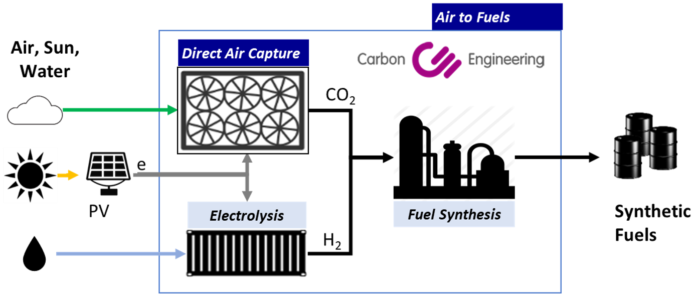
...
Image: Carbon Engineering

Their process, known as “air to fuels” (or A2F) consists of three main steps.
-First, CO2 is captured from the air and purified. The facility in Squamish already removes one tonne of CO2 per day from the atmosphere, but previously, this was simply released back into the air as the rest of the process was not developed enough.
-Next, clean electricity, such as solar power, is used to split hydrogen from water.
-In the final step, the CO2 and hydrogen are synthesised into fuel, such as diesel and jet fuel. Fuels produced this way are also cleaner burning than fossil fuels, according to Carbon Engineering.

“A2F is a potentially game-changing technology,” it says on its website. It “offers an alternative to biofuels and a complement to electric vehicles in the effort to displace fossil fuels from transportation”. While electric vehicles are more suited to shorter distances, long-haul transport, ships and airplanes still need the high-energy density of liquid fuels, according to the company.

However, critics argue that the world’s main priority should not be to capture CO2, but to emit less of it in the first place.

In the journal Science, Professor Kevin Anderson, deputy director of the Tyndall Centre for Climate Change Research, and Glen Peters, research director at the Centre for International Climate Research (Cicero) in Norway, argue that the technologies to remove carbon may not work at scale.

Anderson warns that governments are assuming that these technologies will clean up the atmosphere in the future, according to the Guardian. This gives them less of an incentive to cut emissions now. Anderson points out that it is also a dangerously optimistic assumption given how new and unproven these technologies are on a large scale.

“They are not an insurance policy; they are a high-risk gamble with tomorrow’s generations, particularly those living in poor and climatically vulnerable communities, set to pay the price if our high-stakes bet fails to deliver as promised,” Anderson says. If the technologies are not as successful as promised, “our own children will be forced to endure the consequences of rapidly rising temperatures and a highly unstable climate.”

Bill Gates has argued that governments and companies need to invest in a wide range of cutting-edge energy technologies, from solar fuels to more efficient grids, even though it may take many years for them to work at scale.

“Breakthroughs in energy technologies could reduce air pollution, help people escape poverty, and avoid the worst effects of climate change,” he said in an opinion piece on clean energy last year. “But here’s the tricky part: we don’t yet know which ones will succeed. So we need to explore lots of ideas with investments from both the government and the private sector.”

https://www.weforum.org/agenda/2018/02/bill-gates-to-strip-c02-from-air-for-clea...

Back to top
« Last Edit: May 17th, 2019 at 8:53am by juliar »  
 
IP Logged
 
Page Index Toggle Pages: 1
Send Topic Print