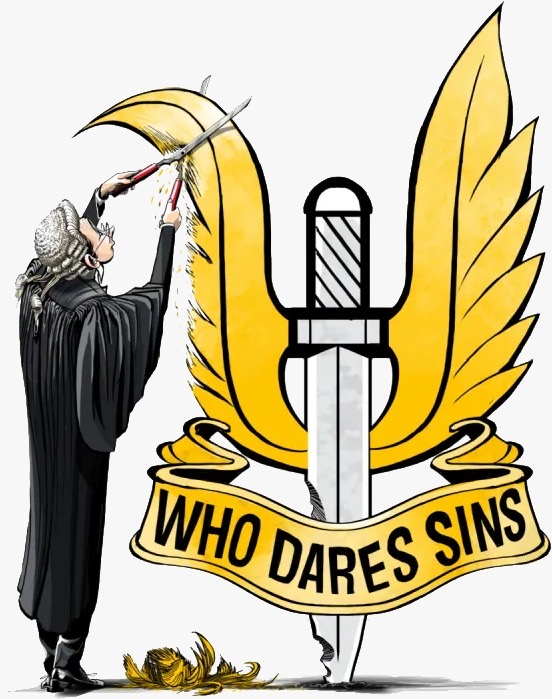
Post by Frank on Apr 27th, 2026 at 11:53am
| Australian Politics Forum | |
|
http://www.ozpolitic.com/forum/YaBB.pl
General Discussion >> Federal Politics >> War crimes - military or civil justice? http://www.ozpolitic.com/forum/YaBB.pl?num=1776578660 Message started by Frank on Apr 19th, 2026 at 4:04pm |
|
|
Title: War crimes - military or civil justice? Post by Frank on Apr 19th, 2026 at 4:04pm
It is worth pausing to examine the legal architecture under which this moment has arrived. What will now unfold before twelve civilian jurors did not begin in Afghanistan. It began in Canberra in 2002.
That year, Australia enacted sweeping amendments to the Commonwealth Criminal Code, inserting Division 268. Its purpose was clear: to create offences of international concern and ensure Australia’s jurisdiction was ‘complementary’ to that of the International Criminal Court. Under the Howard government, parliament ensured that if war crimes were committed, Australia could prosecute them itself, rather than leaving the matter to The Hague. What was once the work of courts martial became proceedings in the ordinary criminal courts. The principle of complementarity does not require what Australia did. It requires only that a state genuinely investigate and, where appropriate, prosecute. It does not prescribe civilian courts, jury trials, or wholesale incorporation of every Rome Statute offence into domestic law. On one level, this ‘domestication’ of international law was understandable. The late-1990s and early-2000s marked a high-water point of ‘end of history’ internationalism. The Rome Statute had been adopted. The horrors of the Balkans and Rwanda were fresh. There was a conviction that the ‘worst crimes’ should never go unpunished. War crimes damage not only victims but national reputation and military morale. A willingness to investigate one’s own was seen as what civilised nations do to maintain integrity in the theatre of war. Yet Australia did not just join the project; it embraced it in full. Division 268 is not selective. It is a near-complete codification of international criminal law: genocide, crimes against humanity, and war crimes, each broken into multiple offences, from murder and inhumane treatment to unlawful confinement and destruction of property not justified by military necessity. The gravest offences carry life imprisonment; even lesser ones attract penalties of 25 or 17 years. Here the first tension arises. The political justification spoke in the language of exceptional evil. But once translated into legislation, ‘war crimes’ became a detailed catalogue of conduct, not all of the same moral order as the crimes that animated the project. Australia imported the project wholesale, placing itself at the more expansive end of comparable democracies. The United States never ratified the Rome Statute. Its War Crimes Act is narrower, confined to grave breaches, with a clear concern for sovereignty to protect US personnel. The UK implemented the Statute but relied heavily on military processes; investigations into Iraq abuses were curtailed after years of controversy. A 2021 law makes prosecutions for overseas conduct more than five years old exceptional, requiring Attorney-General approval. Australia, by contrast, continued at full throttle, albeit with Attorney-General consent still required for prosecutions. What makes the Australian position distinctive is the overlay of our constitutional arrangements. Under section 80, trials on indictment for Commonwealth offences must be by jury. These offences, drawn from international treaties and applied to conduct in distant war zones, once in the Criminal Code, must be determined by twelve ordinary citizens in a civilian courtroom. In the United States, such allegations would be prosecuted by court martial. This matters. The criminal law assumes access to crime scenes, forensic evidence, and witnesses who can be tested contemporaneously. Yet even the Office of the Special Investigator has acknowledged the realities: no access to Afghanistan, no post-mortems, no ballistic evidence, often little more than photographs and recollections. Louise Clegg in The Spectator |
|
Title: Re: War crimes - military or civil justice? Post by Frank on Apr 19th, 2026 at 4:07pm None of this is to suggest serious allegations should not be investigated, or grave wrongdoing excused. But the system now deployed was not designed for these circumstances. It reflects a fusion of two impulses: the late-20th-century drive to universalise international (including war) criminal law, and the older constitutional commitment to trial by jury in ordinary courts. But the political context has shifted. These laws were enacted in an era of confidence in international institutions, before the concept of lawfare: the use of legal processes to pursue political ends, including recently by the International Criminal Court itself. Two decades on, that confidence has eroded. The strategic environment is uncertain, the global and local economic outlook deteriorating, and public patience for years-long processes – this one costing hundreds of millions – is fraying. It is not surprising many Australians feel this process is not on a firm footing. I make no defence of Ben Roberts-Smith. But there are real questions about delay and cost, the institutional fit of a modern jury trial for wartime conduct, and whether parliament in 2002 fully appreciated the divisions it might create in a more polarised world when it copy and pasted the most expansive vision of international criminal justice into domestic law. The politicisation and weaponisation by political actors and media of our most decorated living soldier through this very public process will be devastating to the morale of our defence forces – and to recruitment and retention – at the worst possible time. We are embarked on yet another legal circus that will be used to rip the country apart. Long story short, this process should be playing out in a system of military justice, not the ordinary criminal courts. https://www.spectator.com.au/2026/04/when-the-law-of-war-comes-home-to-roost/ |
|
Title: Re: War crimes - military or civil justice? Post by Valkie on Apr 19th, 2026 at 5:18pm
I question the validity of a civilian court judging a soldier for alleged crimes committed during war.
Especially when the other side has a history of war crimes, not wearing ANY uniform, lies as part of their doctrine and determination of enemy and civilian is simply a matter of opportunity. |
|
Title: Re: War crimes - military or civil justice? Post by Leroy on Apr 19th, 2026 at 5:43pm Valkie wrote on Apr 19th, 2026 at 5:18pm:
I think the first thing they will have to do is prove that the people he allegedly killed are not soldiers and were not out to kill him. This evidence must be shown. |
|
Title: Re: War crimes - military or civil justice? Post by Frank on Apr 19th, 2026 at 6:00pm Leroy wrote on Apr 19th, 2026 at 5:43pm:
Assymetrical war >>> assymetrical lawfare. |
|
Title: Re: War crimes - military or civil justice? Post by Sir Grappler Truth Teller OAM on Apr 19th, 2026 at 7:22pm Valkie wrote on Apr 19th, 2026 at 5:18pm:
Green Zone when the big guns are in town - Red Zone every other time of day... When you're wounded And left on Afghanistan's plains, And the women come out To cut up the remains... |
|
Title: Re: War crimes - military or civil justice? Post by tallowood on Apr 19th, 2026 at 8:08pm Quote:
|
|
Title: Re: War crimes - military or civil justice? Post by Sir Eoin O Fada on Apr 20th, 2026 at 2:02pm
As Command Responsibility cab apply to both civilians and military then the jurisdiction should be civilian.
|
|
Title: Re: War crimes - military or civil justice? Post by Frank on Apr 23rd, 2026 at 8:47pm
Mr Roberts-Smith told The Australian: “I greatly appreciate the support from Keith Payne VC and everyone else that has made contact. Anzac Day is sacred to me and every other veteran. I will be attending to pay my respects and I encourage everyone else to.”
Mr Payne, 92, the soldier’s soldier who earned his VC in 1969, said he would be proud to march alongside his “mate”, Mr Roberts-Smith. Far from turning his back on him, Mr Payne – as full of fight as ever – reached out to Mr Roberts-Smith after he was arrested and initially held in custody over the alleged murder of five Afghan nationals. Mr Payne told him: “Keep a smile on your face, mate. There’s a big win in front of you.” Asked by this masthead whether Mr Roberts-Smith should attend Anzac Day given his notoriety, Mr Payne said forthrightly: “Of course he should march or be at the Dawn Service, whatever he wants to. I’ll be very, very bloody surprised and so will the remainder of the veteran community if he’s not bloody welcome wherever he goes.” |
|
Title: Re: War crimes - military or civil justice? Post by tallowood on Apr 24th, 2026 at 8:27am Frank wrote on Apr 23rd, 2026 at 8:47pm:
Well said, Mr Payne. |
|
Title: Re: War crimes - military or civil justice? Post by Valkie on Apr 25th, 2026 at 7:06pm
My question is.
How will he be tried by a jury of I peers? Are we going to see a collection of non-serving soldiers? Will he be tried by pretend soldiers who have never seen battle. Will he be tried by a collection of activists deliberately orchestrated by a grubberment beholding to muzzos? And has the judge been to war? Has he/ she served under war the horrors there of. Or will they simply be another plant, like the deadbeat Governor General and judges appointed by this horror of a grubberment? We all know this trial is a travesty. We all know the grubberment is pushing this. And unless the soldiers on the other side are similarly taken to trial, it's a miscarriage of justice. |
|
Title: Re: War crimes - military or civil justice? Post by Frank on Apr 25th, 2026 at 8:24pm
Military matters should not be handled by civian criminal courts.
Australia made a mistake when it set up the legal framework for treating international war crimes. It makes no sense for 12 civians to judge SAS activity. See my op. |
|
Title: Re: War crimes - military or civil justice? Post by Frank on Apr 27th, 2026 at 11:53am |
|
Title: Re: War crimes - military or civil justice? Post by Armchair_Politician on Apr 30th, 2026 at 12:52pm
I hope Ben Roberts-Smith didn't do it, but I just don't know. No one other than him and his fellow soldiers who were there know for sure. My gut instinct is telling me that he is innocent. But we have to remember that while our soldiers conducted themselves within the constraints of strict rules of engagement and laws regarding armed combat, the Taliban was restrained by no such morals and frequently used women and children as human shields and forced them into terroristic acts against Coalition forces. It's hard to combat an enemy like that.
The soldiers who are testifying against him as witnesses should be facing charges as accessories to those crimes for which BRS has been accused, because if what they allege is true, then they stood by and did nothing to stop that alleged crime from happening. That they are not facing charges tells me they have probably been offered immunity from prosecution in return for their testimony against BRS. There should also be no trial for BRS until the Afghan who posed as an ANA soldier and murdered a number of our soldiers in a deliberate attack inside the base is arrested and charged with murder. At present, he is living as a free man in Afghanistan, feted by the Taliban for his heinous crime as a hero. The Australian government has done nothing about this. |
|
Title: Re: War crimes - military or civil justice? Post by Daves2017 on Apr 30th, 2026 at 5:48pm
So if I’m reading the op post correctly Howard brought in this law that sees mass killer corporal Smith on charges to prevent the possibility of international embarrassment of having Australian Soldiers face The Hague court on war crime charges?
I also been told repeatedly that Howard was quoted as saying “ don’t blame the soldiers for their actions, I take full responsibility “. I would expect a journalist would remind Howard of his statement and ask how he plans to accept responsibility if mass killer corporal Smith is convicted? We may need to out source this story as Australian journalists have and continue to show not only are alcoholics but lack any spine whatsoever in dealing with there political mates. The truly sad part of the sacking of 20 channel 9 current affairs reporters and staff is the flow on effect to bars, clubs and bottle shops who are bracing to take a huge loss to profits with their best customers now unemployed. |
|
Title: Re: War crimes - military or civil justice? Post by Armchair_Politician on Apr 30th, 2026 at 6:08pm Daves2017 wrote on Apr 30th, 2026 at 5:48pm:
So is Rudd, Gillard, Abbott and Turnbull then… |
|
Australian Politics Forum » Powered by YaBB 2.5.2! YaBB Forum Software © 2000-2026. All Rights Reserved. |