| Australian Politics Forum | |
|
http://www.ozpolitic.com/forum/YaBB.pl
Member Run Boards >> Environment >> Nuclear Simply Doesn't Stack Up http://www.ozpolitic.com/forum/YaBB.pl?num=1716191076 Message started by whiteknight on May 20th, 2024 at 5:44pm |
|
|
Title: Nuclear Simply Doesn't Stack Up Post by whiteknight on May 20th, 2024 at 5:44pm
Nuclear option costs 'six times more' than renewables :(
Shepperton News May 18, 2024 The high upfront costs and burden on consumers of adding nuclear to Australia's energy mix have been confirmed in an independent review. Building nuclear reactors would cost six times more than wind and solar power firmed up with batteries, according to the independent report released on Saturday by the Clean Energy Council. "We support a clear-eyed view of the costs and time required to decarbonise Australia and right now, nuclear simply doesn't stack up," the industry body's chief executive Kane Thornton said. Taxpayers needed to understand the decades of costs if they were forced to foot the bill for building a nuclear industry from scratch, Mr Thornton warned. The analysis prepared by construction and engineering experts Egis also found nuclear energy had poor economic viability in a grid dominated by renewable energy. Renewable energy will provide 82 per cent of the national electricity market under current targets for 2030, which is at least a decade before any nuclear could theoretically be operational. Further, nuclear power stations are not designed to ramp up and down to align with renewable energy generation. Adding to the cost challenges, Australia has no nuclear energy industry because it is prohibited under commonwealth and state laws, which would all need to be changed. Mr Thornton said the analysis confirmed that building nuclear power stations instead of renewables would cause power prices to "explode". The analysis was based on the CSIRO's GenCost 2023-24 consultation draft, the Mineral Council of Australia's Small Modular Reactors study and the industry benchmark Lazard Levelized Cost of Energy Report. These reports did not include waste management and decommissioning of a nuclear plant in cost calculations, which meant the true cost could be even higher, Mr Thornton said. :( |
|
Title: Re: Nuclear Simply Doesn't Stack Up Post by Bobby. on May 20th, 2024 at 5:50pm
Good post sir Crook but I reckon we could avoid all of that
if we just used our gas reserves until renewables and Snowy 2 took over. At the moment we're getting ripped off by selling our gas overseas. |
|
Title: Re: Nuclear Simply Doesn't Stack Up Post by Bobby. on May 20th, 2024 at 5:52pm Why Qatar Earns $76 Billion from Gas While Aussies Get Scammed https://www.youtube.com/watch?v=x-nNpSaLxO8 |
|
Title: Re: Nuclear Simply Doesn't Stack Up Post by lee on May 20th, 2024 at 6:43pm
Snowy 2 is a white elephant.
Lazard is shown to be underreporting. They only include between 1 and 4 hours of battery. It will be more likely a month. 4 hours of battery on a dull day and low wind? "In the column headed “Storage Duration (Hours),” we find a minimum of 1 and a maximum of 4. Four hours of duration just happens to be the norm for the capability of today’s most cost-effective battery storage technology, lithium ion batteries. Unfortunately, the studies that I feature in my energy storage Report calculate that the number of hours duration of storage needed to fully “firm” a system using only wind and solar generation would be at least one month (720 hours), and potentially two to three months (1440 to 2160 hours). Lazard would seem to be off by a factor of somewhere between 180 and 540 of what would be needed." https://www.manhattancontrarian.com/blog/2023-12-17-climate-advocacy-incompetence-versus-intentional-fraud-lazard-edition |
|
Title: Re: Nuclear Simply Doesn't Stack Up Post by Baronvonrort on May 20th, 2024 at 10:33pm whiteknight wrote on May 20th, 2024 at 5:44pm:
What a load of bullcrap. Quote:
To achieve net zero in 2050 with renewables every solat panel and wind turbine currently in use will be in landfill by 2050. Wind turbine blades have a fatigue life of 9 years then they're scrapped. We need nuclear or Hydro and not that pumped hydro bullshit that consumes more energy than it produces. The Greens oppose the 2 cleanest types of electricity. |
|
Title: Re: Nuclear Simply Doesn't Stack Up Post by Bobby. on May 21st, 2024 at 6:57am
More about the gas rip off:
https://www.youtube.com/watch?v=8WuFtV4t0RE |
|
Title: Re: Nuclear Simply Doesn't Stack Up Post by Captain Nemo on May 22nd, 2024 at 10:59am
The first thing to do is to remove the ban on Nuclear power here in Aus.
The longer we procrastinate, the worse things will become regarding continuous electricity supply. Even if nuclear power costs twice as much as Wind and Solar, we need to get on with it. Providing 24/7 electricity should be main priority of any government. |
|
Title: Re: Nuclear Simply Doesn't Stack Up Post by Frank on May 28th, 2024 at 8:17am whiteknight wrote on May 20th, 2024 at 5:44pm:
Nonsense on biased stilts. The cost of nuclear energy is twice the cost of renewables, so sayeth the Commonwealth Scientific and Industrial Research Organisation. But why is the CSIRO in the non-scientific game of providing assumption-driven estimates of the cost of generating electricity in different ways? On the face of it, it looks like a bit of buck-passing by the Australian Energy Market Operator, which enlisted the assistance of the CSIRO some years ago. This is a task for engineers, economists and accountants – not scientists. Modelling is not science, and estimating costs is also not science. By rights, the CSIRO should have declined the request. Its reputation has been markedly sullied. Let’s consider the latest version of the CSIRO’s GenCost report. As with all modelling, it’s a case of garbage in, garbage out. The assumptions in it range from the plausible to the absolutely ridiculous. The most glaring errors in the report are the assumptions about the upfront costs of nuclear plants, their rates of utilisation and their lifespans. The assumption on the capacity of wind power is also laughable and the assumed lifespans of both wind and solar are too long. It looks suspiciously like a tail-wagging-the-dog exercise: how to ensure that nuclear power looks extraordinarily expensive compared with the preferred renewable energy option of the federal and state governments. The fact that Australia is the only country of the largest 20 economies in the world not to have nuclear power didn’t seem to awaken the curiosity of the CSIRO team. Should we be assuming that all their governments are simply stupid by having such an expensive form of generation? And how could it be the case that a very large number of countries are now aggressively investing in more zero-emissions nuclear plants? Indeed, our main ally, the US, has a target of tripling the amount of nuclear power by 2050. The international figures are clear: countries with high wind and solar shares in their generation of electricity actually have relatively high electricity prices. They include Germany, Britain, Spain, Denmark and Italy, as well as the states of California and South Australia. By contrast, those countries with very low renewable shares have the cheapest electricity: Russia, United Arab Emirates, Korea and India. It is worth pausing here to briefly outline the methodology of the GenCost report. It uses levelised cost of electricity, or LCOE, as the key metric – a measure that includes both the cost of installation as well as the expected lifetime of the asset. The cost of the fuel is added, which is zero for wind and solar but material for other means of generation. The capacity factors of different means of generation are then taken into account. They should vary between 25 and 33 per cent for wind and solar but the GenCost report has onshore wind at 48 per cent and offshore wind at 52 per cent, which are both clearly errors. The capacity factor for nuclear should be in the 90s but in one scenario, the CSIRO puts the figure at 53 per cent, another clanger. The methodology of the GenCost report - using levelised cost of electricity - is the wrong measure to use. Istock The methodology of the GenCost report - using levelised cost of electricity - is the wrong measure to use. Istock But the key is this: the LCOE is the wrong measure to use. What is required is a system-wide LCOE because of the inherent intermittency of wind and solar and the inviolable objective of 24/7 power. When the wind blows and the sun shines, the cost of generating electricity by these means is very low. But because the wind doesn’t blow all the time and the sun sets, expensive back-up (or firming) is required. This back-up must be added to the cost of both wind and solar. And account must be taken of both extended wind droughts and cloudy periods – short-duration batteries will simply be inadequate. In practical terms, the option of long-duration, affordable batteries simply doesn’t exist and affordable pumped hydro is not possible in this country. |
|
Title: Re: Nuclear Simply Doesn't Stack Up Post by Frank on May 28th, 2024 at 8:19am
It is worth pausing here to briefly outline the methodology of the GenCost report. It uses levelised cost of electricity, or LCOE, as the key metric – a measure that includes both the cost of installation as well as the expected lifetime of the asset. The cost of the fuel is added, which is zero for wind and solar but material for other means of generation.
The capacity factors of different means of generation are then taken into account. They should vary between 25 and 33 per cent for wind and solar but the GenCost report has onshore wind at 48 per cent and offshore wind at 52 per cent, which are both clearly errors. The capacity factor for nuclear should be in the 90s but in one scenario, the CSIRO puts the figure at 53 per cent, another clanger. But the key is this: the LCOE is the wrong measure to use. What is required is a system-wide LCOE because of the inherent intermittency of wind and solar and the inviolable objective of 24/7 power. When the wind blows and the sun shines, the cost of generating electricity by these means is very low. But because the wind doesn’t blow all the time and the sun sets, expensive back-up (or firming) is required. This back-up must be added to the cost of both wind and solar. And account must be taken of both extended wind droughts and cloudy periods – short-duration batteries will simply be inadequate. In practical terms, the option of long-duration, affordable batteries simply doesn’t exist and affordable pumped hydro is not possible in this country. The GenCost report uses the relatively successful example of Korea’s nuclear program to estimate the expected capital cost of a large-scale plant. The figure is put at $8700 per kilowatt, which sounds reasonable enough. But the figure is then arbitrarily doubled because it would be the “first-of-a-kind” in Australia. It is simply asserted that “FOAK premiums of up to 100 per cannot be ruled out”. This is absurd. After all, Australia would be importing the expertise from experienced players were nuclear plants to be built here. And as the nuclear energy industry enjoys a significant renaissance around the world, the number of companies and the depth of talent involved are increasing markedly. By the time Australia is in a position to consent to nuclear plants, it is inconceivable that the FOAK would be double. This assumption makes a substantial difference to the final results. Stung by the criticism that previous GenCost reports failed to take into account the cost of transmission needed to get renewable energy to the grid, this latest version makes some effort to do so. But instead of focusing on the entire cost of transmission, which feeds into retail prices, only the cost of additional transmission is included in the analysis. Again this is a bias in favour of renewable energy. Of course, one of the advantages of nuclear plants is that they can be located where existing transmission lines exist; the cost of foregone investment in transmission by rights should be included as reducing the cost of nuclear. They can also last more than 80 years, even though the GenCost report bizarrely gives them a lifespan of 30 years. Solar and wind are assumed to last 25 years, which is far too long. https://www.theaustralian.com.au/nation/politics/deck-was-stacked-as-csiro-estimated-the-cost-of-nuclear-power/news-story/2aaa0a5be23b3f09f363a6b3ce19af32 |
|
Title: Re: Nuclear Simply Doesn't Stack Up Post by Laugh till you cry on May 28th, 2024 at 9:52am Baronvonrort wrote on May 20th, 2024 at 10:33pm:
Bvr wears his ignorance like a badge. The prices he quotes are wholesale prices All Australian wholesale prices are much lower than the numbers Bvr lauds What an absolute load of crap. All Australian wholesale electricity suppliers can sell electricity at a fraction of Finland's prices. In the extract below the lowest Australian prices of $29/MWh and $63/MWh are both lower than any of the Finland prices. The biggest part of retail electricity cost is the markup between wholesale prices and retail prices. https://www.abc.net.au/news/2023-10-23/power-prices-to-stay-higher-despite-wholesale-market-slump/103004170 Quote:
|
|
Title: Re: Nuclear Simply Doesn't Stack Up Post by Bobby. on May 28th, 2024 at 10:18am
I'm not sure about how great we'll think nuclear power stations are if Ukraine
has their nuclear reactors destroyed and they melt down at Zaporizhzhia during this war. They are too fragile in wars and can become targets. https://en.wikipedia.org/wiki/Zaporizhzhia_Nuclear_Power_Plant The Zaporizhzhia Nuclear Power Station in southeastern Ukraine is the largest nuclear power plant in Europe and among the 10 largest in the world. It has been under Russian control since 2022. It was built by the Soviet Union near the city of Enerhodar, on the southern shore of the Kakhovka Reservoir on the Dnieper river. It is operated by Energoatom, who operate Ukraine's other three nuclear power stations. The plant has six VVER-1000 pressurized light water nuclear reactors (PWR), each fuelled with 235U (LEU)[1] and generating 950 MWe, for a total power output of 5,700 MWe.[2] The first five were successively brought online between 1985 and 1989, and the sixth was added in 1995. In 2020, the plant generated nearly half of the country's electricity derived from nuclear power,[3] and more than a fifth of total electricity generated in Ukraine.[4] The Zaporizhzhia thermal power station is nearby. On 4 March 2022, days into the Russian invasion of Ukraine, Russian forces seized both the nuclear and thermal power stations. As of 12 March 2022 the Russian company Rosatom claimed control over the plant. Since its capture, the plant does not generate power and is mostly shut down. Shell damage to the roof of the building housing solid radioactive waste and fresh nuclear fuel, September 2022 |
|
Title: Re: Nuclear Simply Doesn't Stack Up Post by lee on May 28th, 2024 at 11:50am Bobby. wrote on May 28th, 2024 at 10:18am:
And of course renewables are immune? ::) |
|
Title: Re: Nuclear Simply Doesn't Stack Up Post by UnSubRocky on May 28th, 2024 at 12:14pm
The amount of energy that could be produced from nuclear energy, would be undeniable. With people using rooftop solar, I have not seen a blackout or brownout in a long time from an overloaded electricity grid. So, we can either look after regions that are not popular with solar energy, by building those nuclear power stations. Or we can sit on coal fired power stations until people are sick of pointing out the relationship of burning coal with raising average global temperature.
|
|
Title: Re: Nuclear Simply Doesn't Stack Up Post by lee on May 28th, 2024 at 1:00pm UnSubRocky wrote on May 28th, 2024 at 12:14pm:
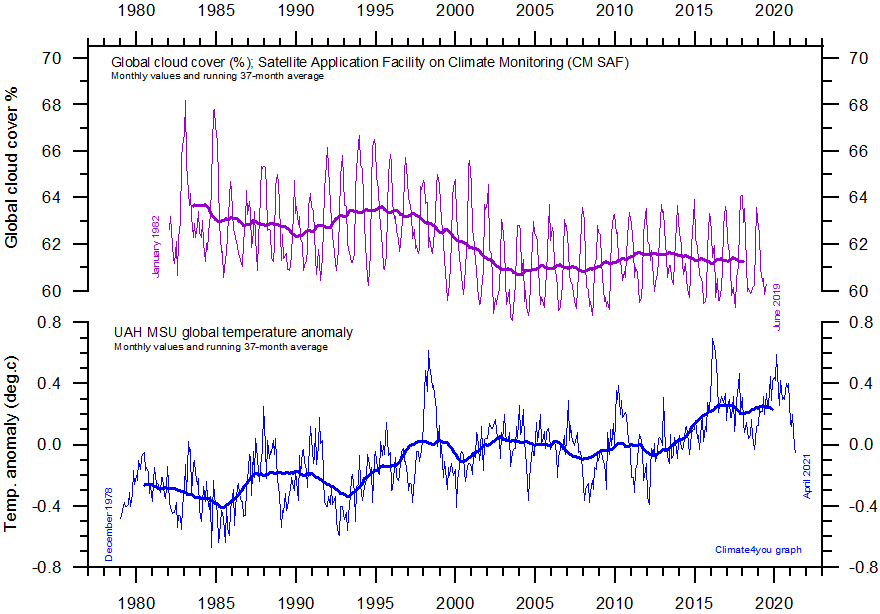
It is a theory; not established fact. Meanwhile, lack of cloud cover is shown to cause warming. |
|
Title: Re: Nuclear Simply Doesn't Stack Up Post by Laugh till you cry on May 28th, 2024 at 2:09pm lee wrote on May 28th, 2024 at 1:00pm:
Of course, it does, just as the absence of clothing correlates to the prevalence of nakedness. Lee should be asking why cloud cover is decreasing. |
|
Title: Re: Nuclear Simply Doesn't Stack Up Post by lee on May 28th, 2024 at 2:15pm Laugh till you cry wrote on May 28th, 2024 at 2:09pm:
Only the sun causes warming. Have you not noticed that? What happens at nighttime? In this case correlation IS causation. ::) |
|
Title: Re: Nuclear Simply Doesn't Stack Up Post by UnSubRocky on May 30th, 2024 at 12:43pm
Cloud cover does wonders to keep the region cooler during the summer. But, it also keeps the region warmer during winters. Whilst we may have cooler days during cloudy winter days. The night time temperatures are quite pleasant and there is no chance of freezing.
At a guess, I would say that the global warming would alter the "conveyor belt" of ocean currents so that weather events shift to other regions that traditionally do not see these weather events happen very often. And when the currents cool, you see a shift in the ocean currents again back to the way it was. Of course, the changes to the seasons has a bigger impact on these ocean currents. |
|
Australian Politics Forum » Powered by YaBB 2.5.2! YaBB Forum Software © 2000-2026. All Rights Reserved. |