Post by lee on Apr 10th, 2021 at 4:31pm
Jovial Monk wrote on Apr 10th, 2021 at 4:29pm:
|
Poor petal. Can't debunk again. Shoots at the messenger; misses. ;D ;D ;D ;D ;D ;D
Have a look at their representation -
| Australian Politics Forum | |
|
http://www.ozpolitic.com/forum/YaBB.pl
Member Run Boards >> Relationships >> Lessons in AGW http://www.ozpolitic.com/forum/YaBB.pl?num=1617573297 Message started by Jovial Monk on Apr 5th, 2021 at 7:54am |
|
|
Title: Lessons in AGW Post by Jovial Monk on Apr 5th, 2021 at 7:54am
From: https://history.aip.org/
Quote:
We will go through this chapter bit by bit, then the next etc. |
|
Title: Re: Lessons in AGW Post by Jovial Monk on Apr 5th, 2021 at 7:58am
The work by the nineteenth and early twentieth centuries scientists was to explain Ice Ages (and whether there were ice ages:)
Quote:
(It was the work of a Serbian astronomer that explained how ice ages formed. Quote:
https://en.wikipedia.org/wiki/Milutin_Milankovi%C4%87 |
|
Title: Re: Lessons in AGW Post by Jovial Monk on Apr 5th, 2021 at 8:05am Quote:
There is a (misnamed) Greenhouse Effect and because of that life is possible on Earth. This is known and inarguable—just look how cold the Moon is when the sun isn’t shining on it. |
|
Title: Re: Lessons in AGW Post by BigP on Apr 5th, 2021 at 10:38am
I believe that science will save us from the green house effect, But what it wont fix is the deforestation of virgin Amazonian rainforest because of mining and the need for more agricultural land, You can produce meat like products from plants but If people don't want to eat it , they will continue to clear more land to graze beef , These forests are the earths lungs they also put a lot of water into the atmosphere that creates precipitation that benefits areas well outside its boundaries
|
|
Title: Re: Lessons in AGW Post by Jovial Monk on Apr 5th, 2021 at 10:56am
We are deforesting madly here too (Aust, not casting aspersions at NZ.)
Science can only fix it by improving carbon emission free energy and transportation which will reduce emissions but not remove CO2 from the atmosphere. Reafforestation is the only way. This includes cleaning up the ocean so marine plants can prosper again (and critters with it.) YOU can do something: pressure your local council to plant more trees and plant some trees yourself. Even on a small block, if you have a fence that gets sun most of the day then with a few posts and 1, 2 or 3 wires you can grow grapes, apples, pears or quinces along that fence. Have a spot with nothing much in it? Dig a hole and plant 4 trees in it, 4 peach trees chosen to give a nice long harvest period. 45cm spacing*, prune the trees so the middle is empty allowing air and sun to reach the trees. Root competition keeps the trees small so not much space is taken up but the four trees give enough fruit to make it worthwhile. Or cherries where they grow, etc. Apricot trees grow like topsy and cutting it back just increases the rate of growth. Need a BIG spot and a chainsaw to grow an apricot tree! Apple and pear trees can grow huge too, hence my suggestion to espalier them against a fence. Supermarkets sell bland apples, golden (cotton wool) “Delicious” and gala, fuji etc. Pfffft! King David, an offspring of Jonathon and Winesap, spicy-tart! Be great juice! Mcintosh, the most popular apple in the US. Cornish Aromatic with real flavor and crunch. Cox Orange Pippin, texture, flavor, aroma in the best eating apple! Etc Etc. Have a look here: https://www.heritagefruittrees.com.au/ and here: https://www.woodbridgefruittrees.com.au/ There is a great resource for info on fruit, an English company operating in England and the US. www.orangepippin.co.uk www.orangepippin.com Not all fruits on the orange pippin list is avaible here, mind, but any apple or cherry variety you come across here will be listed. The so-called fresh food people don’t stock Janathan. Why not? It does not store well! Grow it yourself and do the planet a favor at the same time. * I will confirm the spacing of the four-trees-in-one-hole. |
|
Title: Re: Lessons in AGW Post by BigP on Apr 5th, 2021 at 11:15am Jovial Monk wrote on Apr 5th, 2021 at 10:56am:
Being a small country governed by a single entity, " no federal regimes " Most of our native forests are protected, Selective sustainable logging is allowed in certain areas for high value trees , and if you purchase a property you are allowed to clear enough for your home and a area around it , |
|
Title: Re: Lessons in AGW Post by BigP on Apr 5th, 2021 at 11:20am Jovial Monk wrote on Apr 5th, 2021 at 10:56am:
""Apple and pear trees can grow huge too, hence my suggestion to espalier them against a fence."" Im on 14 acres close to Auckland city If i get onto my roof I can see the city center, I have a orchard with some pears in it and without pruning they become very large trees |
|
Title: Re: Lessons in AGW Post by Jovial Monk on Apr 5th, 2021 at 11:51am
14 acres, nice!
I want 1400m2, 14 acres a bit too much for me! |
|
Title: Re: Lessons in AGW Post by lee on Apr 5th, 2021 at 1:08pm Jovial Monk wrote on Apr 5th, 2021 at 10:56am:
So how many millions of hectares of forest are we down to? ;) 125? 140? |
|
Title: Re: Lessons in AGW Post by Jovial Monk on Apr 5th, 2021 at 1:17pm Quote:
Next—some simple models of the atmosphere. |
|
Title: Re: Lessons in AGW Post by Jovial Monk on Apr 5th, 2021 at 1:19pm
https://history.aip.org/climate/simple.htm#L_0141
Quote:
|
|
Title: Re: Lessons in AGW Post by Jovial Monk on Apr 5th, 2021 at 1:27pm Quote:
|
|
Title: Re: Lessons in AGW Post by lee on Apr 5th, 2021 at 1:39pm Jovial Monk wrote on Apr 5th, 2021 at 1:27pm:
And yet they still parameterise the models. ;D ;D ;D ;D ;D |
|
Title: Re: Lessons in AGW Post by Jovial Monk on Apr 5th, 2021 at 1:53pm
Yes, the Zeller/Nikolov model used SIX parameters ;)
|
|
Title: Re: Lessons in AGW Post by Jovial Monk on Apr 5th, 2021 at 1:53pm Quote:
So we will have a look at an actual model soon. |
|
Title: Re: Lessons in AGW Post by Jovial Monk on Apr 5th, 2021 at 2:01pm
We won’t look at the details of the Manabe-Wetherald model they developed in 1968 when finally computers were powerful enough to run such models. I hope to cover the essentials of it tho.
Remember that scientific studies for the US Air Force and Navy had found that the surface emitted IR, enough IR that heat seeking missiles did not find their targets, bombs did not drop on the target. So by the end of the 1950s there was no longer any doubt that the mechanism of AGW existed. And Tyndall had found that water vapor, CO2 and CH4 were opaque to IR. This was in 1859. |
|
Title: Re: Lessons in AGW Post by Jovial Monk on Apr 5th, 2021 at 2:05pm Quote:
|
|
Title: Re: Lessons in AGW Post by lee on Apr 5th, 2021 at 2:27pm Jovial Monk wrote on Apr 5th, 2021 at 1:53pm:
And how many for the new CMIP6? Most CMIP5's use more. ;) Jovial Monk wrote on Apr 5th, 2021 at 2:05pm:
And yet they still don't do clouds, amongst others, well. |
|
Title: Re: Lessons in AGW Post by Jovial Monk on Apr 5th, 2021 at 2:29pm
You are fixated on clouds, aren’t you? I think you will find understanding of clouds has increased markedly. Poor desperate lee.
|
|
Title: Re: Lessons in AGW Post by lee on Apr 5th, 2021 at 2:34pm Jovial Monk wrote on Apr 5th, 2021 at 2:29pm:
Is that why they are still thought to be net positive? ;D ;D ;D ;D ;D |
|
Title: Re: Lessons in AGW Post by Jovial Monk on Apr 5th, 2021 at 2:40pm
Yes, they are net positive. Very good lee, next we can get onto 2 + 2 = ?
|
|
Title: Re: Lessons in AGW Post by Jovial Monk on Apr 5th, 2021 at 2:41pm Quote:
|
|
Title: Re: Lessons in AGW Post by Jovial Monk on Apr 5th, 2021 at 3:00pm Quote:
Feedback—an essential process and concept especially in meteorology and climatology and biological and physical scienc of course.. Feedback therefor is essential any understanding of climate, essential to any climate model devised. |
|
Title: Re: Lessons in AGW Post by lee on Apr 5th, 2021 at 3:10pm Jovial Monk wrote on Apr 5th, 2021 at 2:40pm:
Citation needed. ;) Jovial Monk wrote on Apr 5th, 2021 at 2:41pm:
So when has the earth ever been in equilibrium? Jovial Monk wrote on Apr 5th, 2021 at 2:41pm:
And yet that has not been shown to be true. |
|
Title: Re: Lessons in AGW Post by Jovial Monk on Apr 5th, 2021 at 3:27pm
Those questions, lee the desperate, are from the very early days you see, it is not what scientists think now. Get that?
|
|
Title: Re: Lessons in AGW Post by BigP on Apr 5th, 2021 at 3:28pm Jovial Monk wrote on Apr 5th, 2021 at 11:51am:
I didn't particularly want that much land but when you are looking for a property in a certain area you have to take what's available , |
|
Title: Re: Lessons in AGW Post by Jovial Monk on Apr 5th, 2021 at 3:31pm
Very true.
If I get much more than I want I will plant it with native trees and bird and butterfly attracting trees, keep the 1500sqm for “orchard”, “vineyard” and house and garden. |
|
Title: Re: Lessons in AGW Post by Jovial Monk on Apr 5th, 2021 at 3:38pm
Hardest part is finding a big block in an area where it doesn’t rain so bloody much!
Rain in Tassie is mainly spread fairly evenly through the year—no hot dry summers to ripen fruit. Can install polytunnels but still have humidity causing fungal infections. |
|
Title: Re: Lessons in AGW Post by Jovial Monk on Apr 5th, 2021 at 3:39pm Quote:
|
|
Title: Re: Lessons in AGW Post by lee on Apr 5th, 2021 at 4:46pm Jovial Monk wrote on Apr 5th, 2021 at 3:27pm:
You do understand the difference between thinking and proving? But the real reason you say that is because you can't refute. Even your go to site SKS says - "Although the cloud feedback is one of the largest remaining uncertainties in climate science, evidence is building that the net cloud feedback is likely positive, and unlikely to be strongly negative." No refutation there. And notice the strange thought process involved. In one "likely positive" - In the other "unlikely strongly negative." They can't even think of clouds as likely negative even a small bit. ;) Earth Ice age; interglacial; Ice age; interglacial - definitely not in equilibrium. ;) |
|
Title: Re: Lessons in AGW Post by Jovial Monk on Apr 5th, 2021 at 4:47pm
These questions, desperate lee, were asked very early in the piece.
Maybe this will help you understand? Quote:
|
|
Title: Re: Lessons in AGW Post by lee on Apr 5th, 2021 at 4:48pm Jovial Monk wrote on Apr 5th, 2021 at 4:47pm:
And you still can't answer. ;D ;D ;D ;D ;D ;D ;D |
|
Title: Re: Lessons in AGW Post by Jovial Monk on Apr 5th, 2021 at 4:51pm
I am going through some of this website, desperate lee: https://history.aip.org/
It covers the history, desperate lee, of the development of climate science and understanding of AGW. |
|
Title: Re: Lessons in AGW Post by Jovial Monk on Apr 5th, 2021 at 5:07pm Quote:
|
|
Title: Re: Lessons in AGW Post by lee on Apr 5th, 2021 at 5:23pm Jovial Monk wrote on Apr 5th, 2021 at 4:51pm:
No it is about the belief in AGW. You can't refute petal. You have no credibility. Even SKS you favoiurite source says it is likely rhat the net effects of clouds is positive. That is not something that has proven to be true. You just close your eyes, fingers in the ears and listen to your own little perturbations. " The balance between the cooling and warming actions of clouds is very close although, overall, averaging the effects of all the clouds around the globe, cooling predominates." https://earthobservatory.nasa.gov/features/Clouds Ooops. |
|
Title: Re: Lessons in AGW Post by Jovial Monk on Apr 5th, 2021 at 5:37pm
Just going through the site which covers the history of the development of AGW science.
|
|
Title: Re: Lessons in AGW Post by Jovial Monk on Apr 5th, 2021 at 5:59pm Quote:
|
|
Title: Re: Lessons in AGW Post by lee on Apr 5th, 2021 at 6:05pm Jovial Monk wrote on Apr 5th, 2021 at 5:37pm:
Yeah and how much it hasn't developed. 50 years of climate models and CMIP6 projections are hotter than CMIP5 models. No improvement in ECS in 40 years. And billions in funding. ;) |
|
Title: Re: Lessons in AGW Post by Jovial Monk on Apr 5th, 2021 at 6:20pm
Nice!
Quote:
Quite an insight! |
|
Title: Re: Lessons in AGW Post by Jovial Monk on Apr 5th, 2021 at 8:51pm Quote:
|
|
Title: Re: Lessons in AGW Post by lee on Apr 5th, 2021 at 9:15pm
That must be why Arrhenius amended his view in 1906.
"Much discussion took place over the following years between colleagues, with one of the main points being the similar effect of water vapour in the atmosphere which was part of the total fig-ure. Some rejected any effect of CO2 at all. There was no effective way to determine this split precisely, but in 1906 Arrhenius amended his view of how increased carbon dioxide would af-fect climate. He thought the effect would be much less in terms of warming, and whatever warming ensued would be beneficial. He published a paper in German. It was never translated at the time or widely distributed, though many European scientists knew of it and read it." I wonder why true believers never mention that? ;) |
|
Title: Re: Lessons in AGW Post by Jovial Monk on Apr 5th, 2021 at 9:21pm
Don’t they? I mention it. The extract I posted mentioned it.
|
|
Title: Re: Lessons in AGW Post by lee on Apr 5th, 2021 at 9:24pm Jovial Monk wrote on Apr 5th, 2021 at 9:21pm:
No it doesn't petal. Why do you lie? ;) "CO2 lasts for centuries" ;D ;D ;D ;D ;D ;D ;D ;D ;D |
|
Title: Re: Lessons in AGW Post by Jovial Monk on Apr 5th, 2021 at 9:25pm
It mentions water vapor, poor desperate lee.
Quote:
|
|
Title: Re: Lessons in AGW Post by lee on Apr 5th, 2021 at 9:33pm Jovial Monk wrote on Apr 5th, 2021 at 9:25pm:
So did 1896. ;) |
|
Title: Re: Lessons in AGW Post by Jovial Monk on Apr 5th, 2021 at 9:36pm Quote:
So gradually other factors are considered. Still the obsession with Ice Ages tho—that is to do with permutations of the earths orbit and inclination. In the absence of man volcanoes add more CO2 to the atmosphere and weathering removes it. |
|
Title: Re: Lessons in AGW Post by lee on Apr 5th, 2021 at 9:43pm Jovial Monk wrote on Apr 5th, 2021 at 9:25pm:
Ooh look he added it later. ;D ;D ;D ;D ;D ;D Jovial Monk wrote on Apr 5th, 2021 at 8:51pm:
But you didn't fix this. ;) |
|
Title: Re: Lessons in AGW Post by Jovial Monk on Apr 5th, 2021 at 9:46pm Quote:
That assumption covered tomorrow. |
|
Title: Re: Lessons in AGW Post by lee on Apr 5th, 2021 at 9:53pm Jovial Monk wrote on Apr 5th, 2021 at 9:46pm:
It is to today's AGW'ers ;D ;D ;D ;D ;D |
|
Title: Re: Lessons in AGW Post by Jovial Monk on Apr 5th, 2021 at 10:27pm Quote:
|
|
Title: Re: Lessons in AGW Post by lee on Apr 7th, 2021 at 12:58pm Jovial Monk wrote on Apr 5th, 2021 at 10:27pm:
And of course that also happens to incoming radiation. That seems to slip through unnoticed. ;) |
|
Title: Re: Lessons in AGW Post by Jovial Monk on Apr 7th, 2021 at 1:01pm
You forgotten already?
Radiation from the sun is _____wave radiation Radiation from the surface is ____wave radiation (Answer Short or Long) If the atmosphere absorbs a lot of IR (but little sunlight) we expect the stratosphere to become: 1. Cooler? or 2. Warmer? The stratosphere is in fact 1. Cooling or 2. Warming. Your answer__________? |
|
Title: Re: Lessons in AGW Post by lee on Apr 7th, 2021 at 1:36pm Jovial Monk wrote on Apr 7th, 2021 at 1:01pm:
Nope but you have. "Incoming ultraviolet, visible, and a limited portion of infrared energy (together sometimes called "shortwave radiation") from the Sun drive the Earth's climate system. " https://science.nasa.gov/ems/13_radiationbudget BTW - what happened to that "hundreds of years" of CO2 residence time? ;D ;D ;D ;D ;D |
|
Title: Re: Lessons in AGW Post by Jovial Monk on Apr 7th, 2021 at 2:01pm
Short wave, OK.
Now answer the quiz, doofus. |
|
Title: Re: Lessons in AGW Post by lee on Apr 7th, 2021 at 3:00pm Jovial Monk wrote on Apr 7th, 2021 at 2:01pm:
I don't need to petal. The earth receives infrared energy from the sun. End of story. Infrared is longwave. ;) |
|
Title: Re: Lessons in AGW Post by Jovial Monk on Apr 7th, 2021 at 3:08pm
Not in the frequencies where AGW happens—near infrared from the sun, far infrared from the surface. Do try to read a science book some time.
|
|
Title: Re: Lessons in AGW Post by lee on Apr 7th, 2021 at 3:47pm Jovial Monk wrote on Apr 7th, 2021 at 3:08pm:
So this AGW component is getting smaller and smaller by the comment. "The far infrared (FIR) spectral region from 100 to 667 cm-1 (100-15 μm) of the Earth's outgoing longwave radiation (OLR) has never been spectrally observed from space. " 20th EGU General Assembly, EGU2018, Proceedings from the conference held 4-13 April, 2018 in Vienna, Austria, p.11022 https://ui.adsabs.harvard.edu/abs/2018EGUGA..2011022P/abstract It's there; we know it's there; we just can't find it. ;D ;D ;D ;D ;D Of course once (if) they find it they will have nothing to compare it to; but it will be "worse than we thought". ;) |
|
Title: Re: Lessons in AGW Post by Jovial Monk on Apr 10th, 2021 at 10:39am
This is 1901!
Quote:
|
|
Title: Re: Lessons in AGW Post by Jovial Monk on Apr 10th, 2021 at 12:00pm
Amazing!
Quote:
|
|
Title: Re: Lessons in AGW Post by lee on Apr 10th, 2021 at 12:28pm Jovial Monk wrote on Apr 10th, 2021 at 10:39am:
Very good as far as it goes. It does not say anything about CO2 outgassing. Which is the largest component of CO2 emissions. ;) |
|
Title: Re: Lessons in AGW Post by Jovial Monk on Apr 10th, 2021 at 1:36pm
The burning of fossil fuels and the making of cement are the main sources of atmospheric CO2.
While the oceans have, naturally, warmed their vast mass and high specific heat means the temperature increase is tiny while the partial pressure of CO2 increases by much more so the oceans are net absorbers not emitters of CO2. |
|
Title: Re: Lessons in AGW Post by Jovial Monk on Apr 10th, 2021 at 3:42pm
Rosby waves are part of the mechanism of weather and climate.
Quote:
|
|
Title: Re: Lessons in AGW Post by lee on Apr 10th, 2021 at 4:27pm Jovial Monk wrote on Apr 10th, 2021 at 1:36pm:
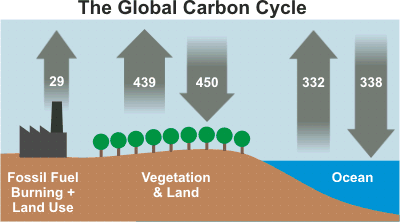
No they are not. Even SKS your go to site disagrees with you. "But consider what happens when more CO2 is released from outside of the natural carbon cycle – by burning fossil fuels. Although our output of 29 gigatons of CO2 is tiny compared to the 750 gigatons moving through the carbon cycle each year, it adds up because the land and ocean cannot absorb all of the extra CO2" https://skepticalscience.com/human-co2-smaller-than-natural-emissions.htm You have trotted this out before, been shot down before; but still you persist with lies. |
|
Title: Re: Lessons in AGW Post by Jovial Monk on Apr 10th, 2021 at 4:29pm
lee pretends he has forgotten the carbon cycle. Shows how desperate he is.
|
|
Title: Re: Lessons in AGW Post by lee on Apr 10th, 2021 at 4:31pm Jovial Monk wrote on Apr 10th, 2021 at 4:29pm:
Poor petal. Can't debunk again. Shoots at the messenger; misses. ;D ;D ;D ;D ;D ;D Have a look at their representation - |
|
Title: Re: Lessons in AGW Post by Jovial Monk on Apr 10th, 2021 at 4:34pm
Even the quote from SS talks of the carbon cycle.
We discussed that before, you thought CO2 was absorbed in the fall ;) Desperate lee. ;D ;D ;D ;D ;D ;D |
|
Title: Re: Lessons in AGW Post by Jovial Monk on Apr 10th, 2021 at 4:40pm Quote:
|
|
Title: Re: Lessons in AGW Post by lee on Apr 10th, 2021 at 5:13pm Jovial Monk wrote on Apr 10th, 2021 at 4:34pm:
And I didn't deny it. ::) Jovial Monk wrote on Apr 10th, 2021 at 4:34pm:
You mean it is absorbed in the rise? ;D ;D ;D ;D ;D ;D |
|
Title: Re: Lessons in AGW Post by Jovial Monk on Apr 10th, 2021 at 5:20pm
It is what you thought back then.
Can you explain the Carbon Cycle in your own words? |
|
Title: Re: Lessons in AGW Post by Jovial Monk on Apr 10th, 2021 at 5:23pm Quote:
|
|
Title: Re: Lessons in AGW Post by lee on Apr 10th, 2021 at 5:57pm Jovial Monk wrote on Apr 10th, 2021 at 5:20pm:
It must have been at the same time you were telling all and sundry the temperature rise in a greenhouse was because of increased CO2 and not because there was no airflow. ;D ;D ;D ;D |
|
Title: Re: Lessons in AGW Post by lee on Apr 10th, 2021 at 6:07pm Jovial Monk wrote on Apr 10th, 2021 at 5:23pm:
And yet the Arctic was sailed in the late 18th Century. Amazing feat when it wasn't ice free. ;D ;D ;D ;D ;D ;D And of course there is anecdotal evidence of sailings in 1660. "At the end of the 17th century the french naval lieutenant La Madeleine was in Portugal, on a mission from his minister, Count Louis de Pontchartrain, to get information on Portuguese navigation and trading in the East. In the course of his mission he heard, from a Havre sailor who lived in Oporto, of an extraordinary voyage from Japan to Portugal effected by a Portuguese with whom the French sailor was personally acquainted. In January 1700 he communicated the information he had got from him to his minister, who had it archived. It was reproduced in a memoir in 1754 by the French Philippe Buache, the distinguished royal geographer of Louis XV. The French sailor told that on 14 March 1660 the Dutch sailing ship «Padre Eterno» under the Portuguese David Melgueiro was ready to set sail from the Japanese port of Cangoshima. It was loaded with rich oriental goods and carried passengers, Dutch and Spanish and perhaps also Portuguese, since they had already entered the Nipponic empire in the previous century. At that time Europe was in the throes of war, Holland against France, Spain against Portugal, Spain against England, Portugal’s ally, who was fighting for her independence. The Atlantic and the eastern seas were infested by armed warships, to which pirates should be added. If the tried to return by the sole route till then used, via the Cape of Good Hope it was almost certain to be taken, so that Melgueiro decided to risk taking the other route open to him, by the arctic seas surrounding the old continent. He thus sailed up the current which washes the eastern coasts of Japan and goes up as far as the Anian-Bering strait, sailed round the coast of North Siberia, presumably far off shore, since he did not know the area. He reached the latitude of 84º N, passed between Greenland and the Spitzberg archipelago and sailed down Norway, where he sailed to windward of Ireland and thus reached a Dutch port, where he disembarked his passengers and goods. " This text refers to the writings of Philippe Buache, a French geographer. The original writings of Philippe Buache are in “Considérations Géographique et physiques sur les nouvelles découvertes au Nord de la grande mer“, 1753, and are available here. The interesting references to Melgueiro are available between pages 137 and 139. |
|
Title: Re: Lessons in AGW Post by Jovial Monk on Apr 10th, 2021 at 6:15pm
“Sailing the Arctic” including winters stuck in the ice is the same as “ice free” is it? ;)
Poor desperate lee. Notice Desperate lee has skipped out of explaining the Carbon Cycle? ;D ;D ;D ;D ;D |
|
Title: Re: Lessons in AGW Post by lee on Apr 10th, 2021 at 6:49pm Jovial Monk wrote on Apr 10th, 2021 at 6:15pm:
Only the 18th century one and that didn't have an ice breaker escort. It did have a 1.5hp motor. ;D ;D ;D ;D ;D ;D Nothing about the 16th century one stuck in the ice. And apparently the new meme for "ice free" is if it get to less than 1m Sq Km. ;D ;D ;D ;D ;D ;D |
|
Title: Re: Lessons in AGW Post by Jovial Monk on Apr 10th, 2021 at 6:55pm
Still skipping describing the carbon cycle. Pissweak description of the Arctic.
Can you do better lee? I doubt it. |
|
Title: Re: Lessons in AGW Post by lee on Apr 10th, 2021 at 7:24pm Jovial Monk wrote on Apr 10th, 2021 at 6:55pm:
poor petal. "The new research, published in the journal Geophysical Research Letters, uses the latest generation of climate models from 21 research institutes from around the world. In climate studies, the Arctic Ocean is said to be ice-free when it shrinks to fragments with a combined area below 1m sq km, which is 75% lower than in 2019." https://www.theguardian.com/world/2020/apr/21/ice-free-arctic-summers-now-very-likely-even-with-climate-action You do believe the garudian; don't you? Or perhaps this - "Still, most CMIP6 models fail to simulate at the same time a plausible evolution of sea‐ice area and of global mean surface temperature. In the vast majority of the available CMIP6 simulations, the Arctic Ocean becomes practically sea‐ice free (sea‐ice area <1 × 10⁶ km2) in September for the first time before the Year 2050 in each of the four emission scenarios SSP1‐1.9, SSP1‐2.6, SSP2‐4.5, and SSP5‐8.5 examined here." https://agupubs.onlinelibrary.wiley.com/journal/19448007 Jovial Monk wrote on Apr 10th, 2021 at 6:55pm:
You really, really need to keep up petal. ;D ;D ;D ;D ;D ;D |
|
Title: Re: Lessons in AGW Post by Jovial Monk on Apr 10th, 2021 at 7:31pm
So you don’t know the carbon cycle.
OK. |
|
Title: Re: Lessons in AGW Post by lee on Apr 10th, 2021 at 7:39pm Jovial Monk wrote on Apr 10th, 2021 at 7:31pm:
Poor petal. trying so hard to be woke. ;D ;D ;D ;D ;D ;D |
|
Title: Re: Lessons in AGW Post by Jovial Monk on Apr 10th, 2021 at 7:41pm
Poor desperate lee, trying so hard to be relevant he uses words he does not know the meaning of, like he uses concepts he does not understand, like the carbon cycle.
poor lee, I pity the coward, a bit. |
|
Title: Re: Lessons in AGW Post by lee on Apr 10th, 2021 at 8:32pm Jovial Monk wrote on Apr 10th, 2021 at 7:41pm:
Poor petal. Trying to prove something? ;D ;D ;D ;D ;D Jovial Monk wrote on Apr 10th, 2021 at 7:41pm:
Yes you are a coward. And more than a bit. ;) |
|
Title: Re: Lessons in AGW Post by Jovial Monk on Apr 11th, 2021 at 11:34am Quote:
It is interesting following the scientific debate, now thought is about unstable climate instead of one regulated by feedbacks. We will see how this is incorporated into increasingly sophisticated and accurate models. |
|
Title: Re: Lessons in AGW Post by lee on Apr 11th, 2021 at 12:52pm Jovial Monk wrote on Apr 11th, 2021 at 11:34am:
You mean CO2 is not the control knob via feedbacks? Heresy. ;D ;D ;D ;D ;D But you do know that they are not mutually exclusive? Differing feedbacks, differing time frames. The ocean with its ability to store heat energy has a long feedback time. Air does not. So these differing feedbacks have a different frequency and depending on the start conditions may be in or out of phase to differing degrees at any one time. And that is one of the failures of climate models. The start condition. |
|
Title: Re: Lessons in AGW Post by Jovial Monk on Apr 11th, 2021 at 12:55pm
OLR.
Two ways the planet can warm, more radiation from the sun (it went a bit quiet in the 1980s) or retaining the heat longer. CO2 etc act to keep the heat energy here longer. |
|
Title: Re: Lessons in AGW Post by Jovial Monk on Apr 11th, 2021 at 1:01pm
Feedback Catastrophes? (1960s)
Norbert Wiener, a mathematical prodigy, had interests ranging from electronic computers to the organization of animals' nervous systems. It was while working on automatic control systems for antiaircraft guns during the Second World War that he had his most famous insights. The result was a theory, and a popular book published in 1948, on something he called "cybernetics."(55) Wiener's book drew attention to feedbacks and the stability or collapse of systems. These were timely topics in an era when electronics opened possibilities ranging from automated factories to novel modes of social communication and control. Through the 1950s, the educated public got used to thinking in cybernetic terms. Climate scientists were swimming with the tide when they directed their attention to feedback mechanisms, whereby a small and gradual change might trigger a big and sudden transition. At the start of the 1960s, a few scientists began to think about transitions between different states of the oceans. Study of cores drilled from the seabed showed that water temperatures could shift more quickly than expected. A rudimentary model of ocean circulation constructed by Henry Stommel suggested that under some conditions only a small perturbation might shift the entire pattern of deep currents from one state to another. It was reminiscent of the shifts in the dishpan fluid models.(56) All this was reinforced by the now familiar concept that fluctuations in ice sheets and snow cover might set off a rapid change in the Earth's surface conditions.(57) Similar ideas had been alive in the Soviet Union since the 1950s, connected to fabulous speculations about deliberate climate modification — making Siberia bloom by damming the Bering Straits, or by spreading soot across the Arctic snows to absorb sunlight. According to the usual ideas invoking snow albedo, if you just gave a push at the right point, feedback would do the rest. These speculations led the Leningrad climatologist Mikhail Budyko to privately advance worries about how feedbacks might amplify human influences. His entry-point was a study on a global scale. Computing the balance of incoming and outgoing radiation energy according to latitude, Budyko found the heat balance worked very differently in the snowy high latitudes as compared with more temperate zones. It took him some time, Budyko later recalled, to understand the importance of this simple calculation.(58) It led him to wonder, before almost any other scientist, about the potentially huge consequences of fossil fuel burning as well as more deliberate human interventions. <=>Climate mod In 1961, Budyko published a generalized warning that the exponential growth of humanity's use of energy will inevitably heat the planet. The next year he followed up with more specific, if still quite simple, calculations of the Earth's energy budget . His equations suggested that climate changes could be extreme. In the nearer term, he advised that the Arctic icepack might disappear quickly if something temporarily perturbed the heat balance. Budyko did not see an ice-free Arctic as a problem so much as a grand opportunity for the Soviet Union, allowing it to become a maritime power (although he admitted the longer-term consequences might be less beneficial).(59) Even setting aside ice-albedo effects, interest in feedbacks was growing. Improvements in digital computers were the main driving force. Now it was possible to compute feedback interactions of radiation and temperature along the lines Arrhenius had attempted, but without spending months grinding away at the arithmetic. A few scientists took a new look at the old ideas about the greenhouse effect. Nobody fully grasped that the arguments about "saturation" of absorption of radiation were irrelevant, since adding more gas would make a difference in the crucial high, thin layers from which much of the radiation does escape into space. But the way radiation traversed the layers was attracting increasing scientific attention. As spectroscopic data and theoretical understanding improved, a few physicists decided that it was worth their time to calculate what happened to the radiation in detail, layer by layer up through the atmosphere. (The details are discussed in the essay on Basic Radiation Calculations, follow link at right.) In 1963, building on pioneering work by Gilbert Plass, Fritz Möller produced a model for what happens in a column of typical air (that is, a "one-dimensional global-average" model). His key assumption was that the water vapor content of the atmosphere should increase with increasing temperature. To put this into the calculations he held the relative humidity constant, which was just what Arrhenius had done long ago.(60) As the temperature rose more water vapor would remain in the air, adding its share to the greenhouse effect. . . .Möller was astounded by the result. Under some reasonable assumptions, doubling the CO2 could bring a temperature rise of 10°C — or perhaps even higher, for the mathematics would allow an arbitrarily high rise. More and more water would evaporate from the oceans until the atmosphere filled with steam! Möller himself found this result so implausible that he doubted the whole theory. et others thought his calculation was worth noticing. The model, as one expert noted, "served to increase confusion as to the real effect of varying the CO2 concentration. |
|
Title: Re: Lessons in AGW Post by lee on Apr 11th, 2021 at 1:15pm Jovial Monk wrote on Apr 11th, 2021 at 12:55pm:
So mere radiation over a long term can't do that? You know like putting a pot onto the stove and it gradually increases water temperature? ;D ;D ;D ;D |
|
Title: Re: Lessons in AGW Post by Jovial Monk on Apr 11th, 2021 at 1:18pm
Look up “equilibrium” lee.
|
|
Title: Re: Lessons in AGW Post by lee on Apr 11th, 2021 at 1:20pm Jovial Monk wrote on Apr 11th, 2021 at 1:18pm:
Show where the earth has ever been in "equilibrium". ;D ;D ;D ;D ;D ;D |
|
Title: Re: Lessons in AGW Post by Jovial Monk on Apr 11th, 2021 at 6:45pm Quote:
|
|
Title: Re: Lessons in AGW Post by Jovial Monk on Apr 11th, 2021 at 7:32pm Quote:
So radiation for earth climate, lifecycle of suns to heat guided missiles. Pure science so often produces more practical results than applied science. |
|
Title: Re: Lessons in AGW Post by Jovial Monk on Apr 12th, 2021 at 9:40am
[quote]
The CO2 Greenhouse Effect Demonstrated (1950-1967) Digital computers were indeed being pressed into service. Some groups were exploring ways to use them to compute the entire three-dimensional general circulation of the atmosphere. But one-dimensional radiation models would be the foundation on which any grander model must be constructed — a three-dimensional atmosphere was just an assembly of a great many one-dimensional vertical columns, exchanging air with one another. It would be a long time before computers could handle the millions of calculations that such a huge model required. So people continued to work on improving the simpler models, now using more extensive electronic computations. Most experts stuck by the old objection to the greenhouse theory of climate change — in the parts of the spectrum where infrared absorption took place, the CO2 plus the water vapor that were already in the atmosphere sufficed to block all the radiation that could be blocked. In this "saturated" condition, raising the level of the gas could not change anything. But this argument was falling into doubt. The discovery of quantum mechanics in the 1920s had opened the way to an accurate theory for the details of how absorption took place, developed by Walter Elsasser during the Second World War. Precise laboratory studies during the war and after confirmed a new outlook. In the frigid and rarified upper atmosphere where the crucial infrared absorption takes place, the nature of the absorption is different from what scientists had assumed from the old sea-level measurements. Take a single molecule of CO2 or H2O. It will absorb light only in a set of specific wavelengths, which show up as thin dark lines in a spectrum. In a gas at sea-level temperature and pressure, the countless molecules colliding with one another at different velocities each absorb at slightly different wavelengths, so the lines are broadened considerably. With the primitive infrared instruments available earlier in the 20th century, scientists saw the absorption smeared out into wide bands. And they had no theory to suggest anything else. A modern spectrograph shows a set of peaks and valleys superimposed on each band, even at sea-level pressure. In cold air at low pressure, each band resolves into a cluster of sharply defined lines, like a picket fence. There are gaps between the H2O lines where radiation can get through unless blocked by CO2 lines. That showed up clearly in data compiled for the U.S. Air Force, drawing the attention of researchers to the details of the absorption, especially at high altitudes. Moreover, researchers working for the Air Force had become acutely aware of how very dry the air gets at upper altitudes—indeed the stratosphere has scarcely any water vapor at all. By contrast, CO2 is fairly well mixed all through the atmosphere, so as you look higher it becomes relatively more significant.(9a) The main points could have been understood in the 1930s if scientists had looked at the greenhouse effect carefully (or if they had noticed Hulburt's paper, which did take a careful look, or had pursued still earlier remarks by Arrhenius himself). But it was in the 1950s, with the new measurements in hand, that a few theoretical physicists realized the question was worth a long and careful new look. Most earlier scientists who looked at the greenhouse effect had treated the atmosphere as a slab, and only tried to measure and calculate radiation in terms of the total content of gas and moisture. But if you were prepared to tackle the full radiative transfer calculations, layer by layer, you would begin to see things differently. What if water vapor did entirely block any radiation that could have been absorbed by adding CO2 in the lower layers of the atmosphere? It was still possible for CO2 to make a difference in the thin, cold upper layers. Lewis D. Kaplan ground through some extensive numerical computations. In 1952, he showed that in the upper atmosphere the saturation of CO2 lines should be weak. Thus adding more of the gas would certainly change the overall balance and temperature structure of the atmosphere.(10) Neither Kaplan nor anyone else at that time was thinking clearly enough about the greenhouse effect to point out that it will operate regardless of the details of the absorption. The trick, again, was to follow how the radiation passed up layer by layer. Consider a layer of the atmosphere so high and thin that heat radiation from lower down would slip through. Add more gas, and the layer would absorb some of the rays. Therefore the place from which heat energy finally left the Earth would shift to a higher layer. That would be a colder layer, unable to radiate heat so efficiently. The imbalance would cause all the lower levels to get warmer, until the high levels became hot enough to radiate as much energy back out as the planet received. (For additional explanation of the "greenhouse effect," follow the link at right to the essay on Simple Models.) Adding carbon dioxide will make for a stronger greenhouse effect regardless of saturation in the lower atmosphere. Nearly at the stage of the first real radiative-convective numerical model of Manabe and Wetherald. |
|
Title: Re: Lessons in AGW Post by Jovial Monk on Apr 12th, 2021 at 9:41am Quote:
|
|
Title: Re: Lessons in AGW Post by lee on Apr 12th, 2021 at 1:00pm Jovial Monk wrote on Apr 12th, 2021 at 9:41am:
And yet the atmosphere has been shown to be effectively saturated. Adding more CO2 produces less response. According to Happer and van Wijngaarden adding more CO2 is like putting a handkerchief onto a doona. |
|
Title: Re: Lessons in AGW Post by Jovial Monk on Apr 12th, 2021 at 1:29pm
I told you before that CO2 is not saturated.
If you had read what I posted you would know that the CO2 is not saturated. More CO2 causes more warming. |
|
Title: Re: Lessons in AGW Post by lee on Apr 12th, 2021 at 2:36pm Jovial Monk wrote on Apr 12th, 2021 at 1:29pm:
It is so close the putative effect is SFA. ;) Jovial Monk wrote on Apr 12th, 2021 at 1:29pm:
How much more warming petal? Remember its effects decrease logarithmically. ;) |
|
Title: Re: Lessons in AGW Post by Jovial Monk on Apr 12th, 2021 at 3:25pm
Keep reading, Desperate lee.
|
|
Title: Re: Lessons in AGW Post by lee on Apr 12th, 2021 at 4:13pm Jovial Monk wrote on Apr 12th, 2021 at 3:25pm:
Poor petal. Too afraid to put a limit to it. ;D ;D ;D ;D ;D ;D This may help you - Five postulates are shown here, which have been provided by sceptic sources and the IPCC. The graph shows in orange the remaining temperature effect of CO2 that could be affected by radical worldwide global de-carbonisation policies, maintaining CO2 levels at the current 400 ppmv. The warming that might result by raising the CO2 level from 400 ppmv up to 1000 ppmv, according to each of these postulates. The range of alternate postulates shows CO2 affecting in the range of ~2% – ~20%. Of these a median value of ~10% is agreed between Lindzen, (as published by the IPCC) and other sceptic academics such as Plimer, Carter, Ball and Archibald. Even lower values are quotes down to ~2% (Salby), whereas other IPCC quoted values give CO2 a significance of up to ~21%. The last two studies are from IPCC authors. https://edmhdotme.wordpress.com/2014/09/13/the-diminishing-influence-of-increasing-carbon-dioxide-co2-on-temperature/ |
|
Title: Re: Lessons in AGW Post by Jovial Monk on May 2nd, 2021 at 3:20pm
Did you have a look at that blog? Loony toons!
|
|
Title: Re: Lessons in AGW Post by lee on May 2nd, 2021 at 4:26pm Jovial Monk wrote on May 2nd, 2021 at 3:20pm:
Ah the shoot the messenger again. ;D ;D ;D ;D ;D |
|
Title: Re: Lessons in AGW Post by Jovial Monk on May 2nd, 2021 at 5:04pm
So you didn’t read it.
Read it, it is a laugh, a sad laugh. |
|
Title: Re: Lessons in AGW Post by lee on May 2nd, 2021 at 5:15pm Jovial Monk wrote on May 2nd, 2021 at 5:04pm:
So sad that you can't critique it. You were supposed to be a scientist. ;D ;D ;D ;D ;D |
|
Title: Re: Lessons in AGW Post by Jovial Monk on May 2nd, 2021 at 6:01pm
Critique a heap of rubbish?
|
|
Title: Re: Lessons in AGW Post by lee on May 2nd, 2021 at 7:36pm Jovial Monk wrote on May 2nd, 2021 at 6:01pm:
Of course. IF you have salient points. I guess that means you don't have salient points. ;D ;D ;D ;D ;D ;D ;D |
|
Australian Politics Forum » Powered by YaBB 2.5.2! YaBB Forum Software © 2000-2025. All Rights Reserved. |