Australian Politics Forum
http://www.ozpolitic.com/forum/YaBB.pl
Member Run Boards >> Environment >> New paper - Ice Cores
http://www.ozpolitic.com/forum/YaBB.pl?num=1595652084

Message started by lee on Jul 25th, 2020 at 2:41pm

Title: New paper - Ice Cores
Post by lee on Jul 25th, 2020 at 2:41pm
Temperature and mineral dust variability recorded in two low-accumulation Alpine ice cores over the last millennium

Among ice core drilling sites in the European Alps, Colle Gnifetti (CG) is the only non-temperate glacier to offer climate records dating back at least 1000 years. This unique long-term archive is the result of an exceptionally low net accumulation driven by wind erosion and rapid annual layer thinning. However, the full exploitation of the CG time series has been hampered by considerable dating uncertainties and the seasonal summer bias in snow preservation. Using a new core drilled in 2013 we extend annual layer counting, for the first time at CG, over the last 1000 years and add additional constraints to the resulting age scale from radiocarbon dating. Based on this improved age scale, and using a multi-core approach with a neighbouring ice core, we explore the time series of stable water isotopes and the mineral dust proxies Ca2+ and insoluble particles. Also in our latest ice core we face the already known limitation to the quantitative use of the stable isotope variability based on a high and potentially non-stationary isotope/temperature sensitivity at CG. Decadal trends in Ca2+ reveal substantial agreement with instrumental temperature and are explored here as a potential site-specific supplement to the isotope-based temperature reconstruction. The observed coupling between temperature and Ca2+ trends likely results from snow preservation effects and the advection of dust-rich air masses coinciding with warm temperatures. We find that if calibrated against instrumental data, the Ca2+-based temperature reconstruction is in robust agreement with the latest proxy-based summer temperature reconstruction, including a “Little Ice Age” cold period as well as a medieval climate anomaly. Part of the medieval climate period around AD 1100–1200 clearly stands out through an increased occurrence of dust events, potentially resulting from a relative increase in meridional flow and/or dry conditions over the Mediterranean.


https://cp.copernicus.org/articles/14/21/2018/

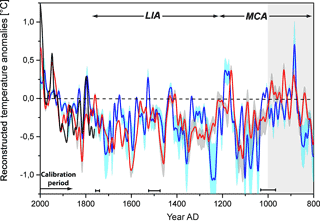
Figure 11 which shows temperature reconstruction with a two-year resolution. Very impressive. Note the steepness of both warming and cooling trends. Dropping by 2.3C between 1190 and 1240 and increasing by the same amount 850 - 855885. So 50 years and 35 years. but somehow 1C in 150 years is "alarming".

Title: Re: New paper - Ice Cores
Post by Bobby. on Jul 25th, 2020 at 3:09pm
Good find Lee.
Let Monk try and come up with an answer now.  :)

Title: Re: New paper - Ice Cores
Post by lee on Jul 25th, 2020 at 3:44pm
And all this when, apparently, there was little change in CO2 levels. ;)

I guess the "control knob" forgot.

Title: Re: New paper - Ice Cores
Post by Bobby. on Jul 25th, 2020 at 3:52pm

lee wrote on Jul 25th, 2020 at 3:44pm:
And all this when, apparently, there was little change in CO2 levels. ;)

I guess the "control knob" forgot.


There are actually many closed loop control systems
built into our climate - and it's for sure
there are many we still don't know about.
Climate change is normal but it always returns to a kind of set point.

Title: Re: New paper - Ice Cores
Post by Ajax on Jul 26th, 2020 at 2:39pm

lee wrote on Jul 25th, 2020 at 2:41pm:
Temperature and mineral dust variability recorded in two low-accumulation Alpine ice cores over the last millennium

Among ice core drilling sites in the European Alps, Colle Gnifetti (CG) is the only non-temperate glacier to offer climate records dating back at least 1000 years. This unique long-term archive is the result of an exceptionally low net accumulation driven by wind erosion and rapid annual layer thinning. However, the full exploitation of the CG time series has been hampered by considerable dating uncertainties and the seasonal summer bias in snow preservation. Using a new core drilled in 2013 we extend annual layer counting, for the first time at CG, over the last 1000 years and add additional constraints to the resulting age scale from radiocarbon dating. Based on this improved age scale, and using a multi-core approach with a neighbouring ice core, we explore the time series of stable water isotopes and the mineral dust proxies Ca2+ and insoluble particles. Also in our latest ice core we face the already known limitation to the quantitative use of the stable isotope variability based on a high and potentially non-stationary isotope/temperature sensitivity at CG. Decadal trends in Ca2+ reveal substantial agreement with instrumental temperature and are explored here as a potential site-specific supplement to the isotope-based temperature reconstruction. The observed coupling between temperature and Ca2+ trends likely results from snow preservation effects and the advection of dust-rich air masses coinciding with warm temperatures. We find that if calibrated against instrumental data, the Ca2+-based temperature reconstruction is in robust agreement with the latest proxy-based summer temperature reconstruction, including a “Little Ice Age” cold period as well as a medieval climate anomaly. Part of the medieval climate period around AD 1100–1200 clearly stands out through an increased occurrence of dust events, potentially resulting from a relative increase in meridional flow and/or dry conditions over the Mediterranean.


https://cp.copernicus.org/articles/14/21/2018/

Figure 11 which shows temperature reconstruction with a two-year resolution. Very impressive. Note the steepness of both warming and cooling trends. Dropping by 2.3C between 1190 and 1240 and increasing by the same amount 850 - 855885. So 50 years and 35 years. but somehow 1C in 150 years is "alarming".


cool................ 8-)

Title: Re: New paper - Ice Cores
Post by chimera on Jul 27th, 2020 at 2:23pm

lee wrote on Jul 25th, 2020 at 2:41pm:
Dropping by 2.3C between 1190 and 1240 and increasing by the same amount 850 - 855885. So 50 years and 35 years. but somehow 1C in 150 years is "alarming".

The entire graph is 2degrees and 2.3 is not on.
Arctic area of melt today is 2months ahead of known average
or 150% ( 6 months in 4). Greenland melt area is also about 150% known average , of about 40 years.

Title: Re: New paper - Ice Cores
Post by lee on Jul 27th, 2020 at 4:10pm

chimera wrote on Jul 27th, 2020 at 2:23pm:
The entire graph is 2degrees and 2.3 is not on.


Nope. There are pieces both under and over the +1C and -1C markings.


chimera wrote on Jul 27th, 2020 at 2:23pm:
Arctic area of melt today is 2months ahead of known average  or 150% ( 6 months in 4). Greenland melt area is also about 150% known average , of about 40 years.


Described by whom? Since 1979? ;D ;D ;D ;D


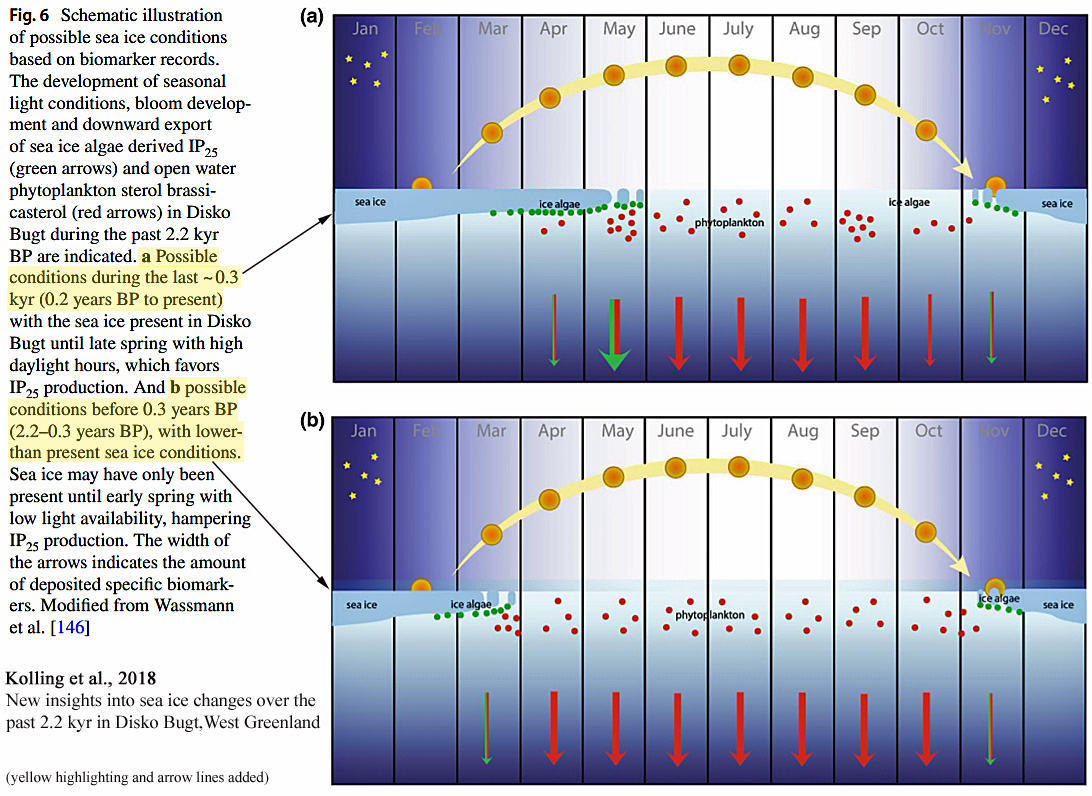
"In the graphical illustration of Late Holocene West Greenland sea ice changes shown above, Kolling and colleagues (2018) indicate that both present-day and Little Ice Age era (~1300s to 1800s AD) sea ice does not melt until May.(Fig. 6a).

During most of the last 2,200 years — especially during the Medieval Warm Period (MWP) and Roman Warm Period (RWP) — spring sea ice melted in March, two months earlier than today (Fig. 6b)."

https://notrickszone.com/2018/08/16/new-arctic-study-finds-spring-sea-ice-melted-2-months-earlier-than-today-during-roman-medieval-times/


Title: Re: New paper - Ice Cores
Post by The_Barnacle on Jul 27th, 2020 at 4:16pm

chimera wrote on Jul 27th, 2020 at 2:23pm:

lee wrote on Jul 25th, 2020 at 2:41pm:
Dropping by 2.3C between 1190 and 1240 and increasing by the same amount 850 - 855885. So 50 years and 35 years. but somehow 1C in 150 years is "alarming".

The entire graph is 2degrees and 2.3 is not on.
Arctic area of melt today is 2months ahead of known average
or 150% ( 6 months in 4). Greenland melt area is also about 150% known average , of about 40 years.


Thanks lee for the update on local conditions in the European Alps.
Good to see you cherry picking the data and then putting your own spin on it  ;)

Title: Re: New paper - Ice Cores
Post by lee on Jul 27th, 2020 at 4:23pm

The_Barnacle wrote on Jul 27th, 2020 at 4:16pm:
Thanks lee for the update on local conditions in the European Alps.


Poor petal. Perhaps you can show where I said anything different? It is just another view, with a much tighter resolution. Perhaps you thought I meant global temperatures? ;D ;D ;D ;D


The_Barnacle wrote on Jul 27th, 2020 at 4:16pm:
Good to see you cherry picking the data and then putting your own spin on it


What did I cherry pick petal? Please be specific.  ;)

Title: Re: New paper - Ice Cores
Post by chimera on Jul 27th, 2020 at 5:16pm
The red and dark blue are not outside 1 degree top and bottom. THe faint blue is not "Dropping by 2.3C between 1190 and 1240 and increasing by the same amount 850 - 855885."

Little men with cameras , sticks, gauges and satellites write down melting records. Ice always melts but a bit more rapidly with Siberian bushfires.

Title: Re: New paper - Ice Cores
Post by lee on Jul 27th, 2020 at 5:37pm

chimera wrote on Jul 27th, 2020 at 5:16pm:
THe faint blue is not "Dropping by 2.3C between 1190 and 1240 and increasing by the same amount 850 - 855885."


The faint blue line decreases from +0.8C to at least -1.5C, between 1190 and 1240. That is 2.3C.

The second date has been edited a strikethrough on 855 and changed to 885.

Between 850 and 885 it is at least 1.9C.  But I'll let you quibble the slight differences. ;)


chimera wrote on Jul 27th, 2020 at 5:16pm:
Little men with cameras , sticks, gauges and satellites write down melting records. Ice always melts but a bit more rapidly with Siberian bushfires.


So nothing on your Arctic ice claim? How unusual. ;D ;D ;D ;D ;D

Title: Re: New paper - Ice Cores
Post by Captain Nemo on Jul 27th, 2020 at 5:43pm

chimera wrote on Jul 27th, 2020 at 5:16pm:
The red and dark blue are not outside 1 degree top and bottom. THe faint blue is not "Dropping by 2.3C between 1190 and 1240 and increasing by the same amount 850 - 855885."

Little men with cameras , sticks, gauges and satellites write down melting records. Ice always melts but a bit more rapidly with Siberian bushfires.


Indeed you are correct ... in fact: the faint blue = "uncertainty indicated as light blue bands"  ;)


https://cp.copernicus.org/articles/14/21/2018/cp-14-21-2018-f11-thumb.png

Figure 11Comparison of decadal temperature trends as anomalies with respect to the mean of AD 2006–1860. Shown are calibrated temperatures obtained from the KCC Ca2+ variability (blue lines, with uncertainty indicated as light blue bands). Also shown are instrumental temperature data (black) and the summer temperature reconstruction of Luterbacher et al. (2016) in red (uncertainty as grey bands). Note that the overall co-variation between the two reconstructions persists for at least another 200 years beyond AD 1000 (light grey shaded area). Black bars on the bottom indicate maximum dating uncertainty.

https://cp.copernicus.org/articles/14/21/2018/


Title: Re: New paper - Ice Cores
Post by lee on Jul 27th, 2020 at 6:02pm

Captain Nemo wrote on Jul 27th, 2020 at 5:43pm:
Indeed you are correct ... in fact: the faint blue = "uncertainty
indicated as light blue bands"


And even without those uncertainty bars, far faster changes than the recent warming. ;)

Australian Politics Forum » Powered by YaBB 2.5.2!
YaBB Forum Software © 2000-2026. All Rights Reserved.