Australian Politics Forum
http://www.ozpolitic.com/forum/YaBB.pl
General Discussion >> General Board >> Australia's risk of recession? House of cards?
http://www.ozpolitic.com/forum/YaBB.pl?num=1432445624

Message started by Svengali on May 24th, 2015 at 3:33pm

Title: Australia's risk of recession? House of cards?
Post by Svengali on May 24th, 2015 at 3:33pm
"Australia’s housing market resembles “a giant Lehman Brothers,”."

Resources depressed. Consumers not spending. Huge indebtedness. Rising unemployment.

Will social welfare be overwhelmed by new clients? Queensland already in recession.

Australia's luck running out?


Quote:
Australia has been rated a high risk of slumping into recession, with commodity prices diving, public finances deteriorating and unemployment rising. After a record twenty-four straight years of economic expansion, has the lucky country’s luck finally run out?

From having at one point a stronger currency and lower unemployment rate than the United States, the tables have rapidly turned for the land “Down Under” following the end of the China-driven mining boom.

Analysts have put the chances of a recession in the world’s twelfth-largest economy at as high as 50 percent, hit by a downturn in the nation’s largest trading partner, China, which has slashed prices of key exports such as coal and iron ore.

Strategist Gerard Minack, “a well-known bear,” told the Sydney Morning Herald in March that the bursting of a housing bubble would mark the end of the good times for Australia.

"There's a 25 to 33 percent chance of a recession in the next 12 to 18 months," Minack said, with only "okay" employment data preventing him from calling a recession “outright.”

Goldman Sachs chief economist Tim Toohey reportedly agreed, predicting a one-in-three chance of recession in 2016. Bank of America Merrill Lynch chief economist Saul Eslake put the odds at “below 25 percent,” saying it would be the “first one that was not preceded by tight monetary policy.”

Already, the resource-rich state of Queensland has revealed that it fell into recession in 2014 for only the third time in the past thirty years, hit by lower prices of coal and other commodities. Its iron ore-rich counterpart, Western Australia, has seen growth slump to just two percent in fiscal 2016, its lowest rate since the recession of 1990.

On May 12, Australian Treasurer Joe Hockey told the nation the cupboard was bare, with previous hopes of a fiscal surplus pushed back to the end of the decade and likely even later. From a projected budget surplus of four billion Australian dollars by 2017, the government now expects a deficit of A$35 billion in the coming fiscal year and another A$26 billion a year later, while the jobless rate is seen climbing to 6.5 percent.

Hockey blamed drought, the “largest fall in our terms of trade in half a century” and a weaker than expected global recovery for wiping out A$90 billion in forecast government revenue.

Describing it as a “soft, cuddlier budget,” ANZ Research noted that structural reforms had been postponed, with any further economic deterioration likely to leave government finances stuck in the red for some time.

The Australian Financial Review’s Christopher Joye was harsher, saying the nation “faces its biggest fiscal challenge in 60 years and does not deserve an AAA credit rating.”

According to Joye, since the budget’s underlying cash balance fell into the red in fiscal 2009, the cumulative shortfall between the government’s revenue and spending has blown out to nearly twenty percent of gross domestic product (GDP).

Joye pointed to a blowout in household debt, which now exceeds 150 percent, despite the lowest interest rates on record, with much of it consumed by rising housing prices in the major cities of Sydney and Melbourne. Yet with the housing market already overvalued by an estimated twenty percent, fiscal and monetary policy options “all but completely spent,” Joye said there few options left to combat a real downturn.

“The rating agencies are smoking dope if they think Australia is a better ‘credit’ today than it was in the 1980s and 1990s,” he said.

On May 5, the Reserve Bank of Australia cut the official cash rate to a record low of two percent, citing weak business and public investment. In its meeting minutes, the central bank said it could consider another cut should the economy weaken further, with the hoped for surge in housing investment lacking outside Sydney and Melbourne and a weak Chinese economy weighing on the commodities sector.

Hockey’s budget forecasts predicted real GDP growth of 2.75 percent in fiscal year 2016, rising to 3.25 percent the following year and 3.5 percent thereafter. But with the forecasts relying on heavily indebted consumers spending more, the resource sector struggling to recover and the national currency remaining stubbornly high, others are less optimistic.

“If Australia does suffer a recession in the next few years it will most likely begin in one of three areas: the property market, our major banks or our mining sector. If I was a betting man I’d put my money on either the property market or the mining sector, with the financial sector suffering a second-order shock,” according to Business Spectator columnist Callam Pickering.

Amid claims that Australia’s housing market resembles “a giant Lehman Brothers,” analysts say the economy would be lucky indeed to continue its winning run through to the end of the decade.

Title: Re: Australia's risk of recession? House of cards?
Post by Dame Pansi on May 24th, 2015 at 5:11pm

We were lucky to walk away from the GFC relatively unscathed, it was in part due to Swan's clever policy of spending rather than austerity measures, plus other factors, known or unknown. This time we won't be so lucky, it's going to catch up with us, it's the same economic crisis, it didn't go away, it just floated around a bit and it's coming back bigger than before.

Real estate will be the second thing to bust, it was the first in America because they didn't have a mining crash, straight into the housing sector boom! boom! bang!
 
Those with zero debt will fare best and those that are lucky enough to keep their job will do ok too.

Title: Re: Australia's risk of recession? House of cards?
Post by longweekend58 on May 24th, 2015 at 6:59pm
and this source????


A BLOG.

from the same people who predicted this in 2014.... and 2013 and 2012.

Title: Re: Australia's risk of recession? House of cards?
Post by Svengali on May 24th, 2015 at 7:10pm

Ex Dame Pansi wrote on May 24th, 2015 at 5:11pm:
We were lucky to walk away from the GFC relatively unscathed, it was in part due to Swan's clever policy of spending rather than austerity measures, plus other factors, known or unknown. This time we won't be so lucky, it's going to catch up with us, it's the same economic crisis, it didn't go away, it just floated around a bit and it's coming back bigger than before.

Real estate will be the second thing to bust, it was the first in America because they didn't have a mining crash, straight into the housing sector boom! boom! bang!
 
Those with zero debt will fare best and those that are lucky enough to keep their job will do ok too.


A spike in unemployment could trigger a property collapse for those unfortunate enough to be over-committed with no financial reserves. A property collapse could also trigger a downward spike in the stock market, and the negative wealth effect from the property and stock market downturn could then strangle spending, spreading a recession to manufacturers, distributors and retailers.

Unemployment is currently spreading through the resource sector. In one instance a mining company suspends operation, workers are unemployed and a major contractor then collapses.

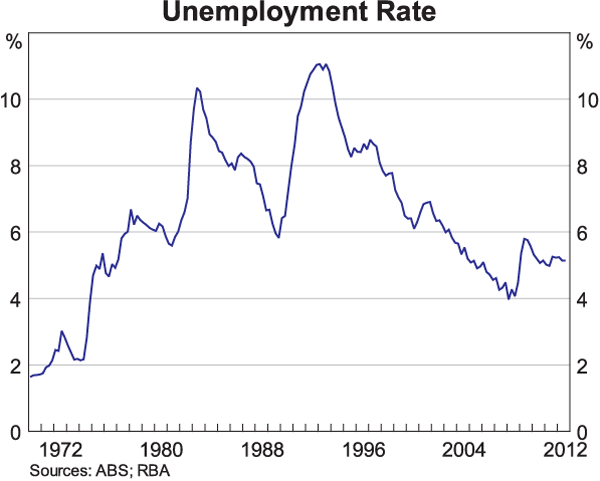
Note the 10.4% national unemployment and 30% for 18-24 by Roy Morgan. This is very bad news with more cuts coming.

More employment cuts coming


Quote:
ABS jobs data, however, excludes anyone who has worked one hour or more per week and those who are not actively seeking work on a daily basis. A more accurate picture is provided by the Roy Morgan jobs survey which estimates that 1.3 million people or 10.4 percent of the workforce are unemployed. Another 1.1 million or 9.0 percent are underemployed and looking for more work. Roy Morgan surveys also calculate that the national unemployment figure for 18- to 24-year-olds is almost 30 percent.

Falling iron ore prices, driven by contracting global demand, particularly in China and other parts of Asia, is fuelling extensive job destruction across that sector.

By early April, iron ore prices had plummeted 65.2 percent from their 2014 high of $US135 a tonne to a low of $47, before recovering to around $61 this month. Financial services provider UBS analysts have dismissed the possibility of any long-term improvement and forecast $45 a tonne in the second half of 2015. Citi group commentators are predicting the price will average of $37 a tonne for the rest of 2015.

Giant mining corporations such as BHP-Billiton and Rio Tinto are currently slashing jobs...

Last month the Western Australian-based Atlas Iron threatened to suspend operations and axe 600 jobs at its three iron ore mines in the north-west Pilbara region unless key contractors lowered costs. While new agreements were made with contracting companies at the Abydos and Wodgina mines, the Mount Webber mine remains closed leaving hundreds of workers without a job.

Rio Tinto has announced that is preparing to slash 800 jobs in the coming months from its iron ore division in Western Australia, adding to the 100 jobs already cut from its operations in Tom Price and Paraburdoo.

In April, Fortescue Metals Group, which continues to teeter on the brink of collapse, cut 200 jobs at the Cloudbreak and Christmas Creek mines in the Pilbara. Fortescue is demanding that its 4,000-strong Pilbara workforce accept major changes to rosters, which, according to industry analysts, could result in the destruction of another 700 jobs.

Depressed coal prices, currently at six-year lows of around $US63 a tonne and far below the $US150 in 2011, continue to drive layoffs across the sector. In the two years to May 2014, more than 10,000 coal mining jobs have been eliminated. In Newcastle-Hunter region—a major coal producing area in New South Wales (NSW)—official unemployment now stands at 12.2 percent.

In April, giant mining company Glencore announced that was axing 70 jobs from its 400-strong workforce at its Mount Owen Coal Mine near Singleton in the Hunter Valley on top of the 36 it axed last year. The company will also slash 75 jobs at its Ulan coal mine in western NSW.

Wollongong Coal has also announced that it will axe an undisclosed number of jobs at its Russell Vale coal mine on the NSW South Coast. The company sacked 152 workers from its Russell Vale and Wongawilli mines last year.

Jobs cuts have been recently announced in the manufacturing, retail and food processing industries. BP has announced it will close its oil refinery in Brisbane, Queensland by mid-2015 at the cost of more than 350 jobs. Western Australia's Water Corporation will slash 300 full-time jobs or 10 percent of its total workforce during the next eight months. Munitions manufacturer Thales Australia will also cut 40 jobs across two plants north-east Victoria and in southern NSW.

Supermarket giant Woolworths revealed it will axe 400 full-time jobs across its stores under its so-called “Lean Retail” plan aimed at slashing $500 million from operating costs during the 2015–16 financial year. The company has already cut 400 full-time positions in its back-office operations this year.

This month JBS Australia, Australia’s largest meat processor, axed 130 jobs at its Brooklyn plant in Melbourne...

Title: Re: Australia's risk of recession? House of cards?
Post by longweekend58 on May 24th, 2015 at 7:13pm

Svengali wrote on May 24th, 2015 at 7:10pm:

Ex Dame Pansi wrote on May 24th, 2015 at 5:11pm:
We were lucky to walk away from the GFC relatively unscathed, it was in part due to Swan's clever policy of spending rather than austerity measures, plus other factors, known or unknown. This time we won't be so lucky, it's going to catch up with us, it's the same economic crisis, it didn't go away, it just floated around a bit and it's coming back bigger than before.

Real estate will be the second thing to bust, it was the first in America because they didn't have a mining crash, straight into the housing sector boom! boom! bang!
 
Those with zero debt will fare best and those that are lucky enough to keep their job will do ok too.


A spike in unemployment could trigger a property collapse for those unfortunate enough to be over-committed with no financial reserves. A property collapse could also trigger a downward spike in the stock market, and the negative wealth effect from the property and stock market downturn could then strangle spending, spreading a recession to manufacturers, distributors and retailers.

Unemployment is currently spreading through the resource sector. In one instance a mining company suspends operation, workers are unemployed and a major contractor then collapses.

Note the 10.4% national unemployment and 30% for 18-24 by Roy Morgan. This is very bad news with more cuts coming.

More employment cuts coming


Quote:
ABS jobs data, however, excludes anyone who has worked one hour or more per week and those who are not actively seeking work on a daily basis. A more accurate picture is provided by the Roy Morgan jobs survey which estimates that 1.3 million people or 10.4 percent of the workforce are unemployed. Another 1.1 million or 9.0 percent are underemployed and looking for more work. Roy Morgan surveys also calculate that the national unemployment figure for 18- to 24-year-olds is almost 30 percent.

Giant mining corporations such as BHP-Billiton and Rio Tinto are currently slashing jobs...

Last month the Western Australian-based Atlas Iron threatened to suspend operations and axe 600 jobs at its three iron ore mines in the north-west Pilbara region unless key contractors lowered costs. While new agreements were made with contracting companies at the Abydos and Wodgina mines, the Mount Webber mine remains closed leaving hundreds of workers without a job.

Rio Tinto has announced that is preparing to slash 800 jobs in the coming months from its iron ore division in Western Australia, adding to the 100 jobs already cut from its operations in Tom Price and Paraburdoo.

In April, Fortescue Metals Group, which continues to teeter on the brink of collapse, cut 200 jobs at the Cloudbreak and Christmas Creek mines in the Pilbara. Fortescue is demanding that its 4,000-strong Pilbara workforce accept major changes to rosters, which, according to industry analysts, could result in the destruction of another 700 jobs.

Depressed coal prices, currently at six-year lows of around $US63 a tonne and far below the $US150 in 2011, continue to drive layoffs across the sector. In the two years to May 2014, more than 10,000 coal mining jobs have been eliminated. In Newcastle-Hunter region—a major coal producing area in New South Wales (NSW)—official unemployment now stands at 12.2 percent.

In April, giant mining company Glencore announced that was axing 70 jobs from its 400-strong workforce at its Mount Owen Coal Mine near Singleton in the Hunter Valley on top of the 36 it axed last year. The company will also slash 75 jobs at its Ulan coal mine in western NSW.

Wollongong Coal has also announced that it will axe an undisclosed number of jobs at its Russell Vale coal mine on the NSW South Coast. The company sacked 152 workers from its Russell Vale and Wongawilli mines last year.

Jobs cuts have been recently announced in the manufacturing, retail and food processing industries. BP has announced it will close its oil refinery in Brisbane, Queensland by mid-2015 at the cost of more than 350 jobs. Western Australia's Water Corporation will slash 300 full-time jobs or 10 percent of its total workforce during the next eight months. Munitions manufacturer Thales Australia will also cut 40 jobs across two plants north-east Victoria and in southern NSW.

Supermarket giant Woolworths revealed it will axe 400 full-time jobs across its stores under its so-called “Lean Retail” plan aimed at slashing $500 million from operating costs during the 2015–16 financial year. The company has already cut 400 full-time positions in its back-office operations this year.

This month JBS Australia, Australia’s largest meat processor, axed 130 jobs at its Brooklyn plant in Melbourne...


except we have had DOUBLE the current unemployment and a global recession and they was no house collapse.


you dont get much right, do you?

Title: Re: Australia's risk of recession? House of cards?
Post by Svengali on May 24th, 2015 at 8:17pm
Australia had 10% unemployment in 1981 and 1990. However property prices and debt levels were much lower then. Furthermore the resources downturns were not as severe as present, and unemployment is increasing not abating.

The government has no tools left to stimulate the economy. The economy is sending signals to homeowners to reduce their spending which will have negative consequences for economic growth.

It could be something as trivial as a prolonged heat wave over most of Australia that triggers a recession.


Title: Re: Australia's risk of recession? House of cards?
Post by Svengali on May 24th, 2015 at 10:59pm
Atlas Iron is closing it's mining operations losing 600 jobs directly and probably a similar number indirectly. Collateral damage from contractor bankruptcies is likely.

Woodside Energy has also acted recently to slash 200+ contractor jobs and reduce the rate of other contractors and employees.

Atlas ceases operation.


Quote:
Close to 600 people are set to lose their jobs after Atlas Iron announced it will close its mining operations.

The company said it will suspend mining over the month of April, with exports to cease a short time later.

The move comes in light of the iron ore price dive which has seen the commodity lose 25 per cent of its value since the start of the year to trade at 10-year lows.

Atlas Iron’s break-even price is $US60 a tonne, well above the current spot price of $US47 a tonne.

All Atlas’ projects will be put on care and maintenance, pending future iron ore market conditions.

The company will cease mining and crushing at its Mt Webber project this week, while operations at the Abydos project are scheduled to come to a halt within 14 days.

Atlas Managing Director Ken Brinsden said the decision to suspend production was taken after extensive consideration of the company’s financial position, discussions with contractors and secured creditors.

“To suspend our operations, with the impact that will have on so many committed and talented people, is an extremely difficult decision,” Brinsden said.

“I sincerely thank all those who have worked so hard to build Atlas’ production base and those who have worked furiously to maintain Atlas’ competitive position over the past 15 months, in the face of increasingly oppressive market conditions.”

Western Australia Premier Colin Barnett said the move by Atlas was of “immense concern” and again hit out at the strategies of BHP Billiton, Rio Tinto and Fortescue Metals Group.

The big miners have been blamed for the falling price of iron ore as they pump record volumes into the market despite reduced demand.

In comments reminiscent of those made just months ago, Barnett warned the miners that they did not own the iron ore reserves.

"The State Government owns the iron ore and we are not willing to simply allow the iron ore continue to be sold at throwaway prices - and that's a pretty clear message to the iron ore industry,” he said.

"Don't forget who owns the iron ore, who controls the projects, who controls the ports, who controls tonnages and the like."

Barnett said he wants companies to understand that he is not “some dopey Premier” who will sit back and do nothing while the resource value falls.

"I cannot understand the business strategy of the three big major iron ore producers of flooding the market when the market is weak," he said.

"That is just a flawed strategy and not only has it hurt a company like Atlas Iron - dramatically - I think the companies are hurting their own shareholders and indeed the market.”

Atlas said it believes the price of iron ore will eventually increase based on the significant percentage of global iron ore production which is now cash flow negative.

However it said the timing of this recovery is unclear and the company is now in discussions with its creditors concerning options which would enable its mines to re-start as efficiently as possible in a circumstance where an operating margin can be re-established.

The flow-on effect the mine closures will have were highlighted this morning with mining contractor MACA announcing its revenue guidance would be impacted by the lost contract.

The contract at Abydos for both mining and crushing services generated between $4 million to $5 million per month for MACA.

In an ASX statement this morning, the company said as a consequence of the contract suspension its full-year revenue guidance for the 2015 financial year will be $600 million.

Title: Re: Australia's risk of recession? House of cards?
Post by cods on May 24th, 2015 at 11:08pm

Ex Dame Pansi wrote on May 24th, 2015 at 5:11pm:
We were lucky to walk away from the GFC relatively unscathed, it was in part due to Swan's clever policy of spending rather than austerity measures, plus other factors, known or unknown. This time we won't be so lucky, it's going to catch up with us, it's the same economic crisis, it didn't go away, it just floated around a bit and it's coming back bigger than before.

Real estate will be the second thing to bust, it was the first in America because they didn't have a mining crash, straight into the housing sector boom! boom! bang!
 
Those with zero debt will fare best and those that are lucky enough to keep their job will do ok too.


SWAN also received a $20billion surplus...most of the spending of that went overseas... how soon you forget.. then with the rest like the pinkbatts fiasco.. I am almost sure we are still being billled for that one..

this time around the Libs inherited a HUGE bloody DEBT that even SWANS figures and then KRUDDS couldnt even come close to fixing...??? but again dont let facts get in the way of anything..

of course the CARBON TAX was in fact a nail in the already crumbling coffin   of the mining industry.... and now shorten wants to bring it all back....

talk about brideshead revisited.. ???? he is a crash waiting to happen....oh wait a minute THERES MORE.... to add to that he wants to open our borders again.... ::) ::) ::) ::)..


havent that lot done enough harm??????....

apparently NOT.....

the labs now cant get rid of the idiot...KRUDDS MASTERPIECE>

Title: Re: Australia's risk of recession? House of cards?
Post by Svengali on May 25th, 2015 at 2:12am
It is not the government debt alone that can trigger a recession. Growing government debt is a sign that something is wrong with the economy which will take a long time to fix.

It is more likely to be something like unstoppable unemployment growth which then triggers mortgage defaults with consequent pressure on banks.

Title: Re: Australia's risk of recession? House of cards?
Post by Sir lastnail on May 25th, 2015 at 12:40pm

longweekend58 wrote on May 24th, 2015 at 6:59pm:
and this source????


A BLOG.

from the same people who predicted this in 2014.... and 2013 and 2012.


And the big one you which you completely missed called the GFC and caused by speculation in 'low risk' property assets ;)

Title: Re: Australia's risk of recession? House of cards?
Post by Sir lastnail on May 25th, 2015 at 12:45pm

Svengali wrote on May 25th, 2015 at 2:12am:
It is not the government debt alone that can trigger a recession. Growing government debt is a sign that something is wrong with the economy which will take a long time to fix.

It is more likely to be something like unstoppable unemployment growth which then triggers mortgage defaults with consequent pressure on banks.


Don't worry, Joe has managed to kick the can down the road yet once again and bought another few months for the housing ponzi scheme as well as all of the tradies and import junkies such as Bunnings and Harvey Norman who feed from it ;)

Just when I though that they couldn't possibly come up with yet another stint at resuscitating the economy, there was Joe breaking all of his own rules of paying down debt :D LOL

Title: Re: Australia's risk of recession? House of cards?
Post by Dame Pansi on May 25th, 2015 at 2:01pm

Sir lastnail wrote on May 25th, 2015 at 12:40pm:

longweekend58 wrote on May 24th, 2015 at 6:59pm:
and this source????


A BLOG.

from the same people who predicted this in 2014.... and 2013 and 2012.


And the big one you which you completely missed called the GFC and caused by speculation in 'low risk' property assets ;)


That looming GFC went straight over longie's head, like most things.

Remember he called us a bunch of doom-sayers with morbid depression for even mentioning an economic collapse. Just like he's doing now with the housing boom. Longy doesn't realise there will come a time when the government can no longer hold up the housing market by manipulating the conditions in which it grows. He's like a kid that can't understand there'll be no more lollies when he finishes that bag.

Title: Re: Australia's risk of recession? House of cards?
Post by perceptions_now on May 25th, 2015 at 2:11pm

Ex Dame Pansi wrote on May 25th, 2015 at 2:01pm:

Sir lastnail wrote on May 25th, 2015 at 12:40pm:

longweekend58 wrote on May 24th, 2015 at 6:59pm:
and this source????


A BLOG.

from the same people who predicted this in 2014.... and 2013 and 2012.


And the big one you which you completely missed called the GFC and caused by speculation in 'low risk' property assets ;)


That looming GFC went straight over longie's head, like most things.

Remember he called us a bunch of doom-sayers with morbid depression for even mentioning an economic collapse. Just like he's doing now with the housing boom. Longy doesn't realise there will come a time when the government can no longer hold up the housing market by manipulating the conditions in which it grows. He's like a kid that can't understand there'll be no more lollies when he finishes that bag.


Well Pansi, GFC2 is certainly on its way & there are now more commentators saying that not only is it coming, But it will be worse & last longer, than the 2008/2009 GFC!

As for Longie, he will find out soon enough and like others who "assume" that there are no Economic Limitations, they will find out they were wrong and the cost to them may well be greater, because they didn't listen to common sense & therefore didn't take the appropriate actions!

Title: Re: Australia's risk of recession? House of cards?
Post by Sir lastnail on May 25th, 2015 at 2:29pm

Ex Dame Pansi wrote on May 25th, 2015 at 2:01pm:

Sir lastnail wrote on May 25th, 2015 at 12:40pm:

longweekend58 wrote on May 24th, 2015 at 6:59pm:
and this source????


A BLOG.

from the same people who predicted this in 2014.... and 2013 and 2012.


And the big one you which you completely missed called the GFC and caused by speculation in 'low risk' property assets ;)


That looming GFC went straight over longie's head, like most things.

Remember he called us a bunch of doom-sayers with morbid depression for even mentioning an economic collapse. Just like he's doing now with the housing boom. Longy doesn't realise there will come a time when the government can no longer hold up the housing market by manipulating the conditions in which it grows. He's like a kid that can't understand there'll be no more lollies when he finishes that bag.


he missed the GFC because just like he is now he believes that property is a 'low risk' investment which can't possibly fail !!

Title: Re: Australia's risk of recession? House of cards?
Post by Svengali on May 25th, 2015 at 2:31pm
The problem will be that the government has no money for economic stimulus in case the recession occurs.

If a recession strikes, the budget will go so far in the red from loss of tax revenue and blow-out in social welfare costs the debt will take decades to repay.

Title: Re: Australia's risk of recession? House of cards?
Post by longweekend58 on May 25th, 2015 at 7:06pm

Svengali wrote on May 24th, 2015 at 8:17pm:
Australia had 10% unemployment in 1981 and 1990. However property prices and debt levels were much lower then. Furthermore the resources downturns were not as severe as present, and unemployment is increasing not abating.

The government has no tools left to stimulate the economy. The economy is sending signals to homeowners to reduce their spending which will have negative consequences for economic growth.

It could be something as trivial as a prolonged heat wave over most of Australia that triggers a recession.


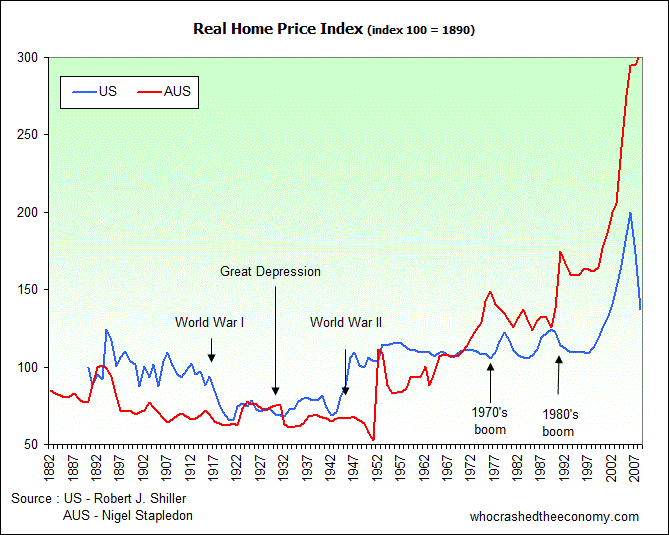
something you obviously didn't notice is that the USA trend largely matches the Australian trend. so if that is the case, why haven't we had housing process crashes - EVER????  Could it be that our housing markets, banking and general finance sector is vastly different, far more regulated and less volatile??

so why should the future be any different to the past?

Title: Re: Australia's risk of recession? House of cards?
Post by Secret Wars on May 25th, 2015 at 7:23pm


Non recourse loans is one hell of a big difference.  Due to its depression legacy if you are in trouble with your housing loan just drop the keys off to the bank and walk away.  Nuffin they can do. 

Plus the antics of fanny Mae and fanny Mac mislaced (read weepy softcock) social housing initiatives offering loans to people who had been refused by every other institution that bothered  to ask how poor folk with no history of saving, no assets, no job or prospect of a job on the horizon would ever reliably repay the loan. 

Title: Re: Australia's risk of recession? House of cards?
Post by Svengali on May 25th, 2015 at 7:36pm

Secret Wars wrote on May 25th, 2015 at 7:23pm:
Non recourse loans is one hell of a big difference.  Due to its depression legacy if you are in trouble with your housing loan just drop the keys off to the bank and walk away.  Nuffin they can do. 

Plus the antics of fanny Mae and fanny Mac mislaced (read weepy softcock) social housing initiatives offering loans to people who had been refused by every other institution that bothered  to ask how poor folk with no history of saving, no assets, no job or prospect of a job on the horizon would ever reliably repay the loan. 


That's not true. Banks and other financial institutions can sue you for their losses. In most cases they may choose not to because the defaulter has no assets worth suing for.

Title: Re: Australia's risk of recession? House of cards?
Post by Svengali on May 25th, 2015 at 7:37pm

longweekend58 wrote on May 25th, 2015 at 7:06pm:

Svengali wrote on May 24th, 2015 at 8:17pm:
Australia had 10% unemployment in 1981 and 1990. However property prices and debt levels were much lower then. Furthermore the resources downturns were not as severe as present, and unemployment is increasing not abating.

The government has no tools left to stimulate the economy. The economy is sending signals to homeowners to reduce their spending which will have negative consequences for economic growth.

It could be something as trivial as a prolonged heat wave over most of Australia that triggers a recession.


something you obviously didn't notice is that the USA trend largely matches the Australian trend. so if that is the case, why haven't we had housing process crashes - EVER????  Could it be that our housing markets, banking and general finance sector is vastly different, far more regulated and less volatile??

so why should the future be any different to the past?


Lessons from GFC!

Title: Re: Australia's risk of recession? House of cards?
Post by longweekend58 on May 25th, 2015 at 7:39pm

Svengali wrote on May 25th, 2015 at 7:36pm:

Secret Wars wrote on May 25th, 2015 at 7:23pm:
Non recourse loans is one hell of a big difference.  Due to its depression legacy if you are in trouble with your housing loan just drop the keys off to the bank and walk away.  Nuffin they can do. 

Plus the antics of fanny Mae and fanny Mac mislaced (read weepy softcock) social housing initiatives offering loans to people who had been refused by every other institution that bothered  to ask how poor folk with no history of saving, no assets, no job or prospect of a job on the horizon would ever reliably repay the loan. 


That's not true. Banks and other financial institutions can sue you for their losses. In most cases they may choose not to because the defaulter has no assets worth suing for.


not ion the USA.  you can literally walk away from your house at any time with no recourse.  and you don't think that turned a major downturn into an avalanche??????

but you cant do that here.

Title: Re: Australia's risk of recession? House of cards?
Post by Svengali on May 25th, 2015 at 7:47pm

longweekend58 wrote on May 25th, 2015 at 7:39pm:

Svengali wrote on May 25th, 2015 at 7:36pm:

Secret Wars wrote on May 25th, 2015 at 7:23pm:
Non recourse loans is one hell of a big difference.  Due to its depression legacy if you are in trouble with your housing loan just drop the keys off to the bank and walk away.  Nuffin they can do. 

Plus the antics of fanny Mae and fanny Mac mislaced (read weepy softcock) social housing initiatives offering loans to people who had been refused by every other institution that bothered  to ask how poor folk with no history of saving, no assets, no job or prospect of a job on the horizon would ever reliably repay the loan. 


That's not true. Banks and other financial institutions can sue you for their losses. In most cases they may choose not to because the defaulter has no assets worth suing for.


not ion the USA.  you can literally walk away from your house at any time with no recourse.  and you don't think that turned a major downturn into an avalanche??????

but you cant do that here.


That is not true. This came up in a much earlier discussion which demonstrated that defaulters could be sued in USA. The problem in USA with suing most defaulters is they have no assets, particularly American defaulters who mostly live from pay cheque to pay cheque and have no financial reserves and a mountain of credit card debt.

Title: Re: Australia's risk of recession? House of cards?
Post by Secret Wars on May 25th, 2015 at 7:52pm

Svengali wrote on May 25th, 2015 at 7:36pm:

Secret Wars wrote on May 25th, 2015 at 7:23pm:
Non recourse loans is one hell of a big difference.  Due to its depression legacy if you are in trouble with your housing loan just drop the keys off to the bank and walk away.  Nuffin they can do. 

Plus the antics of fanny Mae and fanny Mac mislaced (read weepy softcock) social housing initiatives offering loans to people who had been refused by every other institution that bothered  to ask how poor folk with no history of saving, no assets, no job or prospect of a job on the horizon would ever reliably repay the loan. 


That's not true. Banks and other financial institutions can sue you for their losses. In most cases they may choose not to because the defaulter has no assets worth suing for.


::) result being....

Think it through....

Take your time....

Title: Re: Australia's risk of recession? House of cards?
Post by longweekend58 on May 25th, 2015 at 7:55pm

Svengali wrote on May 25th, 2015 at 7:47pm:

longweekend58 wrote on May 25th, 2015 at 7:39pm:

Svengali wrote on May 25th, 2015 at 7:36pm:

Secret Wars wrote on May 25th, 2015 at 7:23pm:
Non recourse loans is one hell of a big difference.  Due to its depression legacy if you are in trouble with your housing loan just drop the keys off to the bank and walk away.  Nuffin they can do. 

Plus the antics of fanny Mae and fanny Mac mislaced (read weepy softcock) social housing initiatives offering loans to people who had been refused by every other institution that bothered  to ask how poor folk with no history of saving, no assets, no job or prospect of a job on the horizon would ever reliably repay the loan. 


That's not true. Banks and other financial institutions can sue you for their losses. In most cases they may choose not to because the defaulter has no assets worth suing for.


not ion the USA.  you can literally walk away from your house at any time with no recourse.  and you don't think that turned a major downturn into an avalanche??????

but you cant do that here.


That is not true. This came up in a much earlier discussion which demonstrated that defaulters could be sued in USA. The problem in USA with suing most defaulters is they have no assets, particularly American defaulters who mostly live from pay cheque to pay cheque and have no financial reserves and a mountain of credit card debt.


well... it still isn't true.  American mortgagees CAN walk away from their homes without a comeback.  That is why the avalanche of people doing just that occurred during the GFC.

and defaulters DO have assets. Most of them have jobs and go to alternate housing and often buy again.

Title: Re: Australia's risk of recession? House of cards?
Post by Sir lastnail on May 25th, 2015 at 8:36pm

longweekend58 wrote on May 25th, 2015 at 7:55pm:

Svengali wrote on May 25th, 2015 at 7:47pm:

longweekend58 wrote on May 25th, 2015 at 7:39pm:

Svengali wrote on May 25th, 2015 at 7:36pm:

Secret Wars wrote on May 25th, 2015 at 7:23pm:
Non recourse loans is one hell of a big difference.  Due to its depression legacy if you are in trouble with your housing loan just drop the keys off to the bank and walk away.  Nuffin they can do. 

Plus the antics of fanny Mae and fanny Mac mislaced (read weepy softcock) social housing initiatives offering loans to people who had been refused by every other institution that bothered  to ask how poor folk with no history of saving, no assets, no job or prospect of a job on the horizon would ever reliably repay the loan. 


That's not true. Banks and other financial institutions can sue you for their losses. In most cases they may choose not to because the defaulter has no assets worth suing for.


not ion the USA.  you can literally walk away from your house at any time with no recourse.  and you don't think that turned a major downturn into an avalanche??????

but you cant do that here.


That is not true. This came up in a much earlier discussion which demonstrated that defaulters could be sued in USA. The problem in USA with suing most defaulters is they have no assets, particularly American defaulters who mostly live from pay cheque to pay cheque and have no financial reserves and a mountain of credit card debt.


well... it still isn't true.  American mortgagees CAN walk away from their homes without a comeback.  That is why the avalanche of people doing just that occurred during the GFC.

and defaulters DO have assets. Most of them have jobs and go to alternate housing and often buy again.


That's exactly what we need here !! Let people walk away from their over priced bullshit and give the banks a dose of their own medicine ;)

Title: Re: Australia's risk of recession? House of cards?
Post by Sir Bobby on May 25th, 2015 at 9:09pm
And the recession will happen under Tony Abbott.

Title: Re: Australia's risk of recession? House of cards?
Post by Svengali on May 25th, 2015 at 9:37pm

longweekend58 wrote on May 25th, 2015 at 7:55pm:

Svengali wrote on May 25th, 2015 at 7:47pm:

longweekend58 wrote on May 25th, 2015 at 7:39pm:

Svengali wrote on May 25th, 2015 at 7:36pm:

Secret Wars wrote on May 25th, 2015 at 7:23pm:
Non recourse loans is one hell of a big difference.  Due to its depression legacy if you are in trouble with your housing loan just drop the keys off to the bank and walk away.  Nuffin they can do. 

Plus the antics of fanny Mae and fanny Mac mislaced (read weepy softcock) social housing initiatives offering loans to people who had been refused by every other institution that bothered  to ask how poor folk with no history of saving, no assets, no job or prospect of a job on the horizon would ever reliably repay the loan. 


That's not true. Banks and other financial institutions can sue you for their losses. In most cases they may choose not to because the defaulter has no assets worth suing for.


not ion the USA.  you can literally walk away from your house at any time with no recourse.  and you don't think that turned a major downturn into an avalanche??????

but you cant do that here.


That is not true. This came up in a much earlier discussion which demonstrated that defaulters could be sued in USA. The problem in USA with suing most defaulters is they have no assets, particularly American defaulters who mostly live from pay cheque to pay cheque and have no financial reserves and a mountain of credit card debt.


well... it still isn't true.  American mortgagees CAN walk away from their homes without a comeback.  That is why the avalanche of people doing just that occurred during the GFC.

and defaulters DO have assets. Most of them have jobs and go to alternate housing and often buy again.


Number of qualifications to this:

1. Non-recourse loans are generally for 50-60% of property value due to risk carried by lender.
2. In case of non-recourse debt forgiveness, the debtor incurs a taxable gain equal to the difference between the sale price and the outstanding debt. If the bank loses $20,000 that is registered as a $20,000 taxable gain by the debtor despite the fact the debtor receives no money from the transaction.
3. The lender records a loss of $20,000 which is deductible from taxable income.

http://en.wikipedia.org/wiki/Nonrecourse_debt

Note the reference in the Wikipedia article to "adjusted basis" where in the example above the taxpayer had equity of $45,000 and was considered to have received a taxable benefit of $45,000 which is considerably more than the difference between the debt and the market value of the property. This 'adjusted basis' appears to be a punishment for repudiation of debt.

Title: Re: Australia's risk of recession? House of cards?
Post by Secret Wars on May 25th, 2015 at 9:41pm
I was addressing the differences between the markets, to break it down, because you seem to getting lost in details.  A major difference was government entities guaranteeing loans for people who otherwise could never get loans who could walk away from those loans. 

That is a big difference. 

Title: Re: Australia's risk of recession? House of cards?
Post by Svengali on May 26th, 2015 at 10:28am

Secret Wars wrote on May 25th, 2015 at 9:41pm:
I was addressing the differences between the markets, to break it down, because you seem to getting lost in details.  A major difference was government entities guaranteeing loans for people who otherwise could never get loans who could walk away from those loans. 

That is a big difference. 


Same has been happening in Australia over the past 10 years. RBA had to impose in Australian banks to tighten their lending policies to avoid creating a bow wave of default in case of a recession.

Title: Re: Australia's risk of recession? House of cards?
Post by longweekend58 on May 26th, 2015 at 12:04pm

Svengali wrote on May 26th, 2015 at 10:28am:

Secret Wars wrote on May 25th, 2015 at 9:41pm:
I was addressing the differences between the markets, to break it down, because you seem to getting lost in details.  A major difference was government entities guaranteeing loans for people who otherwise could never get loans who could walk away from those loans. 

That is a big difference. 


Same has been happening in Australia over the past 10 years. RBA had to impose in Australian banks to tighten their lending policies to avoid creating a bow wave of default in case of a recession.


it was Keating and Costello with their banking reforms that really saved Australia from the worst of the GFC.

Title: Re: Australia's risk of recession? House of cards?
Post by Svengali on May 26th, 2015 at 12:14pm

longweekend58 wrote on May 26th, 2015 at 12:04pm:

Svengali wrote on May 26th, 2015 at 10:28am:

Secret Wars wrote on May 25th, 2015 at 9:41pm:
I was addressing the differences between the markets, to break it down, because you seem to getting lost in details.  A major difference was government entities guaranteeing loans for people who otherwise could never get loans who could walk away from those loans. 

That is a big difference. 


Same has been happening in Australia over the past 10 years. RBA had to impose in Australian banks to tighten their lending policies to avoid creating a bow wave of default in case of a recession.


it was Keating and Costello with their banking reforms that really saved Australia from the worst of the GFC.


Australia was just lucky it was too small to be of interest to the giants of international finance manipulation, otherwise the disease would have spread to Australia.

Title: Re: Australia's risk of recession? House of cards?
Post by longweekend58 on May 26th, 2015 at 12:56pm

Svengali wrote on May 26th, 2015 at 12:14pm:

longweekend58 wrote on May 26th, 2015 at 12:04pm:

Svengali wrote on May 26th, 2015 at 10:28am:

Secret Wars wrote on May 25th, 2015 at 9:41pm:
I was addressing the differences between the markets, to break it down, because you seem to getting lost in details.  A major difference was government entities guaranteeing loans for people who otherwise could never get loans who could walk away from those loans. 

That is a big difference. 


Same has been happening in Australia over the past 10 years. RBA had to impose in Australian banks to tighten their lending policies to avoid creating a bow wave of default in case of a recession.


it was Keating and Costello with their banking reforms that really saved Australia from the worst of the GFC.


Australia was just lucky it was too small to be of interest to the giants of international finance manipulation, otherwise the disease would have spread to Australia.


cue conspiracy theory and paranoia.


get some new meds.

Title: Re: Australia's risk of recession? House of cards?
Post by Svengali on May 26th, 2015 at 7:43pm

longweekend58 wrote on May 26th, 2015 at 12:04pm:

Svengali wrote on May 26th, 2015 at 10:28am:

Secret Wars wrote on May 25th, 2015 at 9:41pm:
I was addressing the differences between the markets, to break it down, because you seem to getting lost in details.  A major difference was government entities guaranteeing loans for people who otherwise could never get loans who could walk away from those loans. 

That is a big difference. 


Same has been happening in Australia over the past 10 years. RBA had to impose in Australian banks to tighten their lending policies to avoid creating a bow wave of default in case of a recession.


it was Keating and Costello with their banking reforms that really saved Australia from the worst of the GFC.


It was more than that. Australia was experiencing inflation and interest rates were much higher than other countries which allowed much greater stimulus from interest rate reductions.

Also, Australia's finances were strong from 17 years of uninterrupted growth.

Yes, banking regulation was helpful, however it was just one factor in the outcome.

Australian Politics Forum » Powered by YaBB 2.5.2!
YaBB Forum Software © 2000-2026. All Rights Reserved.