Australian Politics Forum
http://www.ozpolitic.com/forum/YaBB.pl
Member Run Boards >> Environment >> Is Greenland close to a tipping point?
http://www.ozpolitic.com/forum/YaBB.pl?num=1344047982

Message started by Upton Sinclair on Aug 4th, 2012 at 12:39pm

Title: Is Greenland close to a tipping point?
Post by Upton Sinclair on Aug 4th, 2012 at 12:39pm
Is Greenland close to a climate tipping point?

Recent findings suggest climate change in Greenland may be approaching a tipping point, beyond which amplifying feedbacks could lead (probably over centuries) to complete melting of the ice sheet, raising sea level by about 7 meters.

In June, a team of glaciologists led by Jason Box predicted that we would see melting across 100% of the ice sheet’s surface area in summer within a decade (Box et al., in press). They drew that conclusion from data on the Greenland ice sheet’s surface reflectivity, or “albedo”, showing the surface has gotten darker over the last 12 years. A darker surface absorbs more heat, leading to more melting, causing albedo to decrease further, and so on in a vicious circle.

The ice naturally gets less reflective in summer because the shape of the snowflakes changes and meltwater reveals impurities beneath the surface, but in 2012 Greenland has become much darker than in previous summers. This is occurring particularly at high elevations, which were previously too cold to melt and indeed had gained ice from increasing snowfall. This month, at the height of the melt season, Greenland’s albedo has fallen far off the charts:
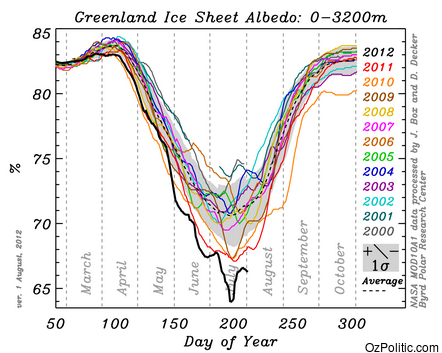

Figure 1: Surface albedo of the Greenland ice sheet (average of all elevations) between March and October in each year from 2000 to 2012. (Source: Ohio State University, 2012)

Then NASA satellites recorded a startling abrupt acceleration of melting over just four days. On 8 July, about 40% of the ice sheet’s area had surface melt. By 12 July, surface melt had spread to no less than 97% of the area, penetrating all the way to the centre of Greenland, three kilometers above sea level:


Figure 2: Map of Greenland showing the area experiencing surface melt on 8 July (left) and on 12 July (right). (Source: NASA, 2012)

“This was so extraordinary that at first I questioned the result: was this real or was it due to a data error?” said Son Nghiem of NASA’s Jet Propulsion Laboratory. The melting has been confirmed by independent measurements, and attributed to a warm air mass sitting over Greenland during that week. Ice cores show this to be a 1-in-150-year event.

It is not yet clear whether this single occurence is indicative of a trend; a year with greater snowfall could return the albedo to a more normal state. Nevertheless, the extraordinary events of recent weeks are cause for concern when considered in the context of Greenland’s ice melting at an accelerating rate for the last decade, losing more than 2 trillion tonnes in total:


Figure 3: Greenland ice sheet mass relative to the 2002-2011 average.

According to recent modeling (Robinson et al, 2012), the tipping point for eventual total melting of the Greenland ice sheet could be a global temperature of around 1.6°C above preindustrial. Worse, the lower end of the range of possibilities is only 0.8°C, equal to today’s global temperature.

There is broader evidence that no significant cushion remains between today’s climate and a dangerous level of warming. In the last interglacial age 125,000 years ago, called the Eemian, global temperature was only ~1°C warmer than preindustrial, ie. only a couple of tenths of a degree warmer than today (Hansen et al., in press). Yet the poles were several degrees warmer, there was no summer sea ice in the Arctic, and multiple studies using different methodologies (Kopp et al., 2009; Dutton & Lambeck, 2012) say sea level was 6-9 meters higher (meaning at least partial melting of the Greenland and/or West Antarctic ice sheets).

All this points to the conclusion we may already be getting close to a dangerous level of global warming. If humanity rapidly cuts global CO2 emissions to zero or near-zero, it might be possible to return the Earth to energy balance and prevent much further warming (Hansen et al., in press). If business-as-usual emissions continue for much longer, there is a risk that eventual melting of the Greenland ice sheet could become irreversible.

Title: Re: Is Greenland close to a tipping point?
Post by namnugenot on Aug 4th, 2012 at 2:47pm
Iceland has been free of ice many times and yet voila currently it has ice as yet to melt. It either will or it won't. On the happy side if it melts you can say "I told you so" as to the event, as to the cause we can continue to speculate on the available evidence. No doubt there are tipping points but in any large poorly understood complex system there are also negative feedbacks. For example higher temperatures causing through these interactions ultimately climate reverses...ie cooling.
Jimmy crack corn and I don't care either way but I will observe with great interest even if....gasp....nothing happens.  :)

Title: Re: Is Greenland close to a tipping point?
Post by muso on Aug 5th, 2012 at 7:31am

namnugenot wrote on Aug 4th, 2012 at 2:47pm:
Iceland has been free of ice many times and yet voila currently it has ice as yet to melt. It either will or it won't. On the happy side if it melts you can say "I told you so" as to the event, as to the cause we can continue to speculate on the available evidence. No doubt there are tipping points but in any large poorly understood complex system there are also negative feedbacks. For example higher temperatures causing through these interactions ultimately climate reverses...ie cooling.
Jimmy crack corn and I don't care either way but I will observe with great interest even if....gasp....nothing happens.  :)


Why are you talking about Iceland?  It has a relatively temperate climate, or it did.
like.jpg (5 KB | 53 )

Title: Re: Is Greenland close to a tipping point?
Post by namnugenot on Aug 5th, 2012 at 8:08am

muso wrote on Aug 5th, 2012 at 7:31am:

namnugenot wrote on Aug 4th, 2012 at 2:47pm:
Iceland has been free of ice many times and yet voila currently it has ice as yet to melt. It either will or it won't. On the happy side if it melts you can say "I told you so" as to the event, as to the cause we can continue to speculate on the available evidence. No doubt there are tipping points but in any large poorly understood complex system there are also negative feedbacks. For example higher temperatures causing through these interactions ultimately climate reverses...ie cooling.
Jimmy crack corn and I don't care either way but I will observe with great interest even if....gasp....nothing happens.  :)


Why are you talking about Iceland?  It has a relatively temperate climate, or it did.


My bad...slip of the pen...scratch Ice sub Green  :)

Title: Re: Is Greenland close to a tipping point?
Post by MOTR on Aug 5th, 2012 at 9:38am

namnugenot wrote on Aug 4th, 2012 at 2:47pm:
Iceland has been free of ice many times and yet voila currently it has ice as yet to melt. It either will or it won't. On the happy side if it melts you can say "I told you so" as to the event, as to the cause we can continue to speculate on the available evidence. No doubt there are tipping points but in any large poorly understood complex system there are also negative feedbacks. For example higher temperatures causing through these interactions ultimately climate reverses...ie cooling.
Jimmy crack corn and I don't care either way but I will observe with great interest even if....gasp....nothing happens.  :)


Which negative feedbacks are going to stop the climate from shifting beyond our comfort zone.

Title: Re: Is Greenland close to a tipping point?
Post by MOTR on Aug 5th, 2012 at 9:41am

namnugenot wrote on Aug 4th, 2012 at 2:47pm:
Iceland has been free of ice many times and yet voila currently it has ice as yet to melt. It either will or it won't. On the happy side if it melts you can say "I told you so" as to the event, as to the cause we can continue to speculate on the available evidence. No doubt there are tipping points but in any large poorly understood complex system there are also negative feedbacks. For example higher temperatures causing through these interactions ultimately climate reverses...ie cooling.
Jimmy crack corn and I don't care either way but I will observe with great interest even if....gasp....nothing happens.  :)


Too cool for school.

Title: Re: Is Greenland close to a tipping point?
Post by muso on Aug 5th, 2012 at 10:08am

MOTR wrote on Aug 5th, 2012 at 9:38am:
[quote author=28272B28332123282932460 link=1344047982/1#1 date=1344055634]

Which negative feedbacks are going to stop the climate from shifting beyond our comfort zone.


God  ;D

Title: Re: Is Greenland close to a tipping point?
Post by namnugenot on Aug 5th, 2012 at 6:18pm

MOTR wrote on Aug 5th, 2012 at 9:38am:

namnugenot wrote on Aug 4th, 2012 at 2:47pm:
Iceland has been free of ice many times and yet voila currently it has ice as yet to melt. It either will or it won't. On the happy side if it melts you can say "I told you so" as to the event, as to the cause we can continue to speculate on the available evidence. No doubt there are tipping points but in any large poorly understood complex system there are also negative feedbacks. For example higher temperatures causing through these interactions ultimately climate reverses...ie cooling.
Jimmy crack corn and I don't care either way but I will observe with great interest even if....gasp....nothing happens.  :)


Which negative feedbacks are going to stop the climate from shifting beyond our comfort zone.


I have no idea what your idea of a "comfort zone" is quantified by so you will need to provide specifications.
In any case what action currently being undertaken on your guesstimation or speculation will prevent climate from departing from that comfort zone?

Title: Re: Is Greenland close to a tipping point?
Post by namnugenot on Aug 5th, 2012 at 6:35pm

MOTR wrote on Aug 5th, 2012 at 9:41am:

namnugenot wrote on Aug 4th, 2012 at 2:47pm:
Iceland has been free of ice many times and yet voila currently it has ice as yet to melt. It either will or it won't. On the happy side if it melts you can say "I told you so" as to the event, as to the cause we can continue to speculate on the available evidence. No doubt there are tipping points but in any large poorly understood complex system there are also negative feedbacks. For example higher temperatures causing through these interactions ultimately climate reverses...ie cooling.
Jimmy crack corn and I don't care either way but I will observe with great interest even if....gasp....nothing happens.  :)


Too cool for school.


Well...I didn't finish High School and failed subjects regularly when I attended. I was a great disappointment to my mother and my teachers but otherwise my formative years were quite a lot of fun.

Since then however I have managed to scrape up two university degrees without failing a unit... So thank you for your concern as to my intellectual shortcomings.

Title: Re: Is Greenland close to a tipping point?
Post by MOTR on Aug 5th, 2012 at 6:59pm

namnugenot wrote on Aug 5th, 2012 at 6:35pm:

MOTR wrote on Aug 5th, 2012 at 9:41am:

namnugenot wrote on Aug 4th, 2012 at 2:47pm:
Iceland has been free of ice many times and yet voila currently it has ice as yet to melt. It either will or it won't. On the happy side if it melts you can say "I told you so" as to the event, as to the cause we can continue to speculate on the available evidence. No doubt there are tipping points but in any large poorly understood complex system there are also negative feedbacks. For example higher temperatures causing through these interactions ultimately climate reverses...ie cooling.
Jimmy crack corn and I don't care either way but I will observe with great interest even if....gasp....nothing happens.  :)


Too cool for school.


Well...I didn't finish High School and failed subjects regularly when I attended. I was a great disappointment to my mother and my teachers but otherwise my formative years were quite a lot of fun.

Since then however I have managed to scrape up two university degrees without failing a unit... So thank you for your concern as to my intellectual shortcomings.


I wasn't commenting on your educational achievements or your intellectual shortcomings. I was commenting on your hubris. If you are too cool for school you know everything to the point where it can harm you or work against you.

Perhaps, when it gets hotter, you can use your origami skills to turn  those two degrees into a paper fan.

Title: Re: Is Greenland close to a tipping point?
Post by MOTR on Aug 5th, 2012 at 7:07pm
As for quantifying our comfort zone, I'd say we are just starting to breach it. We are heading into unknown territory with additional warming still in the system and with more CO2 generating another cycle of warming. We can't stop the warming already in the system but we can limit the amount of additional warming by reducing our emmissions of CO2.

http://www.columbia.edu/%7Ejeh1/mailings/2011/20110118_MilankovicPaper.pdf

Title: Re: Is Greenland close to a tipping point?
Post by Upton Sinclair on Aug 5th, 2012 at 7:26pm

MOTR wrote on Aug 5th, 2012 at 7:07pm:
As for quantifying our comfort zone, I'd say we are just starting to breach it. We are heading into unknown territory with additional warming still in the system and with more CO2 generating another cycle of warming. We can't stop the warming already in the system but we can limit the amount of additional warming by reducing our emmissions of CO2.

http://www.columbia.edu/%7Ejeh1/mailings/2011/20110118_MilankovicPaper.pdf


I'd quantify it by reference to the Holocene Optimum and the conditions which prevailed throughout the entire history of human civilisation, i.e. the climatic conditions to which our civilisation has evolved.

Title: Re: Is Greenland close to a tipping point?
Post by namnugenot on Aug 5th, 2012 at 7:52pm

MOTR wrote on Aug 5th, 2012 at 6:59pm:

namnugenot wrote on Aug 5th, 2012 at 6:35pm:

MOTR wrote on Aug 5th, 2012 at 9:41am:

namnugenot wrote on Aug 4th, 2012 at 2:47pm:
Iceland has been free of ice many times and yet voila currently it has ice as yet to melt. It either will or it won't. On the happy side if it melts you can say "I told you so" as to the event, as to the cause we can continue to speculate on the available evidence. No doubt there are tipping points but in any large poorly understood complex system there are also negative feedbacks. For example higher temperatures causing through these interactions ultimately climate reverses...ie cooling.
Jimmy crack corn and I don't care either way but I will observe with great interest even if....gasp....nothing happens.  :)


Too cool for school.


Well...I didn't finish High School and failed subjects regularly when I attended. I was a great disappointment to my mother and my teachers but otherwise my formative years were quite a lot of fun.

Since then however I have managed to scrape up two university degrees without failing a unit... So thank you for your concern as to my intellectual shortcomings.


I wasn't commenting on your educational achievements or your intellectual shortcomings. I was commenting on your hubris. If you are too cool for school you know everything to the point where it can harm you or work against you.


Sorry I took you literally.

But I don't know everything but I like to learn as much as I can.
Not sure of what point you are trying to make. Is this analogous to I don't know if there is a God, or in fact many Gods, or if there is a hell, if I am wrong as to the existence or identity of any deity I could burn in hell. That would be a consequence of my intellectual position.
What point I was trying to make is that it does not matter if I or you are wrong or right the decisions that are made, are made regardless and the consequences of those decisions will occur irrespective of whatever position we align ourselves to. The harm or otherwise I suffer is independent of my, or your, level of knowledge. Hence it is futile for me to care one way or another.
It is my choice to not bow low to your God no matter how fervent your evangelistic belief.
I am not a denier because you apply a standard of proof that pulls up short.


Title: Re: Is Greenland close to a tipping point?
Post by namnugenot on Aug 5th, 2012 at 8:04pm
Civilisation?...again not sure of which you are talking about, western, eastern,.... Which particular civilisation having gained it's place through the slaughter of it's predecessor are we talking about. the Holocene also encompasses both periods hotter than now and ice age conditions. So you are saying we can cherry pick the temperature to world should be at? Bearing in mind the average for this period is considerably cooler than it is now.

Title: Re: Is Greenland close to a tipping point?
Post by namnugenot on Aug 5th, 2012 at 8:09pm
MOTR still not sure of what you mean by "comfort zone" and whether this is quantifiable? An Inuit may have a different idea of comfort to say a Dogon tribesman.   

Title: Re: Is Greenland close to a tipping point?
Post by MOTR on Aug 5th, 2012 at 10:44pm

namnugenot wrote on Aug 5th, 2012 at 8:09pm:
MOTR still not sure of what you mean by "comfort zone" and whether this is quantifiable? An Inuit may have a different idea of comfort to say a Dogon tribesman.   


Global warming can't be linked to a specific extreme weather event. However, we can see how the dice have been loaded. millions have already been adversely affected by this increase is extreme weather events.


Title: Re: Is Greenland close to a tipping point?
Post by progressiveslol on Aug 5th, 2012 at 11:05pm

MOTR wrote on Aug 5th, 2012 at 10:44pm:

namnugenot wrote on Aug 5th, 2012 at 8:09pm:
MOTR still not sure of what you mean by "comfort zone" and whether this is quantifiable? An Inuit may have a different idea of comfort to say a Dogon tribesman.   


Global warming can't be linked to a specific extreme weather event. However, we can see how the dice have been loaded. millions have already been adversely affected by this increase is extreme weather events.


Except, even your beloved IPCC says 'Climate models are unable to predict extreme events because they lack spatial and temporal resolution. In addition, there is no clear evidence that sustained or worldwide changes in extreme events have occurred in the past few decades'

But of course then go on to say the same ol BS

http://www.ipcc.ch/ipccreports/sres/regional/index.php?idp=232

There is no link to extreme weather event ans CO2. Do you have the data that says extreme weather events are more common now, are greater in intensity now or do you just have lives lost and cost and trying to use that as a "more = worse"?

Title: Re: Is Greenland close to a tipping point?
Post by namnugenot on Aug 5th, 2012 at 11:27pm
IPCC says "...there is no clear evidence that sustained or worldwide changes in extreme events have occurred in the past few decades"

Oh dear...

Title: Re: Is Greenland close to a tipping point?
Post by MOTR on Aug 6th, 2012 at 6:24am
^ I see you still think you're on top of everything.

Watch out for the next report.

http://www.columbia.edu/~jeh1/mailings/2011/20111110_NewClimateDice.pdf

"Our analysis shows that it is no longer enough to say that global warming will increase the likelihood of extreme weather and to repeat the caveat that no individual weather event can be directly linked to climate change. To the contrary, our analysis shows that, for the extreme hot weather of the recent past, there is virtually no explanation other than climate change."

The study, which was published by the Proceedings of the National Academy of Sciences, looks at the past six decades of global temperatures and finds what Hansen described as a "stunning" rise in the frequency of extremely hot summers.
It compared what is happening now to what was happening between 1951-1980. In those years, extremely hot temperatures covered less than 0.2% of the planet. Now, those temperatures cover about 10% of the land area, the study said.

It dismissed the idea that specific weather patterns are by themselves sufficient to explain today's extreme anomalies. Phenomena like La Nina have always been around, but large areas of extreme warming have only come about with climate change, the study said.

"The odds that natural variability created these extremes are minuscule, vanishingly small. To count on those odds would be like quitting your job and playing the lottery every morning to pay the bills," wrote Hansen.

Hansen directs research at the NASA Goddard Institute for Space Studies.

http://www.youtube.com/watch?v=xhCY-3XnqS0&sns=em

Title: Re: Is Greenland close to a tipping point?
Post by progressiveslol on Aug 6th, 2012 at 6:32am

MOTR wrote on Aug 6th, 2012 at 6:24am:
^ I see you still think you're on top of everything.

Watch out for the next report.

http://www.columbia.edu/~jeh1/mailings/2011/20111110_NewClimateDice.pdf

"Our analysis shows that it is no longer enough to say that global warming will increase the likelihood of extreme weather and to repeat the caveat that no individual weather event can be directly linked to climate change. To the contrary, our analysis shows that, for the extreme hot weather of the recent past, there is virtually no explanation other than climate change."

The study, which was published by the Proceedings of the National Academy of Sciences, looks at the past six decades of global temperatures and finds what Hansen described as a "stunning" rise in the frequency of extremely hot summers.
It compared what is happening now to what was happening between 1951-1980. In those years, extremely hot temperatures covered less than 0.2% of the planet. Now, those temperatures cover about 10% of the land area, the study said.

It dismissed the idea that specific weather patterns are by themselves sufficient to explain today's extreme anomalies. Phenomena like La Nina have always been around, but large areas of extreme warming have only come about with climate change, the study said.

"The odds that natural variability created these extremes are minuscule, vanishingly small. To count on those odds would be like quitting your job and playing the lottery every morning to pay the bills," wrote Hansen.

Hansen directs research at the NASA Goddard Institute for Space Studies.

They wouldnt say that or use that, they will be looked at as a laughing stock. They are just putting it out there to see if they can get away with their non-scientific political spin.

1930's is yelling at them saying youhoo, over here. There is good reason they dont want to go from the 30's. Non-scientific IPCC using mr hansom.

Title: Re: Is Greenland close to a tipping point?
Post by MOTR on Aug 6th, 2012 at 6:38am
It comes from a peer reviewed paper, progs. Just because their conclusions dont fit with your smug view of the world doesn't mean the rest of us are going to ignore them.

Are you talking about the US dust bowl drought of the 1930s, an environmental disaster that was as much about poor land use practices as the meteorological conditions that precipitated it.

Title: Re: Is Greenland close to a tipping point?
Post by progressiveslol on Aug 6th, 2012 at 6:45am
Did the peer-reviewed paper look at the 1930's. If not, then it may be right according to such a cherry picked timeframe, but not right overall.

Do they know the history of greenland?

They would do well to look it up before they are laughed at.
http://en.wikipedia.org/wiki/History_of_Greenland

Title: Re: Is Greenland close to a tipping point?
Post by MOTR on Aug 6th, 2012 at 6:52am

progressiveslol wrote on Aug 6th, 2012 at 6:45am:
Did the peer-reviewed paper look at the 1930's. If not, then it may be right according to such a cherry picked timeframe, but not right overall.

Do they know the history of greenland?

They would do well to look it up before they are laughed at.
http://en.wikipedia.org/wiki/History_of_Greenland


Going back to the 1930s wouldn't make any difference to a global study such as this. How about you read the paper first, progs.

Title: Re: Is Greenland close to a tipping point?
Post by progressiveslol on Aug 6th, 2012 at 7:14am
Maybe it is time to pull all mr hansoms political predictions, seeing as he thinks the 30's is more likely an anomoly, yet recently it is just co2.

Title: Re: Is Greenland close to a tipping point?
Post by MOTR on Aug 6th, 2012 at 7:31am
It's about rare weather events becoming more common. Pointing to similar events in the past does not counter this argument. We all know these things happened, but why are they happening more frequently today.

Title: Re: Is Greenland close to a tipping point?
Post by progressiveslol on Aug 6th, 2012 at 7:44am
mr hansom said

Empirical evidence does not lend much support to the notion that climate is headed precipitately toward more extreme heat and drought. The drought of 1999 covered a smaller area than the 1988 drought, when the Mississippi almost dried up. And 1988 was a temporary inconvenience as compared with repeated droughts during the 1930s “Dust Bowl” that caused an exodus from the prairies, as chronicled in Steinbeck’s Grapes of Wrath.

Now with that statement, now being cooler than the 1930's, how the hell can he come up with this new crap.

Title: Re: Is Greenland close to a tipping point?
Post by namnugenot on Aug 6th, 2012 at 8:47am
Are these events actually more common?
They are certainly much better covered by the now global media where in the past it would get little coverage if at all or even ever known about.
Example we would have probably never heard of the 1976 Tangshan Earthquake that initially reportedly killed 1 million and later revised down to about 250,000, had our then former PM not been there in China at the time judging from the coverage at the time.

Title: Re: Is Greenland close to a tipping point?
Post by MOTR on Aug 6th, 2012 at 7:43pm

namnugenot wrote on Aug 6th, 2012 at 8:47am:
Are these events actually more common?
They are certainly much better covered by the now global media where in the past it would get little coverage if at all or even ever known about.
Example we would have probably never heard of the 1976 Tangshan Earthquake that initially reportedly killed 1 million and later revised down to about 250,000, had our then former PM not been there in China at the time judging from the coverage at the time.


What makes you think this hasn't been investigated using scientific methods.

Title: Re: Is Greenland close to a tipping point?
Post by progressiveslol on Aug 6th, 2012 at 7:46pm

MOTR wrote on Aug 6th, 2012 at 7:43pm:

namnugenot wrote on Aug 6th, 2012 at 8:47am:
Are these events actually more common?
They are certainly much better covered by the now global media where in the past it would get little coverage if at all or even ever known about.
Example we would have probably never heard of the 1976 Tangshan Earthquake that initially reportedly killed 1 million and later revised down to about 250,000, had our then former PM not been there in China at the time judging from the coverage at the time.


What makes you think this hasn't been investigated using scientific methods.

Where is the data to that scientific method. Hansoms head.

Title: Re: Is Greenland close to a tipping point?
Post by MOTR on Aug 6th, 2012 at 7:51pm
I linked the paper. What are your specific problems?

Title: Re: Is Greenland close to a tipping point?
Post by Upton Sinclair on Aug 6th, 2012 at 8:06pm

progressiveslol wrote on Aug 5th, 2012 at 11:05pm:
Except, even your beloved IPCC says 'Climate models are unable to predict extreme events because they lack spatial and temporal resolution. In addition, there is no clear evidence that sustained or worldwide changes in extreme events have occurred in the past few decades'


Except what MOTR cited isn't a climate model predicting the future, it's a statistical model of observed change, so you're entire premise is deeply flawed. Apples and oranges.


Quote:
But of course then go on to say the same ol BS

http://www.ipcc.ch/ipccreports/sres/regional/index.php?idp=232

There is no link to extreme weather event ans CO2. Do you have the data that says extreme weather events are more common now, are greater in intensity now or do you just have lives lost and cost and trying to use that as a "more = worse"?


The report was written between 1998 - 2005. Believe it or not, science progresses and evolves and known unknowns soon become knowns. The final submissions to the 2013 IPCC AR5 have just been taken, the Copenhagen Diagnosis was a precursor to the AR5, and the sorts of things that the AR4 couldn't quantify, such sea level changes from ice melt and the ability to attribute extreme weather events to the changing climate. A number of significant papers have been published since 2005 that have done exactly that, most notably with the Russian heatwave of 2010. Because while you guys were obsessing about blog posts and 15 year old hockey-sticks, the real scientific debate has progressed significantly. You know, the OTHER climate debate that you hguys do not participate in?

Title: Re: Is Greenland close to a tipping point?
Post by namnugenot on Aug 6th, 2012 at 9:12pm

MOTR wrote on Aug 6th, 2012 at 7:43pm:

namnugenot wrote on Aug 6th, 2012 at 8:47am:
Are these events actually more common?
They are certainly much better covered by the now global media where in the past it would get little coverage if at all or even ever known about.
Example we would have probably never heard of the 1976 Tangshan Earthquake that initially reportedly killed 1 million and later revised down to about 250,000, had our then former PM not been there in China at the time judging from the coverage at the time.


What makes you think this hasn't been investigated using scientific methods.


Reference to dice, the invocation of prayer and the reference to his own data that does not fit as a statistical fluke. Otherwise he does not cite his methodology so it is difficult to tell.

"It's about rare weather events becoming more common. Pointing to similar events in the past does not counter this argument. We all know these things happened, but why are they happening more frequently today." MOTR 


Other than reference to the US 1930's there is nothing in the paper other than speculation going to the frequency of global "rare weather events". He also states that the four mean temperature anomalies for 1934, 1936, 2006 and 2011 are practically indistinguishable. He goes on to say that it is difficult and perhaps unessential to find an "explanation" for either the large 1930's anomalies or the relatively slow upturn in hot upturns for the last few decades. From this he leaps wildly into speculation that because the last few decades in the US were lower than what was expected it will climb even more rapidly. You can't be serious.
This does not address global rare weather events. For Australia it is certainly the case that the weather events at around the beginning of the last century were more pronounced adverse weather was evident, added to which there was not the water usage in anywhere near the current rates for either rural or urban centers.
There are also many parts of the world where there were no records until quite recently so the veracity of such a claim as to the frequency of such events while described as difficult for where there are detailed records (US) are impossible where there are none or where the quality of such data is questionable.

Title: Re: Is Greenland close to a tipping point?
Post by Soren on Aug 6th, 2012 at 10:32pm
Ice loss from Greenland's vast sheet may happen mainly in short bursts, research by Danish scientists suggests.

They used aerial photos dating back to the 1980s to plot shrinking of glaciers around the island's northwest coast.

In the journal Science, they show that most of the ice loss happened in two periods - 1985-1993 and 2005-10 - with relative stability in between.

They say it will be hard to project sea level changes from Greenland ice melt until these patterns are deciphered.

A complete melt of the ice sheet would raise sea levels globally by about 7m, but it could take centuries for this to occur.

Last month, Nasa released evidence showing that ice melting had been observed across virtually the whole extent of the Greenland ice sheet, unprecedented in the satellite era.

Days earlier, an iceberg twice the size of Manhattan broke away from the Petermann glacier in northwest Greenland.

Dramatic though those events were, neither means much on its own for the long-term picture.


Title: Re: Is Greenland close to a tipping point?
Post by MOTR on Aug 7th, 2012 at 1:43am

namnugenot wrote on Aug 6th, 2012 at 9:12pm:
Reference to dice, the invocation of prayer and the reference to his own data that does not fit as a statistical fluke. Otherwise he does not cite his methodology so it is difficult to tell.


Quote:
"It's about rare weather events becoming more common. Pointing to similar events in the past does not counter this argument. We all know these things happened, but why are they happening more frequently today." MOTR
 

Other than reference to the US 1930's there is nothing in the paper other than speculation going to the frequency of global "rare weather events". He also states that the four mean temperature anomalies for 1934, 1936, 2006 and 2011 are practically indistinguishable. He goes on to say that it is difficult and perhaps unessential to find an "explanation" for either the large 1930's anomalies or the relatively slow upturn in hot upturns for the last few decades. From this he leaps wildly into speculation that because the last few decades in the US were lower than what was expected it will climb even more rapidly. You can't be serious.

This does not address global rare weather events. For Australia it is certainly the case that the weather events at around the beginning of the last century were more pronounced adverse weather was evident, added to which there was not the water usage in anywhere near the current rates for either rural or urban centers.

There are also many parts of the world where there were no records until quite recently so the veracity of such a claim as to the frequency of such events while described as difficult for where there are detailed records (US) are impossible where there are none or where the quality of such data is questionable.


Here is the reference to dice.


Quote:
Abstract. The "climate dice" describing the chance of an unusually warm or cool season, relative to the climatology of 1951-1980, have progressively become more "loaded" during the past 30 years, coincident with increased global warming. The most dramatic and important change of the climate dice is the appearance of a new category of extreme climate outliers. These extremes were practically absent in the period of climatology, covering much less than 1% of Earth's surface. Now summertime extremely hot outliers, more than three standard deviations (σ) warmer than climatology, typically cover about 10% of the land area. Thus there is no need to equivocate about the summer heat waves in Texas in 2011 and Moscow in 2010, which exceeded 3σ – it is nearly certain that they would not have occurred in the absence of global warming. If global warming is not slowed from its current pace, by mid- century 3σ events will be the new norm and 5σ events will be common.


Here is the invocation of prayer.


Quote:
One of the major candidates in the current Presidential primary in the United States has declared that human-made global warming is a hoax, and he has issued an official Proclamation: " I, Rick Perry, Governor of Texas, under the authority vested in me by the Constitution and Statutes of the State of Texas, do hereby proclaim the three-day period from Friday, April 22, 2011, to Sunday, April 24, 2011, as Days of Prayer for Rain in the State of Texas. I urge Texans of all faiths and traditions to offer prayers on those days for the healing of our land, the rebuilding of our communities and the restoration of our normal way of life."

Science cannot disprove the possibility of divine intervention. However, there is a relevant saying that "Heaven helps those who help themselves."

Science does show that business-as-usual fossil fuel emissions will cause atmospheric CO2 to continue to increase rapidly. The increasing greenhouse gases will cause the rapid global warming of the past three decades to continue, and this warming will cause the climate dice to become more and more loaded with greater and greater extreme events. The probability that this conclusion is wrong is about as close to zero as one can get.

Fortunately, it is not necessary to continue business-as-usual. In a paper that we are working on with a number of distinguished colleagues we argue that an appropriately rising price on carbon emissions could move the world to a clean energy future fast enough to limit further global warming to several tenths of a degree Celsius. Such a scenario is needed if we are to preserve life as we know it.


Here is the statistical fluke.


Quote:
The longer time scale is important for the United States, because of the well-known extreme heat and droughts of the 1930s. . . The 48 states cover less than 1.6% of the global area and thus the results are very "noisy". Despite the noise, we can discern that the trend toward hot summers in recent decades is not as pronounced in the United States as it is in hemispheric land area as a whole. Also the extreme summer heat of the 1930s, especially 1934 and 1936, is comparable to the most extreme recent years.

Summer temperature anomalies for the United States are shown in Figure 8, including maps for 1934, 1936, 2006 and 2011. The mean temperature anomalies in these four warm summers (approximately +1°C or +2°F) are practically indistinguishable, as the differences among them are smaller than the uncertainty. Year-to-year variability, which is mainly unforced weather variability, is so large for an area the size of the United States that it is difficult and perhaps unessential to find an "explanation" for either the large 1930s anomalies or the relatively slow upturn in hot anomalies during the past few decades. However, this matter warrants discussion, because, if the absence of a stronger warming in recent years is a statistical fluke, the United States may have in store a relatively rapid trend toward more extreme anomalies.


And his methodology is not difficult to follow. It is a simple statistical analysis of the data found here.


Quote:
The Goddard Institute for Space Studies (GISS) surface air temperature analysis (Hansen et al., 2010) is carried out at two spatial resolutions: 1200 km and 250 km. In this paper we use the 250 km analysis, which is well-suited for our objective to illustrate seasonal-mean climate variability on regional spatial scales and investigate the significance of recent extreme events.

Title: Re: Is Greenland close to a tipping point?
Post by MOTR on Aug 7th, 2012 at 5:39am
http://www.youtube.com/watch?v=TX2KyF0p-xU&sns=em

Title: Re: Is Greenland close to a tipping point?
Post by progressiveslol on Aug 7th, 2012 at 9:55am

MOTR wrote on Aug 7th, 2012 at 5:39am:
http://www.youtube.com/watch?v=TX2KyF0p-xU&sns=em

Mr Hansom says 'if you ignore the past and like cherries'

Title: Re: Is Greenland close to a tipping point?
Post by progressiveslol on Aug 7th, 2012 at 10:43am
Hansen failed in 1988 with his failed predictions, so he up the cherry picking and political spin. Temps now are actually less than hansens lowest estimate/prediction which is of zero emmisions.


Title: Re: Is Greenland close to a tipping point?
Post by namnugenot on Aug 7th, 2012 at 11:05am

MOTR wrote on Aug 7th, 2012 at 1:43am:

namnugenot wrote on Aug 6th, 2012 at 9:12pm:
Reference to dice, the invocation of prayer and the reference to his own data that does not fit as a statistical fluke. Otherwise he does not cite his methodology so it is difficult to tell.


Quote:
"It's about rare weather events becoming more common. Pointing to similar events in the past does not counter this argument. We all know these things happened, but why are they happening more frequently today." MOTR
 

Other than reference to the US 1930's there is nothing in the paper other than speculation going to the frequency of global "rare weather events". He also states that the four mean temperature anomalies for 1934, 1936, 2006 and 2011 are practically indistinguishable. He goes on to say that it is difficult and perhaps unessential to find an "explanation" for either the large 1930's anomalies or the relatively slow upturn in hot upturns for the last few decades. From this he leaps wildly into speculation that because the last few decades in the US were lower than what was expected it will climb even more rapidly. You can't be serious.

This does not address global rare weather events. For Australia it is certainly the case that the weather events at around the beginning of the last century were more pronounced adverse weather was evident, added to which there was not the water usage in anywhere near the current rates for either rural or urban centers.

There are also many parts of the world where there were no records until quite recently so the veracity of such a claim as to the frequency of such events while described as difficult for where there are detailed records (US) are impossible where there are none or where the quality of such data is questionable.


Here is the reference to dice.

[quote]Abstract. The "climate dice" describing the chance of an unusually warm or cool season, relative to the climatology of 1951-1980, have progressively become more "loaded" during the past 30 years, coincident with increased global warming. The most dramatic and important change of the climate dice is the appearance of a new category of extreme climate outliers. These extremes were practically absent in the period of climatology, covering much less than 1% of Earth's surface. Now summertime extremely hot outliers, more than three standard deviations (σ) warmer than climatology, typically cover about 10% of the land area. Thus there is no need to equivocate about the summer heat waves in Texas in 2011 and Moscow in 2010, which exceeded 3σ – it is nearly certain that they would not have occurred in the absence of global warming. If global warming is not slowed from its current pace, by mid- century 3σ events will be the new norm and 5σ events will be common.


Here is the invocation of prayer.


Quote:
One of the major candidates in the current Presidential primary in the United States has declared that human-made global warming is a hoax, and he has issued an official Proclamation: " I, Rick Perry, Governor of Texas, under the authority vested in me by the Constitution and Statutes of the State of Texas, do hereby proclaim the three-day period from Friday, April 22, 2011, to Sunday, April 24, 2011, as Days of Prayer for Rain in the State of Texas. I urge Texans of all faiths and traditions to offer prayers on those days for the healing of our land, the rebuilding of our communities and the restoration of our normal way of life."

Science cannot disprove the possibility of divine intervention. However, there is a relevant saying that "Heaven helps those who help themselves."

Science does show that business-as-usual fossil fuel emissions will cause atmospheric CO2 to continue to increase rapidly. The increasing greenhouse gases will cause the rapid global warming of the past three decades to continue, and this warming will cause the climate dice to become more and more loaded with greater and greater extreme events. The probability that this conclusion is wrong is about as close to zero as one can get.

Fortunately, it is not necessary to continue business-as-usual. In a paper that we are working on with a number of distinguished colleagues we argue that an appropriately rising price on carbon emissions could move the world to a clean energy future fast enough to limit further global warming to several tenths of a degree Celsius. Such a scenario is needed if we are to preserve life as we know it.


Here is the statistical fluke.


Quote:
The longer time scale is important for the United States, because of the well-known extreme heat and droughts of the 1930s. . . The 48 states cover less than 1.6% of the global area and thus the results are very "noisy". Despite the noise, we can discern that the trend toward hot summers in recent decades is not as pronounced in the United States as it is in hemispheric land area as a whole. Also the extreme summer heat of the 1930s, especially 1934 and 1936, is comparable to the most extreme recent years.

Summer temperature anomalies for the United States are shown in Figure 8, including maps for 1934, 1936, 2006 and 2011. The mean temperature anomalies in these four warm summers (approximately +1°C or +2°F) are practically indistinguishable, as the differences among them are smaller than the uncertainty. Year-to-year variability, which is mainly unforced weather variability, is so large for an area the size of the United States that it is difficult and perhaps unessential to find an "explanation" for either the large 1930s anomalies or the relatively slow upturn in hot anomalies during the past few decades. However, this matter warrants discussion, because, if the absence of a stronger warming in recent years is a statistical fluke, the United States may have in store a relatively rapid trend toward more extreme anomalies.


And his methodology is not difficult to follow. It is a simple statistical analysis of the data found here.


Quote:
The Goddard Institute for Space Studies (GISS) surface air temperature analysis (Hansen et al., 2010) is carried out at two spatial resolutions: 1200 km and 250 km. In this paper we use the 250 km analysis, which is well-suited for our objective to illustrate seasonal-mean climate variability on regional spatial scales and investigate the significance of recent extreme events.
[/quote]

Lovely graphs and all but when it all boils down he has only speculation that does not fit with the geological fraction of an eye blink that he looked at so what does he do is extrapolate his expectations rather than the data he has into the future. He then puts this down to CO2 greenhouse and speculates that we can avoid catastrophe by moving to a low carbon future. This has flaws you can drive a planet through. He is measuring surface temperature ignoring how greenhouse works and the available evidence for it being not other than possibly a minor greenhouse effect. It also ignores that globally CO2 will increase regardless of what western nations do. Also that regardless the IPCC say CO2 has an atmospheric residency of 100 years so accordingly we cannot expect these increases to reverse until then. Assuming we all stop producing all CO2 now that would put the top the curve at 2112.
What he also does is reference Puma and Cook to highlight the increase of irrigation over the last 50 or so years to explain summers cooler than expected in the US. 
This touches on, but misses, a more plausible explanation consistent with small changes of temperature that could occur at or near the surface.
This is my own wild speculation and I have no proof whatever so call me a climatologist.  :)
Changes and reduction in the quality and extent of vegetation cover. Where cooling effects and heating are dispersed, ala similar to the dispersal of heat from ocean currents over land masses in the northern hemisphere (about 6+ degrees C). Trees especially pump huge amounts of water and have a huge transpiring leaf surface area that would dwarf irrigation as a climate modification vector. So they have atmospheric effects in addition to the production of atmospheric O2 which as it happens has been steadily falling. Cities tend to be hotter than surrounding areas, because the anthropogenic structures tend to reradiate heat causing urban heat islands.  This heat diffuses more widely. Urban areas also have over-representation in the temperature records. If you are unconvinced of the ability of anthropogenic surfaces to reradiate heat and don't have a properly calibrated thermometer stand on the bitumen on a hot day in bare feet and then on some lawn see if there is difference, you can repeat, you can even plot it on a graph, surface against time at different times of the day...blisters permitting. Or you could plot surface against blisters. Mmmmmm..........sciency.
Lots of reasons to point the finger at other than CO2 as causative of any increase in temperature. 
But like I say, purely observational and wild speculation on my part.

Title: Re: Is Greenland close to a tipping point?
Post by Upton Sinclair on Aug 7th, 2012 at 6:33pm

namnugenot wrote on Aug 7th, 2012 at 11:05am:
But like I say, purely observational and wild speculation on my part.


Well, at least you got ONE thing right in that post. All I can really say is you should probably give up on the wild speculation and do some really quite cursory research into how climate science actually works. You might find it quite a revelation to, oh I don't know, pick up a text book and try reading it? .

Let's just say that at this stage you're doing it wrong and leave it at that.

Title: Re: Is Greenland close to a tipping point?
Post by Upton Sinclair on Aug 7th, 2012 at 6:40pm

progressiveslol wrote on Aug 7th, 2012 at 10:43am:
Hansen failed in 1988 with his failed predictions, so he up the cherry picking and political spin. Temps now are actually less than hansens lowest estimate/prediction which is of zero emmisions.


It's not of "zero emmisions", you can't even get the basics right, its a lower emission scenario based on the world taking action earlier.

And, that model was written almost 30 years ago, things have progressed significantly since then. The mechanics of the model work fine, the problem lay with the assumption made 30 years ago that climate sensitivity would be higher than what the last 30 years of research has demonstrated it really is. When you input the assumption of modern day sensitivity then you get a much closer fit with the observational record.

Here's an ensemble of IPCC model runs, published 20 years AFTER Hansen's testimony to congress:


Title: Re: Is Greenland close to a tipping point?
Post by progressiveslol on Aug 7th, 2012 at 7:03pm

Upton Sinclair wrote on Aug 7th, 2012 at 6:40pm:

progressiveslol wrote on Aug 7th, 2012 at 10:43am:
Hansen failed in 1988 with his failed predictions, so he up the cherry picking and political spin. Temps now are actually less than hansens lowest estimate/prediction which is of zero emmisions.


It's not of "zero emmisions", you can't even get the basics right, its a lower emission scenario based on the world taking action earlier.

And, that model was written almost 30 years ago, things have progressed significantly since then. The mechanics of the model work fine, the problem lay with the assumption made 30 years ago that climate sensitivity would be higher than what the last 30 years of research has demonstrated it really is. When you input the assumption of modern day sensitivity then you get a much closer fit with the observational record.

Here's an ensemble of IPCC model runs, published 20 years AFTER Hansen's testimony to congress:


Things have progressed, like data manipulation. I seeno 1930's real observations in your graphs.

Title: Re: Is Greenland close to a tipping point?
Post by namnugenot on Aug 7th, 2012 at 7:07pm

Upton Sinclair wrote on Aug 7th, 2012 at 6:33pm:

namnugenot wrote on Aug 7th, 2012 at 11:05am:
But like I say, purely observational and wild speculation on my part.


Well, at least you got ONE thing right in that post. All I can really say is you should probably give up on the wild speculation and do some really quite cursory research into how climate science actually works. You might find it quite a revelation to, oh I don't know, pick up a text book and try reading it? .

Let's just say that at this stage you're doing it wrong and leave it at that.


I've got plenty of textbooks and read plenty of papers so you need not worry.
Judging from the drivel you continually come up with yours consists of throwing chicken bones onto the ground.

Title: Re: Is Greenland close to a tipping point?
Post by Upton Sinclair on Aug 7th, 2012 at 7:16pm

namnugenot wrote on Aug 7th, 2012 at 7:07pm:
I've got plenty of textbooks


Great. Then pick one up from the geophysical section of your expansive library and read it. Then you won't have to base your views on wild speculation  :)

Title: Re: Is Greenland close to a tipping point?
Post by Upton Sinclair on Aug 7th, 2012 at 7:20pm

progressiveslol wrote on Aug 7th, 2012 at 7:03pm:
Things have progressed, like data manipulation. I seeno 1930's real observations in your graphs.


What ARE you on about? Do you have an alternative instrumental temperature record to support this conspiracy theory?

Title: Re: Is Greenland close to a tipping point?
Post by namnugenot on Aug 7th, 2012 at 7:24pm

Upton Sinclair wrote on Aug 7th, 2012 at 7:16pm:

namnugenot wrote on Aug 7th, 2012 at 7:07pm:
I've got plenty of textbooks


Great. Then pick one up from the geophysical section of your expansive library and read it. Then you won't have to base your views on wild speculation  :)


I've read all my textbooks thank you.
But why the new found aversion to speculation it seems to be good enough for yourself and virtually everyone you quote?

Title: Re: Is Greenland close to a tipping point?
Post by Upton Sinclair on Aug 7th, 2012 at 7:39pm

namnugenot wrote on Aug 7th, 2012 at 7:24pm:
I've read all my textbooks thank you.


Yeah. I'm not telling you to read YOUR textbooks. I'm telling you to read textbooks (hell, even a well informed academic blog would suffice - I can point you in the direction of a few if you want?) relating to the topic on which you are attempting to express an opinion on.

Title: W
Post by namnugenot on Aug 9th, 2012 at 8:35am

Upton Sinclair wrote on Aug 7th, 2012 at 7:39pm:

namnugenot wrote on Aug 7th, 2012 at 7:24pm:
I've read all my textbooks thank you.


Yeah. I'm not telling you to read YOUR textbooks. I'm telling you to read textbooks (hell, even a well informed academic blog would suffice - I can point you in the direction of a few if you want?) relating to the topic on which you are attempting to express an opinion on.


Sorry fore the delay, some of us have to earn a crust.
For someone as knowledgeable as yourself you don't actually put up much do you?, happy as you are to regurgitate parrot fashion with little or no understanding of applied knowledge.
However the textbooks that I have read seem to be in error so maybe you can help me out.
You have stated before that CO2 and temperature are well coorellated and there are no negative feedbacks and currently no possible other cause for global temperature change to explain any warming that may (or may not) be happening at present, at least you have responded with ridicule when other causes or feedbacks have been proposed. 

So here is a question for you for a change.
What was the temperature consistent with your coorellation and lack of negative feedback when the atmospheric CO2 was 7000ppm or even 2000ppm? Someone with a brain the size of your can no doubt come up with a ballpark figure plus or minus 10. If there are reasons for a temperature range lower then possibly you can state what these are?

Title: Re: Is Greenland close to a tipping point?
Post by MOTR on Aug 12th, 2012 at 3:03am

Title: Re: W
Post by MOTR on Aug 12th, 2012 at 3:12am

namnugenot wrote on Aug 9th, 2012 at 8:35am:

Upton Sinclair wrote on Aug 7th, 2012 at 7:39pm:

namnugenot wrote on Aug 7th, 2012 at 7:24pm:
I've read all my textbooks thank you.


Yeah. I'm not telling you to read YOUR textbooks. I'm telling you to read textbooks (hell, even a well informed academic blog would suffice - I can point you in the direction of a few if you want?) relating to the topic on which you are attempting to express an opinion on.


Sorry fore the delay, some of us have to earn a crust.
For someone as knowledgeable as yourself you don't actually put up much do you?, happy as you are to regurgitate parrot fashion with little or no understanding of applied knowledge.
However the textbooks that I have read seem to be in error so maybe you can help me out.
You have stated before that CO2 and temperature are well coorellated and there are no negative feedbacks and currently no possible other cause for global temperature change to explain any warming that may (or may not) be happening at present, at least you have responded with ridicule when other causes or feedbacks have been proposed. 

So here is a question for you for a change.
What was the temperature consistent with your coorellation and lack of negative feedback when the atmospheric CO2 was 7000ppm or even 2000ppm? Someone with a brain the size of your can no doubt come up with a ballpark figure plus or minus 10. If there are reasons for a temperature range lower then possibly you can state what these are?


No one is saying there are no negative feedbacks, no one is saying CO2 is the only driver. You surely accept the output of the sun has an impact on temperatures and so too ocean currents. Both of these were very different back in the day.

You can't keep on putting up the same straw man all over the place and expect people to take you seriously.

Title: Re: W
Post by namnugenot on Aug 12th, 2012 at 1:09pm

MOTR wrote on Aug 12th, 2012 at 3:12am:

namnugenot wrote on Aug 9th, 2012 at 8:35am:

Upton Sinclair wrote on Aug 7th, 2012 at 7:39pm:

namnugenot wrote on Aug 7th, 2012 at 7:24pm:
I've read all my textbooks thank you.


Yeah. I'm not telling you to read YOUR textbooks. I'm telling you to read textbooks (hell, even a well informed academic blog would suffice - I can point you in the direction of a few if you want?) relating to the topic on which you are attempting to express an opinion on.


Sorry fore the delay, some of us have to earn a crust.
For someone as knowledgeable as yourself you don't actually put up much do you?, happy as you are to regurgitate parrot fashion with little or no understanding of applied knowledge.
However the textbooks that I have read seem to be in error so maybe you can help me out.
You have stated before that CO2 and temperature are well coorellated and there are no negative feedbacks and currently no possible other cause for global temperature change to explain any warming that may (or may not) be happening at present, at least you have responded with ridicule when other causes or feedbacks have been proposed. 

So here is a question for you for a change.
What was the temperature consistent with your coorellation and lack of negative feedback when the atmospheric CO2 was 7000ppm or even 2000ppm? Someone with a brain the size of your can no doubt come up with a ballpark figure plus or minus 10. If there are reasons for a temperature range lower then possibly you can state what these are?


No one is saying there are no negative feedbacks, no one is saying CO2 is the only driver. You surely accept the output of the sun has an impact on temperatures and so too ocean currents. Both of these were very different back in the day.

You can't keep on putting up the same straw man all over the place and expect people to take you seriously.


So give us a breakdown of the contributions of CO2 and the other drivers.
BTW the sun was not all that different during the cambrian. Muso had a 70% capacity sun that is the calculated luminosity at 4.5 billion years ago and even here it does not fit the available evidence re the faint sun paradox.

Title: Re: Is Greenland close to a tipping point?
Post by MOTR on Aug 12th, 2012 at 1:56pm
I haven't come across anything in my reading that does anything remotely close to this. It would surely have to be a fairly broad estimate at best.

We could start with the luminosity of the sun and it's effect on temperatures. The sensitivity of temperature to CO2 would be less as the albedo effect would be negligible. And still we would have to consider currents.

You really have set a massive task. I'd say it would be hotter but by how much would be guess work on my part.


Title: Re: W
Post by muso on Aug 12th, 2012 at 7:23pm

namnugenot wrote on Aug 12th, 2012 at 1:09pm:

MOTR wrote on Aug 12th, 2012 at 3:12am:

namnugenot wrote on Aug 9th, 2012 at 8:35am:

Upton Sinclair wrote on Aug 7th, 2012 at 7:39pm:

namnugenot wrote on Aug 7th, 2012 at 7:24pm:
I've read all my textbooks thank you.


Yeah. I'm not telling you to read YOUR textbooks. I'm telling you to read textbooks (hell, even a well informed academic blog would suffice - I can point you in the direction of a few if you want?) relating to the topic on which you are attempting to express an opinion on.


Sorry fore the delay, some of us have to earn a crust.
For someone as knowledgeable as yourself you don't actually put up much do you?, happy as you are to regurgitate parrot fashion with little or no understanding of applied knowledge.
However the textbooks that I have read seem to be in error so maybe you can help me out.
You have stated before that CO2 and temperature are well coorellated and there are no negative feedbacks and currently no possible other cause for global temperature change to explain any warming that may (or may not) be happening at present, at least you have responded with ridicule when other causes or feedbacks have been proposed. 

So here is a question for you for a change.
What was the temperature consistent with your coorellation and lack of negative feedback when the atmospheric CO2 was 7000ppm or even 2000ppm? Someone with a brain the size of your can no doubt come up with a ballpark figure plus or minus 10. If there are reasons for a temperature range lower then possibly you can state what these are?


No one is saying there are no negative feedbacks, no one is saying CO2 is the only driver. You surely accept the output of the sun has an impact on temperatures and so too ocean currents. Both of these were very different back in the day.

You can't keep on putting up the same straw man all over the place and expect people to take you seriously.


So give us a breakdown of the contributions of CO2 and the other drivers.
BTW the sun was not all that different during the cambrian. Muso had a 70% capacity sun that is the calculated luminosity at 4.5 billion years ago and even here it does not fit the available evidence re the faint sun paradox.


You're the one that mentioned the Cambrian. I was talking about the Precambrian. How do you know that it doesn't fit the data? Do you have privileged knowledge about the oceanography of (say) 2 billion years ago.

Look, it's your hairbrained theory, so go  jump in Dr Who's Tardis and take yourself back to the  Archaean or the Hadean and try to gather some data to support your extremely tenuous  argument, but I'll tell you now that you probably won't be able to breathe the atmosphere. .

-and don't beleive anything that Plimer writes on the subject.

Title: Re: Is Greenland close to a tipping point?
Post by MOTR on Aug 12th, 2012 at 7:42pm
Another Ian Plimer


Title: Re: Is Greenland close to a tipping point?
Post by MOTR on Aug 12th, 2012 at 7:49pm
Plimer vs Plimer.

Together with water vapour, CO2 keeps our planet warm so that it is not covered in ice, too hot or devoid of liquid water. (Heaven and Earth p.411)

vs.

Temperature and CO2 are not connected. (Heaven and Earth p.278)

http://www.skepticalscience.com/plimervsplimer.php

Here is the one most relevant to this discussion.


Quote:
The early Sun had a luminosity of some 30 per cent less than now and, over time, luminosity has increased in a steady state. The low lumunosity of the early Sun was such that the Earth's average surface temperature would have been below 0°C from 4500 to 2000 million years ago. But, there is evidence of running water and oceans as far back as 3800 million years ago. This paradox is solved if the Earth had an enhanced greenhouse with an atmosphere of a lot of carbon dioxide and methane.

A Short History of Planet Earth, 2001 Page 45      


vs


Quote:
Over geological time, there is no observed relationship between global climate and atmospheric CO2. At times, CO2 was up to 25 times higher than at present.

Heaven & Earth, 2009 Page 130      


Title: Re: Is Greenland close to a tipping point?
Post by muso on Aug 12th, 2012 at 7:50pm

Quote:
So here is a question for you for a change.
What was the temperature consistent with your coorellation and lack of negative feedback when the atmospheric CO2 was 7000ppm or even 2000ppm? Someone with a brain the size of your can no doubt come up with a ballpark figure plus or minus 10. If there are reasons for a temperature range lower then possibly you can state what these are?


Now that tells me that you really don't follow the basic atmospheric physics.

Nobody can answer your question, but this site can provide you with a  a quick and nasty understanding of planetary temperatures.

Try substituting 956 Wm-2  (70% of current Solar Constant). I've no idea what the Albedo factor would be for that period or the Earth's Keplerian elements for that matter ( and neither doess anybody else) but  just play with the variables and see if you can understand what's going on.

A Solar constant of 70% would be like placing the Earth halfway between its current orbit and that of Mars in terms of solar input alone.

Also look at the Tau values for water and carbon dioxide for the Earth and Mars while you're at it. He doesn't even touch on the tau for atmospheric dust on Mars, which has an enormous effect on the Martian climate.

http://bartonpaullevenson.com/NewPlanetTemps.html

Then there's the question of atmospheric density. At least on one occasion, the atmosphere of the Earth was severely ablated by factors such as the solar wind and major impacts. We can speculate on these things, and such articles even make our resident denialist Soren, come up with sarcastic remarks, but nobody really knows for sure very much about the planetary climatology of the Paleozoic. . 

Title: Re: Is Greenland close to a tipping point?
Post by MOTR on Aug 12th, 2012 at 8:11pm

muso wrote on Aug 12th, 2012 at 7:50pm:
By the way, you could probably read this site for a quick and nasty understanding of planetary temperatures.

Try substituting 956 Wm-2  (70% of current Solar Constant). I've no idea what the Albedo factor would be for that period or the Earth's Keplerian elements for that matter ( and neither doess anybody else) but  just play with the variables and see if you can understand what's going on.

A Solar constant of 70% would be like placing the Earth halfway between its current orbit and that of Mars in terms of solar input alone.

Also look at the Tau values for water and carbon dioxide for the Earth and Mars while you're at it. He doesn't even touch on the tau for atmospheric dust on Mars, which has an enormous effect on the Martian climate.

http://bartonpaullevenson.com/NewPlanetTemps.html


Thanks, Muso. I hadn't come across this bloke before.

Here's an interesting summary of the predictive ability of GCMs

http://bartonpaullevenson.com/ModelsReliable.html


Title: Re: Is Greenland close to a tipping point?
Post by Soren on Aug 12th, 2012 at 9:20pm

muso wrote on Aug 12th, 2012 at 7:50pm:

Quote:
So here is a question for you for a change.
What was the temperature consistent with your coorellation and lack of negative feedback when the atmospheric CO2 was 7000ppm or even 2000ppm? Someone with a brain the size of your can no doubt come up with a ballpark figure plus or minus 10. If there are reasons for a temperature range lower then possibly you can state what these are?


Now that tells me that you really don't follow the basic atmospheric physics.

Nobody can answer your question, but this site can provide you with a  a quick and nasty understanding of planetary temperatures.

Try substituting 956 Wm-2  (70% of current Solar Constant). I've no idea what the Albedo factor would be for that period or the Earth's Keplerian elements for that matter ( and neither does anybody else) but  just play with the variables and see if you can understand what's going on.

A Solar constant of 70% would be like placing the Earth halfway between its current orbit and that of Mars in terms of solar input alone.

Also look at the Tau values for water and carbon dioxide for the Earth and Mars while you're at it. He doesn't even touch on the tau for atmospheric dust on Mars, which has an enormous effect on the Martian climate.

http://bartonpaullevenson.com/NewPlanetTemps.html

Then there's the question of atmospheric density. At least on one occasion, the atmosphere of the Earth was severely ablated by factors such as the solar wind and major impacts. We can speculate on these things, and such articles even make our resident denialist Soren, come up with sarcastic remarks, but nobody really knows for sure very much about the planetary climatology of the Paleozoic. . 


;D ;D ;D ;D

You are coming around to what I have been saying all along.


Title: Re: W
Post by namnugenot on Aug 13th, 2012 at 8:33am

muso wrote on Aug 12th, 2012 at 7:23pm:

namnugenot wrote on Aug 12th, 2012 at 1:09pm:

MOTR wrote on Aug 12th, 2012 at 3:12am:

namnugenot wrote on Aug 9th, 2012 at 8:35am:

Upton Sinclair wrote on Aug 7th, 2012 at 7:39pm:

namnugenot wrote on Aug 7th, 2012 at 7:24pm:
I've read all my textbooks thank you.


Yeah. I'm not telling you to read YOUR textbooks. I'm telling you to read textbooks (hell, even a well informed academic blog would suffice - I can point you in the direction of a few if you want?) relating to the topic on which you are attempting to express an opinion on.


Sorry fore the delay, some of us have to earn a crust.
For someone as knowledgeable as yourself you don't actually put up much do you?, happy as you are to regurgitate parrot fashion with little or no understanding of applied knowledge.
However the textbooks that I have read seem to be in error so maybe you can help me out.
You have stated before that CO2 and temperature are well coorellated and there are no negative feedbacks and currently no possible other cause for global temperature change to explain any warming that may (or may not) be happening at present, at least you have responded with ridicule when other causes or feedbacks have been proposed. 

So here is a question for you for a change.
What was the temperature consistent with your coorellation and lack of negative feedback when the atmospheric CO2 was 7000ppm or even 2000ppm? Someone with a brain the size of your can no doubt come up with a ballpark figure plus or minus 10. If there are reasons for a temperature range lower then possibly you can state what these are?


No one is saying there are no negative feedbacks, no one is saying CO2 is the only driver. You surely accept the output of the sun has an impact on temperatures and so too ocean currents. Both of these were very different back in the day.

You can't keep on putting up the same straw man all over the place and expect people to take you seriously.


So give us a breakdown of the contributions of CO2 and the other drivers.
BTW the sun was not all that different during the cambrian. Muso had a 70% capacity sun that is the calculated luminosity at 4.5 billion years ago and even here it does not fit the available evidence re the faint sun paradox.


You're the one that mentioned the Cambrian. I was talking about the Precambrian. How do you know that it doesn't fit the data? Do you have privileged knowledge about the oceanography of (say) 2 billion years ago.

Look, it's your hairbrained theory, so go  jump in Dr Who's Tardis and take yourself back to the  Archaean or the Hadean and try to gather some data to support your extremely tenuous  argument, but I'll tell you now that you probably won't be able to breathe the atmosphere. .

-and don't beleive anything that Plimer writes on the subject.


Don't get pissed because you were a measly 4 billion years out...rookie mistake on your part.
It doesn't fit the data because the 70% sun luminosity is not consistent with running water and we have alluvial deposits from that time...that particular hairbrained branch of science is geology.

Title: Re: Is Greenland close to a tipping point?
Post by namnugenot on Aug 13th, 2012 at 8:36am
Sorry just read the post further down.
Alluvial deposits...actual.
Greenhouse for that time...speculation.

Title: Re: Is Greenland close to a tipping point?
Post by Deathridesahorse on Aug 13th, 2012 at 4:52pm

namnugenot wrote on Aug 13th, 2012 at 8:36am:
Sorry just read the post further down.
Alluvial deposits...actual.
Greenhouse for that time...speculation.

NAM CAN'T LOOK HIS KIDS IN THE EYE!

Title: Re: W
Post by muso on Aug 13th, 2012 at 6:54pm

namnugenot wrote on Aug 13th, 2012 at 8:33am:
Don't get pissed because you were a measly 4 billion years out...rookie mistake on your part.
It doesn't fit the data because the 70% sun luminosity is not consistent with running water and we have alluvial deposits from that time...that particular hairbrained branch of science is geology.


Mate, I cut my teeth on Geology. I studied it at University some 34 years ago, albeit just up to second year level and I have been following developments since then.  I even worked in the geochemical field for about 10 years.

Paleoclimatology is not hairbrained, but once you get back as far as the Mesozoic, it becomes very speculative. The plethora of varying theories on the paleoclimate of the Mesozoic alone should be enough to convince you of that.

I'd love to see your calculations. What atmospheric concentration of carbonyl sulphide do you use to come to that (highlighted) conclusion?   (I have of course heard of the faint sun paradox, but there has been a fair bit of work carried out on sulphur isotopes in the last decade.)

Australian Politics Forum » Powered by YaBB 2.5.2!
YaBB Forum Software © 2000-2026. All Rights Reserved.