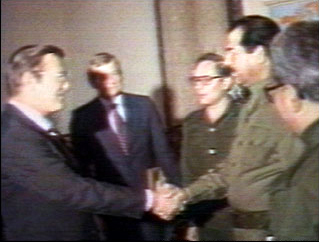
Post by abu_rashid on Jul 11th, 2008 at 3:38am
If they were serious about it they wouldn't have funded him to begin with. Rumsfeld wouldn't have been there selling back in the 80's when he was preparing to gas the Iranians and Kurds.
| Australian Politics Forum | |
|
http://www.ozpolitic.com/forum/YaBB.pl
Member Run Boards >> Islam >> Islam and science http://www.ozpolitic.com/forum/YaBB.pl?num=1215152411 Message started by freediver on Jul 4th, 2008 at 4:20pm |
|
|
Title: Islam and science Post by freediver on Jul 4th, 2008 at 4:20pm
This came up in the thread about Islam and Australian values:
http://www.ozpolitic.com/forum/YaBB.pl?num=1215058243/20#20 Was there a 'golden age' of scientific enquiry in the middle east? When was it? Was it preceded by something similar in China? What caused it to end? Are there any Islamic laws relating directly to science and technology? What is Islamic law regarding economics? Did Islam introduce any novel concepts regarding trade and economics? As far as I know economics as an academic enquiry only began a few centuries ago. |
|
Title: Re: Islam and science Post by Malik.Shakur on Jul 4th, 2008 at 9:07pm
Hey those are some great questions FD,
Firstly, economics as an academic school of thought has been around for quite some time, it was there in the early days of Islam and perhaps a form of study well before Islam came. Islam has a regulated form of capitalism and free trade. I've found it to be quite similar in many ways to the Austrian School of Economics. In regards to the Golden Age of Islam here is a documentary, part 2 of the BBC series, Islam: Empire of Faith http://video.google.com/videoplay?docid=7502243539190558658&q=golden+age+of+islam+&ei=AQBuSKjCCYyErgOHjY2bDw&hl=en Plus theres some general information on Wikipedia: http://en.wikipedia.org/wiki/Islamic_Golden_Age Hope that helps |
|
Title: Re: Islam and science Post by sprintcyclist on Jul 4th, 2008 at 10:11pm yes, the golfen age of islam included such luminaries as the guy who jumped off a mosque with a sheet to try to fly. Other than that, they made miniscule steps on from what already existed. |
|
Title: Re: Islam and science Post by Malik.Shakur on Jul 4th, 2008 at 10:43pm Sprintcyclist wrote on Jul 4th, 2008 at 10:11pm:
You're really very uneducated Sprint, while Europe was in it's dark ages and refusing to bathe and praying on the bones of the dead to cure illnesses Muslims had hospitals, universities, street lighting, paved roads, medicine, algebra, science etc. |
|
Title: Re: Islam and science Post by sprintcyclist on Jul 4th, 2008 at 10:57pm
uneducated ?? That's a vast improvement from previous comments !!
What gave rise to my upgrading ? "The Dark Ages Early scholars gave the name "Dark Ages" to the period in Europe after the fall of the Roman Empire. During this period, barbarian Goths, Vandals, and Huns swept down on Europe from the north and east. They destroyed many fine buildings and works of art that had existed during Roman times. During the Dark Ages, knowledge survived only in monasteries, and there were very few schools. Many of the old arts and crafts were lost. This is why the time was called the "Dark Ages." The eastern Roman Empire was not conquered by the barbarians. There, the arts still flourished. People were still thinking and making fine works of art in other parts of the world. In China and India, great civilizations grew and spread. In the 1000s, Europe began to slowly recover from its artistic darkness. The lost knowledge of the ancient Greeks and Romans was found again. There was a new interest in learning, and the richer life of the Middle Ages began." http://mr_sedivy.tripod.com/med_hist.html muslims advanced very little beyond what they already had been given. as evidenced nowadays by their abysmal performance in nobel prize recipients. |
|
Title: Re: Islam and science Post by Malik.Shakur on Jul 5th, 2008 at 12:09am Quote:
|
|
Title: Re: Islam and science Post by Malik.Shakur on Jul 5th, 2008 at 12:10am
Continued
Quote:
|
|
Title: Re: Islam and science Post by Malik.Shakur on Jul 5th, 2008 at 12:13am
Islam and Science
http://www.islamicity.com/Science/iqs/sld001.htm |
|
Title: Re: Islam and science Post by sprintcyclist on Jul 5th, 2008 at 12:14am
jews have won 165 nobel awards, muslims about 8.
If you include the gun toting yassar arafat as one. But don't say a thing about it . "Egypt's Nobel-prize-winning novelist Naguib Mahfouz, who had been critical of Muslim militants, was stabbed in the neck and seriously wounded yesterday in Cairo. There was no immediate claim of responsibility for the assault, but Islamic militants have in the past condemned the 82-year-old author as an infidel and threatened to kill him for writing "blasphemous" novels." http://topics.nytimes.com/top/news/science/topics/nobel_prizes/index.html?query=EGYPT&field=geo&match=exact |
|
Title: Re: Islam and science Post by Malik.Shakur on Jul 5th, 2008 at 12:33am
You're delusional.
Muslims have contributed a great deal to sciences. Tell me sprint, where was the first university made in the world? Muslims had universities more than 200 years before Christians did.. |
|
Title: Re: Islam and science Post by sprintcyclist on Jul 5th, 2008 at 12:37am
That's much like your normal personal comments against me.
Against which I take no umbridge. Whereas if I call mohammad the paediophile what he is, you go all girly and claim - "insult" The first Uni was in India. It has the best University in the world currently. India will be the next great world leader, imho. China will lead for a wee while, but India will far eclipse it. |
|
Title: Re: Islam and science Post by freediver on Jul 6th, 2008 at 10:35am
from Abu in the other thread:
We never had a renaissance because we never needed one really. Our belief system doesn't suppress science and technology and advancement, it advocates and promotes them. The lessons weren't learned because the mistakes weren't made to begin with. Islam certainly seems to be supressing science at the moment. It seems the more true a state is to Islam, the less it contributes to science. Islam itself appears at least partly responsible. There is certainly no question about whether there was a decline. http://en.wikipedia.org/wiki/Islamic_Golden_Age#Causes_of_decline Causes of decline "The achievements of the Arabic speaking peoples between the ninth and twelfth centuries are so great as to baffle our understanding. The decadence of Islam and of Arabic is almost as puzzling in its speed and completeness as their phenomenal rise. Scholars will forever try to explain it as they try to explain the decadence and fall of Rome. Such questions are exceedingly complex and it is impossible to answer them in a simple way." — George Sarton , The Incubation of Western Culture in the Middle East' [206] The Islamic civilization which had at the outset been creative and dynamic in dealing with issues, began to struggle to respond to the challenges and rapid changes it faced during the 12th and 13th centuries onwards towards the end of the Abbassid rule. Despite a brief respite with the new Ottoman rule, the decline continued until its eventual collapse and subsequent stagnation in the 20th century. Despite a number of attempts by many writers, historical and modern, none seem to agree on the causes of decline. The main views on the causes of decline comprise the following: political mismanagement after the early Caliphs (10th century onwards), closure of the gates of ijtihad (12th century), institutionalisation of taqlid rather than bid'ah (13th century), foreign involvement by invading forces and colonial powers (11th century Crusades, 13th century Mongol Empire, 15th century Reconquista, 19th century European empires), and the disruption to the cycle of equity based on Ibn Khaldun's famous model of Asabiyyah (the rise and fall of civilizations) which points to the decline being mainly due to political and economic factors.[4] Tolerance about different ideas reduced and faded, with some seminaries systematically forbidding speculative philosophy, while polemic debates also appear to have been abandoned after the 13th century. A significant intellectual shift in Islamic philosophy is perhaps demonstrated by al-Ghazali's late 11th century polemic work The Incoherence of the Philosophers, which lambasted metaphysical philosophy in favor of the primacy of scripture, and was later criticized in The Incoherence of the Incoherence by Averroes. Institutions of science comprising Islamic universities, libraries (including the House of Wisdom), observatories, and hospitals, were later destroyed by foreign invaders like the Crusaders and particularly the Mongols, and were rarely promoted again in the devastated regions.[207] Not only wasn't new publishing equipment accepted but also wide illiteracy overwhelmed the devastated lands, especially in Mesopotamia. Some historians have recently come to question the traditional picture of decline, pointing to continued astronomical activity as a sign of a continuing and creative scientific tradition through to the 15th and 16th centuries, with the works of Ibn al-Shatir, Ulugh Beg, Ali Kuşçu, al-Birjandi and Taqi al-Din considered noteworthy examples.[208][209] This was also the case for other fields, such as medicine, notably the works of Ibn al-Nafis, Mansur ibn Ilyas and Şerafeddin Sabuncuoğlu; mathematics, notably the works of al-Kashi and al-Qalasadi; philosophy, notably Mulla Sadra's Transcendent Theosophy; and the social sciences, notably Ibn Khaldun's Muqaddimah (1370), which itself points out that though science was declining in Iraq, al-Andalus and Maghreb, it continued to flourish in Persia, Syria and Egypt during his time.[4] |
|
Title: Re: Islam and science Post by abu_rashid on Jul 6th, 2008 at 12:26pm
this sprint guy is hilarious.
Quote:
It was just magically found was it? It wasn't preserved by the Muslim scholars was it? And translated from Latin and Greek into Arabic and then later back into the European languages during the Renaissance was it? Many European scholars even agree that a large part of the credit for the Renaissance in Europe is owed to the Muslim civilisation that kept the knowledge alive for so long, and generally allowed the free flow of knowledge to other cultures. Unlike the West today, the recipents of that knowledge, who horde it all for themselves, and actively prevent other cultures rom attaining knowledge lest they compete with them. |
|
Title: Re: Islam and science Post by abu_rashid on Jul 6th, 2008 at 12:51pm Quote:
Yes, and in India, and Greece etc. I don't think any one civilisation can claim to be the originator of knowledge, all civilisations inherit and benefit from the work done by civilisations before them. But only the West seems intent on proclaiming their civilisation is all original, and the Islamic civilisation was just copied from others, and that Muslims contributed nothing to civilisation at all. Quote:
It ended mostly for political reasons. Muslims became politically weak and at the same time the West became very technologically and politically adept. So the Ottoman Caliphate became a technological customer of the West, and began using their second hand technology, which was obviously far behind the cutting edge European technology. Then the Western powers conspired together to divide and carve up the Islamic lands and share them amongst themselves. Consider for instance in the 1400's when the Ottoman State conquered Constantinople and abolished the last vestiges of the Roman empire (the Byzantines), Muslim military technology was far more advanced compared to the West's. The cannons used just obliterated the Western armies. And this continued all the way to the gates of Vienna. We are the ones who transferred gunpowder to the West, but once they got it, they refined it much more and then used it against us, and eventually used it against the Chinese, which is where we originally got it from. Quote:
There are laws and other things that encourage education and flow of konwledge. The Prophet (Pbuh) is reported as saying "Seek knowledge, even if you must travel to China", and the Muslims did just that. Quote:
This is a very deep subject, and fills books upon books. The basic tenets of Islamic economics though are based on trade, so what you might call a free market, I certainly wouldn't call it capitalism though. It also has a lot of aspects similar to socialism too, there is well established welfare system, most major resources are considered to be state/community property. Contrast this to the modern secular Arab states where major resources (oil anyone?) are the personal property of the King and his family. Quote:
Uloom al-Iqtisadiyyah (Sciences of Ecnomics) has been a field of study in Islamic civilisation since about the 8th. century. There are numerous classical works that detail the economic system in Islam. It's truly sad that the bias in the West has presented them from mentioning much about Islamic civilisation. Haven't you ever noticed there's a great 1350 year gap in the historical accounts of the West?? We go from the decline of the Roman empire through the Dark ages and all of a sudden it's the renaissance, they completely leave out the achievements of Islamic civilisation and it's influence on the Western world. Although recently there has been a few honest scholars in the West beginning to investigate this. There was in fact a nice documentary on SBS last Sunday night about it, nobody watched it? Quote:
As has been mentioned to you before, the Islamic civilisation came to an end in the early part of the 20th. century. It's a known fact the Caliphate was abolished, and it was replaced by about 40 independant states all having different ideologies, none of them being based on Islam implementing the system of Caliphate. If you like I can show you some newspaper clippings from the time if that might help for it to sink in. You cannot blame the Islamic system for what states do, that don't implement the Islamic system. Just because they write "Allahu Akbar" between the coloured lines on their flag, or they behead adulterers and gays, or they have a religious ministry, or Eid al-Fitr is a public holiday, or Friday is part of the weekend doesn't mean they implement the Islamic State System. |
|
Title: Re: Islam and science Post by abu_rashid on Jul 6th, 2008 at 2:12pm
Here's some quotes from Western writers (just so you know it's not Islamic propaganda and all) regarding Muslim contributions to civilisation, technology and science:
George Sarton's Tribute to Muslim Scientists in the "Introduction to the History of Science," "It will suffice here to evoke a few glorious names without contemporary equivalents in the West: Jabir ibn Haiyan, al-Kindi, al-Khwarizmi, al-Fargani, al-Razi, Thabit ibn Qurra, al-Battani, Hunain ibn Ishaq, al-Farabi, Ibrahim ibn Sinan, al-Masudi, al-Tabari, Abul Wafa, 'Ali ibn Abbas, Abul Qasim, Ibn al-Jazzar, al-Biruni, Ibn Sina, Ibn Yunus, al-Kashi, Ibn al-Haitham, 'Ali Ibn 'Isa al-Ghazali, al-zarqab, Omar Khayyam. A magnificent array of names which it would not be difficult to extend. If anyone tells you that the Middle Ages were scientifically sterile, just quote these men to him, all of whom flourished within a short period, 750 to 1100 A.D." John William Draper in the "Intellectual Development of Europe" "I have to deplore the systematic manner in which the literature of Europe has continued to put out of sight our obligations to the Muhammadans. Surely they cannot be much longer hidden. Injustice founded on religious rancour and national conceit cannot be perpetuated forever. The Arab has left his intellectual impress on Europe. He has indelibly written it on the heavens as any one may see who reads the names of the stars on a common celestial globe." Robert Briffault in the "Making of Humanity" "It was under the influence of the arabs and Moorish revival of culture and not in the 15th century, that a real renaissance took place. Spain, not Italy, was the cradle of the rebirth of Europe. After steadily sinking lower and lower into barbarism, it had reached the darkest depths of ignorance and degradation when cities of the Saracenic world, Baghdad, Cairo, Cordova, and Toledo, were growing centers of civilization and intellectual activity. It was there that the new life arose which was to grow into new phase of human evolution. From the time when the influence of their culture made itself felt, began the stirring of new life. "It was under their successors at Oxford School (that is, successors to the Muslims of Spain) that Roger Bacon learned Arabic and Arabic Sciences. Neither Roger Bacon nor later namesake has any title to be credited with having introduced the experimental method. Roger Bacon was no more than one of apostles of Muslim Science and Method to Christian Europe; and he never wearied of declaring that knowledge of Arabic and Arabic Sciences was for his contemporaries the only way to true knowledge. Discussion as to who was the originator of the experimental method....are part of the colossal misinterpretation of the origins of European civilization. The experimental method of Arabs was by Bacon's time widespread and eagerly cultivated throughout Europe. "Science is the most momentous contribution of Arab civilization to the modern world; but its fruits were slow in ripening. Not until long after Moorish culture had sunk back into darkness did the giant, which it had given birth to, rise in his might. It was not science only which brought Europe back to life. Other and manifold influence from the civilization of Islam communicated its first glow to European Life. "For Although there is not a single aspect of European growth in which the decisive influence of Islamic Culture is not traceable, nowhere is it so clear and momentous as in the genesis of that power which constitutes the permanent distinctive force of the modern world, and the supreme source of its victory, natural science and the scientific spirit. "The debt of our science to that of the Arabs does not consist in startling discoveries or revolutionary theories, science owes a great deal more to Arab culture, it owes its existence. The Astronomy and Mathematics of the Greeks were a foreign importation never thoroughly acclimatized in Greek culture. The Greeks systematized, generalized and theorized, but the patient ways of investigation, the accumulation of positive knowledge, the minute method of science, detailed and prolonged observation and experimental inquiry were altogether alien to the Greek temperament. Only in Hellenistic Alexandria was any approach to scientific work conducted in the ancient classical world. What we call science arose in Europe as a result of new spirit of enquiry, of new methods of experiment, observation, measurement, of the development of mathematics, in a form unknown to the Greeks. That spirit and those methods were introduced into the European world by the Arabs. "It is highly probable that but for the Arabs, modern European civilization would never have arisen at all; it is absolutely certain that but for them, it would not have assumed that character which has enabled it to transcend all previous phases of evolution." Source to be continued... |
|
Title: Re: Islam and science Post by abu_rashid on Jul 6th, 2008 at 2:16pm
...continued
Arnold and Guillaume in "Lagacy of Islam" on Islamic science and medicine "Looking back we may say that Islamic medicine and science reflected the light of the Hellenic sun, when its day had fled, and that they shone like a moon, illuminating the darkest night of the European middle Ages; that some bright stars lent their own light, and that moon and stars alike faded at the dawn of a new day - the Renaissance. Since they had their share in the direction and introduction of that great movement, it may reasonably be claimed that they are with us yet." George Sarton in the "Introduction to the History of Science" "During the reign of Caliph Al-Mamun (813-33 A.D.), the new learning reached its climax. The monarch created in Baghdad a regular school for translation. It was equipped with a library, one of the translators there was Hunayn Ibn Ishaq (809-77) a particularly gifted philosopher and physician of wide erudition, the dominating figure of this century of translators. We know from his own recently published Memoir that he translated practically the whole immense corpus of Galenic writings." "Besides the translation of Greek works and their extracts, the translators made manuals of which one form, that of the 'pandects,' is typical of the period of Arabic learning. These are recapitulations of the whole medicine, discussing the affections of the body, systematically beginning at the head and working down to the feet." "The Muslim ideal was, it goes without saying, not visual beauty but God in His plentitude; that is God with all his manifestations, the stars and the heavens, the earth and all nature. The Muslim ideal is thus infinite. But in dealing with the infinite as conceived by the Muslims, we cannot limit ourselves to the space alone, but must equally consider time. "The first mathematical step from the Greek conception of a static universe to the Islamic one of a dynamic universe was made by Al-Khwarizmi (780-850), the founder of modern Algebra. He enhanced the purely arithmetical character of numbers as finite magnitudes by demonstrating their possibilities as elements of infinite manipulations and investigations of properties and relations. "In Greek mathematics, the numbers could expand only by the laborious process of addition and multiplication. Khwarizmi's algebraic symbols for numbers contain within themselves the potentialities of the infinite. So we might say that the advance from arithmetic to algebra implies a step from being to 'becoming' from the Greek universe to the living universe of Islam. The importance of Khwarizmi's algebra was recognized, in the twelfth century, by the West, - when Girard of Cremona translated his theses into Latin. Until the sixteenth century this version was used in European universities as the principal mathematical text book. But Khwarizmi's influence reached far beyond the universities. We find it reflected in the mathematical works of Leonardo Fibinacci of Pissa, Master Jacob of Florence, and even of Leonardo da Vinci." "Through their medical investigations they not merely widened the horizons of medicine, but enlarged humanistic concepts generally. And once again they brought this about because of their over riding spiritual convictions. Thus it can hardly have been accidental that those researches should have led them that were inevitably beyond the reach of Greek masters. If it is regarded as symbolic that the most spectacular achievement of the mid-twentieth century is atomic fission and the nuclear bomb, likewise it would not seem fortuitous that the early Muslim's medical endeavor should have led to a discovery that was quite as revolutionary though possibly more beneficent." "A philosophy of self-centredness, under whatever disguise, would be both incomprehensible and reprehensible to the Muslim mind. That mind was incapable of viewing man, whether in health or sickness as isolated from God, from fellow men, and from the world around him. It was probably inevitable that the Muslims should have discovered that disease need not be born within the patient himself but may reach from outside, in other words, that they should have been the first to establish clearly the existence of contagion." "One of the most famous exponents of Muslim universalism and an eminent figure in Islamic learning was Ibn Sina, known in the West as Avicenna (981-1037). For a thousand years he has retained his original renown as one of the greatest thinkers and medical scholars in history. His most important medical works are the Qanun (Canon) and a treatise on Cardiac drugs. The 'Qanun fi-l-Tibb' is an immense encyclopedia of medicine. It contains some of the most illuminating thoughts pertaining to distinction of mediastinitis from pleurisy; contagious nature of phthisis; distribution of diseases by water and soil; careful description of skin troubles; of sexual diseases and perversions; of nervous ailments." "We have reason to believe that when, during the crusades, Europe at last began to establish hospitals, they were inspired by the Arabs of near East....The first hospital in Paris, Les Quinze-vingt, was founded by Louis IX after his return from the crusade 1254-1260." to be continued... |
|
Title: Re: Islam and science Post by abu_rashid on Jul 6th, 2008 at 2:18pm
continued...
"We find in his (Jabir, Geber) writings remarkably sound views on methods of chemical research, a theory on the geologic formation of metals (the six metals differ essentially because of different proportions of sulphur and mercury in them); preparation of various substances (e.g., basic lead carbonatic, arsenic and antimony from their sulphides)." Ibn Haytham's writings reveal his fine development of the experimental faculty. His tables of corresponding angles of incidence and refraction of light passing from one medium to another show how closely he had approached discovering the law of constancy of ratio of sines, later attributed to snell. He accounted correctly for twilight as due to atmospheric refraction, estimating the sun's depression to be 19 degrees below the horizon, at the commencement of the phenomenon in the mornings or at its termination in the evenings." "A great deal of geographical as well as historical and scientific knowledge is contained in the thirty volume meadows of Gold and Mines of Gems by one of the leading Muslim Historians, the tenth century al Mas'udi. A more strictly geographical work is the dictionary 'Mujam al-Buldan' by al-Hamami (1179-1229). This is a veritable encyclopedia that, in going far beyond the confines of geography, incorporates also a great deal of scientific lore." "They studied, collected and described plants that might have some utilitarian purpose, whether in agriculture or in medicine. These excellent tendencies, without equivalent in Christendom, were continued during the first half of the thirteenth century by an admirable group of four botanists. One of these Ibn al-Baitar compiled the most elaborate Arabic work on the subject (Botany), in fact the most important for the whole period extending from Dioscorides down to the sixteenth century. It was a true encyclopedia on the subject, incorporating the whole Greek and Arabic experience." "'Abd al-Malik ibn Quraib al-Asmai (739-831) was a pious Arab who wrote some valuable books on human anatomy. Al-Jawaliqi who flourished in the first half of the twelfth century and 'Abd al-Mumin who flourished in the second half of the thirteenth century in Egypt, wrote treatises on horses. The greatest zoologist amongst the Arabs was al-Damiri (1405) of Egypt whose book on animal life, 'Hayat al-Hayawan' has been translated into English by A.S.G. Jayakar (London 1906, 1908)." "The weight of venerable authority, for example that of Ptolemy, seldom intimidated them. They were always eager to put a theory to tests, and they never tired of experimentation. Though motivated and permeated by the spirit of their religion, they would not allow dogma as interpreted by the orthodox to stand in the way of their scientific research." |
|
Title: Re: Islam and science Post by sprintcyclist on Jul 6th, 2008 at 9:34pm Where is the muslim space rocket ? Got anything newer than the MK IV asses's leather strap, 1100 AD as an invention? |
|
Title: Re: Islam and science Post by freediver on Jul 6th, 2008 at 9:56pm
Unlike the West today, the recipents of that knowledge, who horde it all for themselves, and actively prevent other cultures rom attaining knowledge lest they compete with them.
That's a bit silly Abu. You can't horde knowledge. As has been mentioned to you before, the Islamic civilisation came to an end in the early part of the 20th. century. It's a known fact the Caliphate was abolished, and it was replaced by about 40 independant states all having different ideologies, none of them being based on Islam implementing the system of Caliphate. If you like I can show you some newspaper clippings from the time if that might help for it to sink in. I think I get that Europe carved up the middle east. But didn't scientific enquiry in the area drop back well before then? For example, what lead the people to place so little value on printing presses that they weren't rebuilt? Why did Europe overtake the middle east, rather than 'joining in'? And why would the recent European carve-up cause them to devalue science so much? You cannot blame the Islamic system for what states do, that don't implement the Islamic system. Just because they write "Allahu Akbar" between the coloured lines on their flag, or they behead adulterers and gays, or they have a religious ministry, or Eid al-Fitr is a public holiday, or Friday is part of the weekend doesn't mean they implement the Islamic State System. Equally, you cannot deny that Islam has a very strong influence on the society. |
|
Title: Re: Islam and science Post by Malik.Shakur on Jul 6th, 2008 at 10:08pm Sprintcyclist wrote on Jul 6th, 2008 at 9:34pm:
Without Muslims you wouldn't have space rockets because it requires the mathematical and scientific contributions we made during the golden age.. Heck you wouldn't even be using soap nor have hygene practices, if it weren't for us and you'd smell as bad and carry as much disease as rats. |
|
Title: Re: Islam and science Post by abu_rashid on Jul 7th, 2008 at 12:42am Quote:
Tell that to anyone who wants to download certain kinds of software that uses certain encryption algorithms inside the USA, it's against the law. Also tell it to the founder of the Pakustan's nucealr program, who's now in US custody for sharing knowledge that the US didn't want him to. These are but a few examples of the West and their attempts to hinder the progress of all other societies in order to ensure their dominance over them. Quote:
I mentioned that no state today implements the Islamic system, because you claimed Islam was responsible for the regressive condition of the current Arab states. Quote:
Printing presses have always been used in Islamic lands, since they were first discovered, as far as I'm aware. why did you believe they stopped being used? Quote:
Because we weren't cautious enough, and we allowed them to overtake us. Quote:
The decline had already set in before the European carve up, but after that it became far worse, because the European powers obviously wanted to place the most despicable tyrants in charge of the Muslim countries, in order to keep the Muslims downtrodden and oppressed. Quote:
That's like blaming the situation in China on Democracy, because Chinese people yearn for Democracy, and it's ideas have a strong influence on them. The fact is they don't live under Democracy, and the Democratic ideology cannot be blamed for the conditions in a country in which it is not implemented. Likewise for Islam. To suggest otherwise is just illogical. |
|
Title: Re: Islam and science Post by abu_rashid on Jul 7th, 2008 at 1:01am
Just a friendly suggestion freediver, can you learn how to use the quote tags, or at least use the bold tags, it's so hard to sift through your posts and work out which part is italicised (in the font I am using anyway) and see which part is yours and which part is the text you're replying to.
|
|
Title: Re: Islam and science Post by freediver on Jul 7th, 2008 at 5:04pm Quote:
I posted this on the previous page: http://en.wikipedia.org/wiki/Islamic_Golden_Age#Causes_of_decline Institutions of science comprising Islamic universities, libraries (including the House of Wisdom), observatories, and hospitals, were later destroyed by foreign invaders like the Crusaders and particularly the Mongols, and were rarely promoted again in the devastated regions.[207] Not only wasn't new publishing equipment accepted but also wide illiteracy overwhelmed the devastated lands, especially in Mesopotamia. Quote:
Islam has a far stronger influence on the middle east than democracy does on China. The comparison is absurd. |
|
Title: Re: Islam and science Post by muso on Jul 8th, 2008 at 9:06am freediver wrote on Jul 7th, 2008 at 5:04pm:
Somebody somewhere once made this observation: "Imagine a playground full of kids. One of them (Jeremy) reads a lot and is actually quite intelligent. He keeps himself to himself and tries to apply his knowledge fairly. The other one (Fred) is a bit of a ruffian. He has a lot of friends that he manipulates and gets them to do his dirty work. He doesn't do any homework. He has minions that do that for him. Despite that fact, he has a lot more influence over the playground 'society' than Jeremy, who only has the following of a small group of nerds." Which one is the more civilised? Put it in the context of the world 'playground' over historical time and the various groups of 'kids' who played out their lives over the ages. Ok, we have one group who base their lives on the sacred documents of one 'chosen' tribe in the Eastern Mediterranean. They believe that only those who follow their belief system will go to heaven after they die. The rest of the world's population will go to hell. They believe that they have little capacity to control their own morality and even their actions, so instead of trying, they put all their faith in their god, which they believe is the only road to salvation. Of course that salvation really only comes into effect after they die. Their god is jealous and doesn't tolerate other gods, and they see themselves as created in the image as their god. Therefore they feel justified in conquering large tracts of the global playground with the 'altruistic' goal of providing the world with hope of salvation, while picking up the odd piece of gold donated by the grateful inhabitants of the lands they conquer. Contrast that with a group that believes that the only road to salvation from poverty, pain and suffering is to understand the reality and nature of our surroundings, and to use that knowledge in a practical way. They see humility, generosity and compassion as virtues. On the whole, apart from one slightly embarrassing episode in the mid 20th century by one small insular group who were inspired by an emperor who was seen as a 'living god', they are peace loving and ethical people. Which is the most civilized? |
|
Title: Re: Islam and science Post by freediver on Jul 9th, 2008 at 3:36pm
http://en.wikipedia.org/wiki/Ottoman_Empire
The long period of Ottoman stagnation is typically characterized by historians as an era of failed reforms. In the latter part of this period there were educational and technological reforms, including the establishment of higher education institutions such as Istanbul Technical University; Ottoman science and technology had been highly regarded in medieval times, as a result of Ottoman scholars' synthesis of classical learning with Islamic philosophy and mathematics, and knowledge of such Chinese advances in technology as gunpowder and the magnetic compass. By this period though the influences had become regressive and conservative. The guilds of writers denounced the printing press as "the Devil's Invention", and were responsible for a 43-year lag between its invention by Johannes Gutenberg in Europe in 1450 and its introduction to the Ottoman society with the Gutenberg press in Constantinople that was established by the Sephardic Jews of Spain in 1493. Sephardic Jews migrated to the Ottoman Empire as they escaped from the Spanish Inquisition of 1492. Closure of the gates of ijtihad: http://en.wikipedia.org/wiki/Ijtihad Ironically, the loss of its application in law seems to have also led to its loss in philosophy and the sciences, which most historians think caused Muslim societies to stagnate before the 1492 fall of al-Andalus, after which Muslim works were translated and led in part to The Renaissance revival of Classical works, using improved methods, although the Muslims themselves were no longer using these methods in their daily life at all. |
|
Title: Re: Islam and science Post by abu_rashid on Jul 9th, 2008 at 11:21pm
Yes there was a great loss of civilisation, but it was mostly in 1258 with the Mongol destruction of Baghdad, it was recorded that unlike previous massacres, the rivers did not flow red with blood, they flowed black with ink, from the hundreds of thousands of books they tossed into the Tigris.
The Ottoman state actually grew out of the Mongol destruction. The early Oghuz tribes from who the Ottomans arose, were actually refugees escaping the Mongol devastation as it swept across central Asia. So it's amazing they even reached the heights they did, but your pathetic attempt to paint religious conservatism as the root cause of their decline is just plain wrong. In their early years they were extremely religious, and extremely prosperous and advanced. In their later years, they began to fall away from Islam, so too they began to be backward and declined. Their greatest and most advanced leaders were generally the ones who were most attached to Islam, whilst their worst and most defeated leaders were those who strayed from Islam and were besotted by the Europeans. |
|
Title: Re: Islam and science Post by sprintcyclist on Jul 9th, 2008 at 11:41pm
abu - i got no idea why you are such a person of the past.
Seems to me like the Ottoman empire started off ok. Borne of war and bloodshed, which was the norm then. They inherited many things from prior peoples. Probably extremists took charge (typical) and stagnated the whole empire. I'm glad some of them managed to copy the findings of prior peoples, before they took a few normal steps forward , then stopped up against the muslim extremists. Or, are you saying islam failed to remain true to the koran? Either way, islam failed |
|
Title: Re: Islam and science Post by Acid Monkey on Jul 10th, 2008 at 1:08am freediver wrote on Jul 6th, 2008 at 9:56pm:
International copyright and patent laws. Also, industrial secrets such as Coca Cola's ingredient X |
|
Title: Re: Islam and science Post by freediver on Jul 10th, 2008 at 12:42pm
Patents do not horde knowledge. They do the opposite.
|
|
Title: Re: Islam and science Post by Malik.Shakur on Jul 10th, 2008 at 6:31pm Sprintcyclist wrote on Jul 9th, 2008 at 11:41pm:
haha.. and christianity is doing any better sprint? absolutely not.. christianity has obviously failed with george bush at the helm of the US leading the christian-secular army into the muslim lands, as bad as the hordes of mongols we faced if you ask me.. except the mongol hordes were smart enough to accept islam, obviously the christian-secular hordes arent.. well not yet at least, but many soldiers who've gone there have.. you guys still have time i suppose.. God willing.. |
|
Title: Re: Islam and science Post by freediver on Jul 10th, 2008 at 6:50pm
So the US is as bad as the mongol empire? That's a bit overdramatic don't you think malik?
|
|
Title: Re: Islam and science Post by Malik.Shakur on Jul 10th, 2008 at 7:00pm freediver wrote on Jul 10th, 2008 at 6:50pm:
I hardly call more than one million innocent Iraqis dead now due to the invasion and continual occupation of Iraq as something which is overdramatic FD. Note I'm speaking about the US Government, not the US people. |
|
Title: Re: Islam and science Post by freediver on Jul 10th, 2008 at 7:04pm
Do you think the US government actually wants to occupy the territory indefinately? Do you really think they want to rape, pillage and destroy? Do you think the US government has benefitted economically from the war?
|
|
Title: Re: Islam and science Post by sprintcyclist on Jul 10th, 2008 at 8:24pm
malik - and how many of those did islamics blow up??
it's muslims killing muslims |
|
Title: Re: Islam and science Post by abu_rashid on Jul 10th, 2008 at 11:15pm
freediver,
They now got control of the largest swath of oil in the world, I think they've done quite dandy out of it. Not to mention all the looting they did of the museums, do you know how much all that Babylonian and Sumerian stuff is worth??? Not just that, they prevented anyone else from getting in there first, which alone is motivation enough. |
|
Title: Re: Islam and science Post by sprintcyclist on Jul 10th, 2008 at 11:47pm
The war in iraq costs US BILLIONS of dollars per day !!!
US still has to buy oil. It was not an economic decision |
|
Title: Re: Islam and science Post by Malik.Shakur on Jul 11th, 2008 at 2:42am Sprintcyclist wrote on Jul 10th, 2008 at 11:47pm:
yes, but george bush's cronies are making trillions out of it with the contracts handed out you.. the people of the US suffer as the rest of us do.. but it was never for the people.. the people are lambs to the slaughter for the cause.. |
|
Title: Re: Islam and science Post by Malik.Shakur on Jul 11th, 2008 at 2:45am freediver wrote on Jul 10th, 2008 at 7:04pm:
certain elements in the government have of course and their cronies.. and yes, i think they want to create a civil war in iraq so they can maintain a stronghold on iraqi politics.. iraq is far worse off now than it was under saddam.. if the west were serious in getting rid of him they would have supported the people who rose up in the first gulf war and took control of iraq's second largest city when george bush snr asked them too.. they rose up and the US didn't help them at all, they didn't even protect them from iraqi gunships and jets.. so thousands upon thousands of brave people who stood up were murdered.. if the west were serious they wouldn't have done that.. |
|
Title: Re: Islam and science Post by abu_rashid on Jul 11th, 2008 at 3:38am
If they were serious about it they wouldn't have funded him to begin with. Rumsfeld wouldn't have been there selling back in the 80's when he was preparing to gas the Iranians and Kurds.
|
|
Title: Re: Islam and science Post by freediver on Sep 25th, 2008 at 10:12am
Why did it take them 300 years to build another observatory?
What Went Wrong? By Bernard Lewis http://books.google.com.au/books? id=SmrdqwESEq0C&pg=PA80&lpg=PA80&dq=TaqI+al- +Dm's+observatory+razed&source=web&ots=w08X3gOq1N&sig=1xxY w312Mnuj4h2BDcBkRcpkM38&hl=en&sa=X&oi=book_result&resnum=1 &ct=result page 80 Another example of the widening gap may be seen in the fate of the great observatory built in Galata, in Istanbul, in 1557. This was due to the initiative of Taqi al-Din (ca. 1526-1585), a major figure in Muslim scientific history and the author of several books on astronomy, optics, and mechanical clocks. Born in Syria or Egypt (the sources differ), he studied in Cairo, and after a career as a jurist and theologian he went to Istanbul, where in 1571 he was appointed munejjim-basbi, astronomer (and astrologer) in chief to the Sultan Selim II. A few years later he persuaded the new Sultan Murad III to allow him to build an observatory, comparable in its technical equipment and its specialist personnel with that of his celebrated contemporary, the Danish astronomer Tycho Brahe. But there the comparison ends. Tycho Brahe's observatory and the work accomplished in it opened the way to a vast new development of astonomical science. Taqi al-Din's observatory was razed to the ground by a squad of Janissaries, by order of the sultan, on the recommendation of the Chief Mufti. The observatory had many predecessors in the lands of Islam; it had no successors until the age of modernization. |
|
Title: Re: Islam and science Post by Lestat on Sep 25th, 2008 at 10:44am freediver wrote on Sep 25th, 2008 at 10:12am:
Have actually read this book, and it was rather poor read to say the least. Then again, it is written by Bernad 'I love to Generalise' Lewis. The guy has no idea and is one of the poorer Orientists I have come across. THen again I can understand why you'd admire his writing. |
|
Title: Re: Islam and science Post by freediver on Sep 25th, 2008 at 10:52am
Did you know that argumentum ad hominem is a logical fallacy?
Why did it take them 300 years to build another observatory? |
|
Title: Re: Islam and science Post by Lestat on Sep 25th, 2008 at 11:02am freediver wrote on Sep 25th, 2008 at 10:52am:
What...aren't I allowed to have an opinion? I've got the book at home, have read it, and I believe it is a rather poor read. Edward Said has picked his views apart and ripped them to shreds. Have you read the book Fd? freediver wrote on Sep 25th, 2008 at 10:52am:
You already know the answer...so why ask it? |
|
Title: Re: Islam and science Post by freediver on Sep 25th, 2008 at 11:04am
You already know the answer...so why ask it?
No I don't. It is not a rhetorical question. Of course I have strong suspicions. Are you saying my suspicions are correct? |
|
Title: Re: Islam and science Post by locutius on Sep 25th, 2008 at 12:00pm
If Lestast won't elaborate, what are your suspicions F.D. I have no answer so I am curious. I won't hold that you are making a statement of fact, as you have said they are suspicions.
|
|
Title: Re: Islam and science Post by freediver on Sep 25th, 2008 at 12:15pm
I think it comes back to separation of church and state. Any movement will have it's share of fools who would use the ideology to micromanage every aspect of people's lives. Islam seems to put them in charge. Obviously while it was a 'new kid on the block' it would have had no problem with other novelties and tools of discovery. There was a lengthy period where Islam itself was open to human scrutiny and investigation. But oppressive conservatism was inevitable.
|
|
Title: Re: Islam and science Post by locutius on Sep 25th, 2008 at 1:09pm freediver wrote on Sep 25th, 2008 at 12:15pm:
I think what you have said is essentially accurate as to the malaise of modern Muslim technological achievements. |
|
Title: Re: Islam and science Post by abu_rashid on Sep 25th, 2008 at 1:23pm Quote:
A good 700 years is considered to be 'new kid on the block'??? That's over half the time the Caliphate existed. Also the Caliphate was militarily still superior for a few more centuries after that. Controlling the Mediterranean and lunging into the heart of Europe. Also you have still never substantiated your claim that Islamic civilisation was less Islamically conservative during the 700 years of dominance and it's stagnation and decline was caused by Islamic conservatism. You never countered my points that religions begin as communities of quite zealous people who've actually seen the prophet/leader, and then generally move away from this zealousness. And that Shari'ah was strictly implemented for the first 700 years, and only in the period of stagnation and decline did it get replaced with non-Islamic laws. You did claim that causality is not the same as correlation, but that doesn't really mean much when ALL the signs and evidences point to my position, and ALL the signs and evidences point away from yours. |
|
Title: Re: Islam and science Post by freediver on Sep 25th, 2008 at 11:12pm
So why did it take them 300 years before another observatory could be built?
|
|
Title: Re: Islam and science Post by soren on Sep 25th, 2008 at 11:38pm abu_rashid wrote on Sep 25th, 2008 at 1:23pm:
Those non-Islamic laws enabled everyone but the Arabs to thrive, to innovate, to renew and engage with science of every description. Your whole theory is an attempt to justify a return to the Caliphate, a return to how things were 700 years ago. That is crazy and bizarre. Just as a by the way, many of the scientist in the golden age of Islam were jews and christians who either came under Islamic rule and were dhimmis or who converted. Some of these converts were undoubtedly geuine, many were doing so out of cconvenience. The vast majority of the translators of greek and latin texts, for example, were jews and christians by birth. Most Muslims were interested only in texts directly relevant to islam. Unrelated texts were NOT translated by the muslism. They were saved by the Irish monks. and those they taught. As usual, there is a massive oversatement and exaggeration of a kernel of truth about the importance of Islamic science. Why did islam stagnate after a period of flowering? Because of the hubris, arrogancee and sense of superiority the Musslim established in their hearts and still nurse to this day.The same sense of superiority that now causes them to be apoplectic when rerminded of their backwardness, despite being Allah's faithful servants. There is a massive cognitive dissonance that has been there for centuries - the Muslims, especially Arabs, sing in their hearts 'we are the champoins', to them everyone else is inferior or a dhimmi or should be killed. As payment for this hubris and bizarre superiority complex, Allah has been giving them nothing but sh|t sandwiches for a long, long time. Allah knows best, isn't that right, boys? |
|
Title: Re: Islam and science Post by Lestat on Sep 26th, 2008 at 9:16am Soren wrote on Sep 25th, 2008 at 11:38pm:
Amazing...in the very same post you go on about 'muslm superiority, then talk about how 'backward' muslims are. Is this not a reflection on your very own 'feelings of superiority'...or do your pathetic views only apply to muslims. Its quite amusing actually....all I seem to be reading from you is how you and the west is superior and advanced, and us muslims are barbaric and backwards. And here you are accusing others of arrogance and 'superiority complexes'. So here you are accusing muslims of doing the very same thing you are doing, and whats even better is that you've done it in the very same post. And you have the nerve to talk about arrogance. Once again...your hypocricy is staggering. And your to dopey to even realise it. |
|
Title: Re: Islam and science Post by abu_rashid on Sep 26th, 2008 at 11:14am Quote:
Since the Islamic civilisation was under heavy attack from all sides, I guess that's probably why they focused more on military matters rather than those of scientific discovery. Remember that Muslims were fighting with Christians to the west and Mongols and Tatars to the east. Scientific endeavour requires a certain level of peace and prosperity that was slipping away in the Muslim lands, whilst at the same time was opening up in Europe. Also freediver, I'm still interested in hearing you reconcile how this statement of yours: Quote:
with the fact that Islamic civilisation experienced a 700 year high during the period in which there was the least amount of secularisation (in fact there was no seperation whatsoever in the early Islamic period), whilst the period of decline was accompanied by the only known attempts at secularisation in Islamic history, such as the Ottoman Tanzimaat period. It's onne thing to make the claim, it's another to provide a little evidence to back it up. Even if you can show some mere correlation, rather than causation, that'd be fine by me, at least it'd be something, rather than nothing :) |
|
Title: Re: Islam and science Post by abu_rashid on Sep 26th, 2008 at 11:35am Quote:
That's right because the Judaeo-Christian tradition is actually stifling to progress and civilisation. It wasn't until the West finally disposed of Judaeo-Christian input to their society that they actually advanced. Contrary to your claims Christianity just kept Europe in the dark ages, for almost the entire period that they implemented and subscribed to it. Muslims on the contrary declined at the same time they fell away from their religion. Quote:
The re-adoption of the Caliphate system is no more a return to how things were 700 years ago than it was when it was re-established during the Mameluke period, almost 700 years after it's first inception. The Caliphate is a system, it is not a means of government, it is a style. No doubt you view it as a return to the use of Camels for transport and messenger pidgeons for communications. Quote:
There were some, I wouldn't say many. And this is in fact testament to the greatness of Islamic civilisation and how it raised all peoples regardless of their religion to great heights. For 600 years Christians had made little achievement, likewise Jews for many more before that. It wasn't until Islamic civilisation came along and provided them with a platform in which to excel in the scientific arena that they did. Not just that, but the diffusion of scientific knowledge into Europe was undoubtedly a direct precursor to the scientific awakening that occured there much later. Unlike the Western civilisation, the Islamic civilisation spread it's knowledge far and wide, and considered it a gift for all humanity. They did not horde it and consider it a secret weapon with which to control and hinder other civilisations. If you look at most of the earliest great European mathematicians for instance (in the Christian era), you'll find they were all not just mathematicians, but scholars in Arabic, whose main achievements were mostly translating books from Arabic. Quote:
What an interesting insight you have into the personal convictions and intentions of people who lived so long ago. I assume it's based on some kind of historical evidence, right? Quote:
They were? For example? Quote:
Caliph al-Ma'mun was Jewish or Christian by birth? I'm curious. He was a Muslim, and he was the single most influential figure in bringing about the translation of those texts. Even if what you claim is correct, that is actually even more profound, because Jews and Christians weren't even able to read those texts, let alone translate them into the common language in their own Judaeo-Christian Europe. Only under the tolerant and advanced civilisation of Islam was it permitted. Quote:
Irish monks?? do tell. |
|
Title: Re: Islam and science Post by Sappho on Sep 26th, 2008 at 2:17pm
Ho hum... the history of science is well known and attributed fairly between Islam and The Enlightenment onwards. Christians did contribute significantly during the Enlightenment which of itself represents the dawn of Humanism and the intellectual persuits of Humans rather than some lasting glory to Christians!
But... since this thread is about Islam and science, and since we are just being the 21st Century... I am more interested in hearing about the scientific acheivements of Islam in the last century and this. What are they? |
|
Title: Re: Islam and science Post by helian on Sep 26th, 2008 at 2:28pm Sappho wrote on Sep 26th, 2008 at 2:17pm:
But wait... There's more... Don't forget the Renaissance... 'attributed fairly between Islam and The Renaissance onwards'. Wouldn't want to leave out the likes of Copernicus and poor old Galileo would ya? |
|
Title: Re: Islam and science Post by Lestat on Sep 26th, 2008 at 2:29pm Sappho wrote on Sep 26th, 2008 at 2:17pm:
Just out of curiousity...could you please list me the scientific achievements of Christianity in the last century... Or scientific achievements of Judism...or Hindu's, or Budhists? Just wondering how does religon contribute to science, especially in these modern times where secularism has replaced religon in the running of nearly all countries in the world. Or do you actually mean 'scientific advances achieved by muslims'? Cause I know you'll be surprised...but there are many great scientists/doctors who are at the forefront of their fields and who also happen to be muslim. So just to clarify...does their achievements count as an 'Islamic achievement'? |
|
Title: Re: Islam and science Post by Sappho on Sep 26th, 2008 at 2:37pm Lestat wrote on Sep 26th, 2008 at 2:29pm:
No, not really, that would be off topic. Besides I'm pretty comfortable with the idea that Religion in general, does little to promote or further science in modern societies... where as Humanism does much to further their quest for Human Knowledge. Quote:
Sure, Muslims will do, if you don't like the collective known Islam. Don't really know much about what science they have advanced. Any Nobels amongst them? What are the advancements Muslims have contributed to Science? Quote:
From my perspective... yes! Now tell me about the great wonders of scientific knowledge that Islam has contributed in the last 108 years. Please. |
|
Title: Re: Islam and science Post by Sappho on Sep 26th, 2008 at 2:51pm NorthOfNorth wrote on Sep 26th, 2008 at 2:28pm:
Oooooh whoopsies... I really did mean from the Renaissance onwards... who could forget Cartisan geometry.... silly, silly, me. Thank you Helian for picking up on that. ;) |
|
Title: Re: Islam and science Post by Sappho on Sep 26th, 2008 at 2:52pm
whoopsies again. :D
|
|
Title: Re: Islam and science Post by Sappho on Sep 27th, 2008 at 10:23am Lestat wrote on Sep 26th, 2008 at 2:29pm:
So anyways... what are the scientific 'Islamic achievements'? Anyone?????? Please????? I'm starting to think there are none noteworthy.... and that the silence from our Muslim contributers is confirming this. Sort of explains does it not, why Muslims prefer to hide behind the centuries past greatness. Thing is gentlemen, the greatness of your past, is not your present. Islam of today is more known for their illiteracy than they are their science. |
|
Title: Re: Islam and science Post by abu_rashid on Sep 27th, 2008 at 12:34pm
Sappho,
Quote:
Islamic civilisation began to crumble in the 16th. century and continued to crumble until it was completey abolished in the 20th. century, this is well known history. The reason there's been no significant Islamic scientific advances since is because there's no Islamic civilisation left to make them. |
|
Title: Re: Islam and science Post by Sappho on Sep 27th, 2008 at 12:45pm abu_rashid wrote on Sep 27th, 2008 at 12:34pm:
Previously, Sappho wrote... Quote:
And I am still waiting... waiting... waiting... Whilst we are about it.... Why does the Muslim faith have so many illiterate believers? |
|
Title: Re: Islam and science Post by helian on Sep 27th, 2008 at 12:49pm abu_rashid wrote on Sep 27th, 2008 at 12:34pm:
16th century eh? Interesting. I was listening to an interview with the author Simon Winchester discussing his new book “Bomb. Book and Compass” which is about the British eccentric genius Joseph Needham who wrote his unparalleled twenty-four-volume masterpiece, “Science and Civilisation in China”. Needham discovered while living in China that the Chinese were the world’s most productive scientists and the most prolific inventors, many times more prolific than anything in the west including the Greeks, often predating European versions by hundreds of years (printing, for example, used in China from at least the 9th century). They invented a vaccine for smallpox, knew the value of pi before the Greeks, invented the compass and suspension bridges to name just a fraction. It all came to a halt in the 16th century and one of the reasons Needham offered was that the Chinese developed an obsession with bureaucracy and the best and brightest turned from science and towards running the country as it had always been run. Since 1984, however, when Deng Xiaoping warmed the nation to capitalism the Chinese have begun to reclaim their past glory (by the number of patents being registered) as inventors and innovators and now rank fifth in the world and rising fast. |
|
Title: Re: Islam and science Post by abu_rashid on Sep 27th, 2008 at 3:27pm
Sappho,
Quote:
Since I've not made any assertion that Islamic/Muslim scientists have made many contributions since the period of decline, I'm not going to be bringing you much of an answer for this one. It's very true that Muslims have made very few contributions to science since the decline, and when we consider that most Muslim countries are either being occupied, engaged in wars or too poor to even feed their own people, is it any wonder? Such conditions generally don't breed scientific discovery and innovation. Since Lestat made the claim, I will leave it up to him to produce the results. I personally don't consider achievements by Muslims, who are not part of the Islamic civilisation, to be noteworthy anyway, and those made in non-Muslim countries can't even be counted as Islamic achievements, as they were made under the system and institutions of other civilisations, and should be rightfully credited to those civilisations. Likewise, I consider the achievements of Jews and Christians under Islamic civilisation, to have been Islamic achievements, not Jewish or Christian achievements, since it was Islamic civilisation that allowed them to occur. Quote:
Firstly, I'd like to question what your intention is in making this [dubious] claim? Are you suggesting Muslims are Muslims as a result of their illiteracy, and therefore assumedly they embraced Islam out of ignorance? Islam has always considered education important, and has always encouraged a literate and well educated society. If we look at the records, we'll find that Islamic society under the Islamic civilisation was probably a lot more literate than Europe for instance. Compare for instance the fact that many Muslim children would attend their local mosque (which usually included a school also) to learn to read and write and to understand their sacred texts, when Europeans were pretty much forbidden from even possessing their sacred texts in their own colloquial languages. Secondly, are you aware that there's 3 Muslim countries that have higher literacy rates than Australia? Thirdly, more than half of the majority Muslim countries in the world have literacy rates above the weighted average literacy rate of 83.5%. So please I'm interested to know what led you to believe that Muslims are so incredibly illiterate? No doubt there are predominantly Muslim countries with poor literacy rates, there's also predominantly Christian countries too. |
|
Title: Re: Islam and science Post by Sappho on Sep 27th, 2008 at 4:50pm abu_rashid wrote on Sep 27th, 2008 at 3:27pm:
This I find very sad. And you are right, such conditions do not breed scientific discovery, innovation or even literacy... which brings us to the next issue. Quote:
Firstly, I'd like to question what your intention is in making this [dubious] claim? Are you suggesting Muslims are Muslims as a result of their illiteracy, and therefore assumedly they embraced Islam out of ignorance?[/quote] No not at all. I do not think you need to be literate to resonnate with a faith. I was thinking more of African Muslims and Asians Muslims not from city centres. Quote:
Why do you persist in reference history? My question relates to the present and not history. Yes Islam was once great. Yes Greece was once great. But, you don't hear the Greeks harking back to their glory days to defend the present.... now do you Abu Rashid. Moreover, I am not going to dispute that the dark ages saw Christians, as Muslims are now in 'such conditions do not breed scientific discovery, innovation' or even literacy... but then, I am no fan of Christians. I am a Hedonist, Humanist and Seculartain. My kind are reknowned for our scientific discoveries, innovation, creativity and the furthering of all avenues of Human knowledge. So, if you really feel the need to compare and contrast, what I have not asked you to compare and contrast... make it Islam vs Humanism, and then you will be directing your comments directly to me. :) Quote:
Are you aware that there are more educated and/ or literate Humanists of the world, than there are amongst Muslims of the world. None of which answers my question though. Quote:
Almost all Humanists are literate, with the exceptions usually being the children of Humanists. Quote:
Africa and Rural Asia inwhich Muslims dominate and yet are illiterate... has caused me to ask the question. |
|
Title: Re: Islam and science Post by soren on Sep 27th, 2008 at 5:04pm
Most Muslims do only what, they believe, Allah told them to do. This is evident from the fact that most, if not all, Muslims do nothing in their lives without first saying “Bismillah …” i.e. beginning everything in Allah’s name, without whose help, so they believe, they can achieve nothing in their lives.
Most of them spend a colossal amount of their valuable time on prayer to Him. Believing that mustering the teachings of the Qur’an is what they needed in their lives, they helped produce in the past, and are still helping produce, a large number of Islamic clerics, instead of good scientists and scholars of other subjects that are essential for the good, and the survival, of mankind. The following statistics throws a light on the state of the ‘man-given knowledge’ in the Muslim world: There are 57 member-countries of the Organization of Islamic Conference (OIC), and all of them put together have around 500 universities; one university for every three million Muslims. The United States has 5,758 universities and India has 8,407. In 2004, Shanghai Jiao Tong University compiled an 'Academic Ranking of World Universities, and intriguingly, not one university from the Muslim-majority states was in the top-500. This clearly tells us that the Muslims lack in education; this being the result of their Islamic beliefs, as a consequence of which, over the past 105 years, only three Nobel Prizes have been won by about 1.4 billion Muslims (other than the Peace Prizes), while approximately 14 million Jews have won 180 Nobel Prizes during the same period. |
|
Title: Re: Islam and science Post by Lestat on Sep 27th, 2008 at 5:33pm Soren wrote on Sep 27th, 2008 at 5:04pm:
YAWN! Your beginning to sound like a broken record...the same old lies time and time again. |
|
Title: Re: Islam and science Post by Sappho on Sep 27th, 2008 at 5:35pm Quote:
And you are yet to honour your claims regarding modern Muslims and science. Are you having trouble sourcing any Muslims of scientific note? |
|
Title: Re: Islam and science Post by Lestat on Sep 27th, 2008 at 5:51pm Sappho wrote on Sep 27th, 2008 at 5:35pm:
Not really...I haven't really looked. Am fasting, and haven't really had the time. But never fear...I will get back to you. Do you truly believe that their are NO muslims scientists that have ACHIEVED ANYTHING in the last 100 years? |
|
Title: Re: Islam and science Post by abu_rashid on Sep 27th, 2008 at 5:58pm
Sappho,
Quote:
Likewise non-Muslims from those regions tend to be in pretty bad shape also. I don't think their beliefs or lack thereof necessarily have a lot to do with it, which is what I think you were getting at. There's probably even some secular humanists in those regions too who are doing it tough, do you think it's at all related to their secular humanism? Quote:
As you noted, Muslims have nothing current to reference. Our civilisation has vanished, Why do Mayans or Aztecs also not reference the great current achievements of their civilisations? Because there are none. My point was to show that Islam as an ideology promotes learning and education. Prophet Muhammad (pbuh) said "Seek knowledge even if you must travel to China". Quote:
I don't think secular humanists can really be defined as holding a single core of beliefs that we could compare them to Muslims or Christians for instance. Although I agree the Western nations, who've mostly adopted secular ideals have prospered and advanced a great deal in the past few centuries. If you'd like, I can surely attribute it to their secualist ideals, certainly not Judaeo-Christian ideals. Quote:
Perhaps if you could provide some figures on how many humanists there are in the world, we might be able to check the accuracy of this claim. I can tell you this much, the Muslim countries that have over 99% literacy rates have total populations of around 50 million people, those that have over 90% have total populations of about 270 million, and so on. Do you think humanists even number this many in the world (if we assume they are 100% literate)? If we can actually narrow down and define what a 'humanist' is? Quote:
Since Asia is a very large area, and could include a lot of different places, your statement is a little vague. The 3 Muslim countries that I mentioned which have over 99% literacy are all in Asia. In fact pretty much all of the Muslim countries above the weighted average for literacy are in Asia. Indonesia, which is the largest Muslim country in the world, which is also in Asia has over 90% literacy. Anyway as mentioned, I agree there's a lot of problems with Muslim society today, and education is one of them, but it might not be exactly what you think it is. I think poverty caused my government mismanagement is a much bigger problem. The governments in Muslim countries just have absolutely no care whatsoever for advancing their people. They are more concerned with getting their hand outs from the West, and this money is generally spent on their militiaries (which are pathetic anyway), and which are mostly aimed at their own populace, rather than at any perceived external threat. One really has to question the policy America giving so much money to dictatorships in the Middle East that do nothing but arm themselves against the possibility of civilian unrest. I'm not 'passing the buck' I just wonder if you actually know the situation in those countries? Did you ever goto an Arab country and see soldiers standing in guard towers with machine guns in the middle of the civilian population? All paid for (and often trained) by the Good ol' US of A. Police states don't produce scientists and enlightened people, they produce angry and violent people. They also help to keep the political situation to America's liking.. |
|
Title: Re: Islam and science Post by soren on Sep 27th, 2008 at 11:09pm abu_rashid wrote on Sep 27th, 2008 at 5:58pm:
yes, yes, the muslims cannot but degrade themselves decade in decade out because it suits America. How utterly stupid. This pervasive instinct for conspiracy is the result of the complete disorientation of Muslims - "we are Allah's chosen, yet the infidels are controling us, holding us back, usurping our talent, treasure, laugh at and ridiucule our piety, disrespect our prophet and our heavenly book. And they are doing much better in every aspect of human life except the one thing tht really matters - they don't know the koran by heart well as we do." Hmm. Must be a conspiracy. America, the great tempter, wants to tempt Muslims away from jihad and koran memorisation to do more about civil organisation, education, economic development, safety, eliminate corruption (BIG JOB). ANd they give the muslims a lot of money for this. They know that the mussims are corrupt to their bones but that is part of thee plan - they give the muslims money to keep them corrupt. How very dare they do that to the Muslims!?! Outrageous orientalists. Your post-modern mixture of islamic political zeal, Marxism, orientalism, post-colonial claptrap, third world liberationism is the mind-fordged straitjacket that helps to keep Muslims oppressed until Islam goes out of vogue. Learn something useful, go out there and do it well. That will do infinitely more for muslims than this pseudo-intellectual poseur crap. You are a demagogue and the Mulisms are chocking on demagogues. Do something useful. There is not going to be a caliphate. Islam is not going to survive the sunlight of reason and open examination. It may be the new gay now but you can't cruise on that deferntial sensitivity for decades. The jokes are coming out now, people are starting to laugh at Islam. You are done. Have a shave and get a job, son, do yourself a favour. And us. |
|
Title: Re: Islam and science Post by freediver on Sep 27th, 2008 at 11:13pm
Amazing...in the very same post you go on about 'muslm superiority, then talk about how 'backward' muslims are. Is this not a reflection on your very own 'feelings of superiority'...or do your pathetic views only apply to muslims.
To what extent is it a statement of fact Les? Do you agree that most of the middle east is pretty backwardsnow and has been for a while? There has been a lot of talk about how (comparitively) advanced the middle east was for a while. IF you acknowledge that, why not acknowledge it's decline? Since the Islamic civilisation was under heavy attack from all sides, I guess that's probably why they focused more on military matters rather than those of scientific discovery. Remember that Muslims were fighting with Christians to the west and Mongols and Tatars to the east. There's a big difference between focussing on other issues and actively suppressing science and the work of scientists, not all of whom are going to drop their test tubes just because there's another war on the frontier. In fact, the military is often an important source of funding for research. Scientific endeavour requires a certain level of peace and prosperity that was slipping away in the Muslim lands, whilst at the same time was opening up in Europe. That's an interesting theory. Can you back it up with evidence? I've never thought of European history as peaceful. with the fact that Islamic civilisation experienced a 700 year high during the period in which there was the least amount of secularisation It was remarkably resilient, but I would also put a lot of this on external circumstances, like the taxes they could apply to trade - kind of similar to the wealth they are getting from oil at the moment. Also, for many of those early centuries Islam was rather different, especially before the closure of the gates of Ijtihad. Obviously 'the church' is not going to start oppression other modes of thought while it is still formulating it's own religion. Compared to modern Islam, it must have been like the sixties in those early days. A new releigion was being put together. People were free to criticise it or suggest changes. Contrary to your claims Christianity just kept Europe in the dark ages, for almost the entire period that they implemented and subscribed to it. Can you elaborate on this? How did Christianity keep Europe in the dark ages? They did not horde it and consider it a secret weapon with which to control and hinder other civilisations. I think you've made this claim before, but never explained it. How can you horde knowledge while still conducting a broad scientific research effort? The reason there's been no significant Islamic scientific advances since is because there's no Islamic civilisation left to make them. You don't need a great civilisation to continue scientific research. A city is usually enough to give a scientist a place to work from. The Europeans managed to get it together despite the fact that they all spoke different languages and were regularly invading each other, being crippled by disease, etc. and when we consider that most Muslim countries are either being occupied, engaged in wars or too poor to even feed their own people There are plenty that are filthy rich. Secondly, are you aware that there's 3 Muslim countries that have higher literacy rates than Australia? Are these the ones that are occupied, the ones at war, or the ones that are too poor to feed their own people? There are 57 member-countries of the Organization of Islamic Conference (OIC), and all of them put together have around 500 universities; one university for every three million Muslims. The United States has 5,758 universities and India has 8,407. In 2004, Shanghai Jiao Tong University compiled an 'Academic Ranking of World Universities, and intriguingly, not one university from the Muslim-majority states was in the top-500. That is interesting Soren, and that may have a lot to do with it. There are plenty of filthy rich Muslim countries around that could easily set up top notch research facilities for anyone interested in science. They even have universities, but there is something different about them. Maybe it's the American's fault for giving them so much money for oil. Do you truly believe that their are NO muslims scientists that have ACHIEVED ANYTHING in the last 100 years? Les, check Soren's post. 3 of them won nobel prizes. Why do Mayans or Aztecs also not reference the great current achievements of their civilisations? Jared Diamond put together a good answer to this question in 'Guns, Germs and Steel.' |
|
Title: Re: Islam and science Post by soren on Sep 28th, 2008 at 12:19am abu_rashid wrote on Sep 26th, 2008 at 11:35am:
See Thomas Cahill's How the Irish saved civilisation. It has a bibliography as well. http://www.powells.com/biblio?isbn=9780385418492 |
|
Title: Re: Islam and science Post by abu_rashid on Sep 28th, 2008 at 8:22am
freediver,
Quote:
I don't think modern day Muslim states actively suppress science and the work of scientists, they just don't fund or encourage it. Do you mean in the Ottoman period? Quote:
No Muslim country really has a decent military to speak of. Probably the best would be Pakistan, and they have a few scientists of note, perhaps even a Nobel prize awarded to someone originally from the country (but for work in another country), probably because Pakistan is a little short on particle accelerators at the moment. Their top nuclear scientist is in custody at the request of the Americans. Quote:
You left out the prosperity part. Pretty hard to make scientific discoveries if you can't even manage to feed a good proportion of your people. Also Europe did have a decent level of peace and prosperity in the sense all their conflicts were internal. There was no real external force that was capable of impeding or dominating them from about the 16th. century onwards. The Muslim states today are all in the position of client-states. They have no forseeable hope of breaking out of their inferior position until they manage to break loose of the client-state relationship. Quote:
Putting taxes on trade doesn't build an industrious and advanced society. To suggest this is the reason they advanced is just ridiculous. The Persians before them had just as much control over the silk road and other major trade routes, yet didn't come close to the heights achieved by Islamic society. Quote:
Exactly, they have a huge amount of revenue, and do absolutely nothing noteworthy with it. They squander it on their lavish royal lifestyles. Quote:
Agreed, but I don't think you actually understand the difference. You seem to be under the impression that it was a difference that permitted them to implement something other than Islam or that was somehow related to liberal-secularist ideas? Do you actually realise what ijtihad is? The fact is, that the growing Islamic revivalist movement today, is the return to ijtihad. Whereas you seem to consider it part of the stifling reason for decline. ie. adherence to the fundamental principles of Islam. Quote:
Criticism of Islam was never permitted in those times. Your fantasy of Islam as some experimental counter-culture is just that, a fantasy. The Muslims in the early days, the most prosperous days, were the strictest in their adherence to Islam. Orthodoxy was very solidly adhered to and adopted by the state. Quote:
Most notably the Catholic church banning books, banning scientific ideas, banning study of the Arabic language & numerals, Banning study of ancient Greek works etc. They didn't even let the common folk read the Bible in their own languages. Quote:
There's several means. The first is obviously through classification and restriction of technologies. For example restriction on export of cryptography, which prevented most of us not that long ago even being able to download a version of Netscape Navigator with a decent encryption level. Secondly is through providing 'incentives' for foreign scientists to migrate to the US, otherwise known as 'intellectual poaching' or 'brain drain'. Some links about this: Brain Drain: Egypt's diaspora doesn't yet equal that of the Irish, but it's moving in the same direction Reversing the brain drain: Will Egypt finally join the international Knowledge Economy? Poaching Scientists The Egyptian Brain Drain: A Multi-Dimensional Problem Now this is not to suggest that it's all a one way street, it's not, and that's my point also, the Arab governments provide absolutely no incentive for these intellectuals to stay in their countries. They're not interested in them staying and in bettering the situation of the country. If the situation of the country improves, they'll most likely be overthrown, or at best their people will demand a lot more rights, which they don't wanna give. |
|
Title: Re: Islam and science Post by abu_rashid on Sep 28th, 2008 at 8:40am Quote:
This is the point you just keep refusing to accept. The Muslim leaders don't want to give them a place to work from. They don't want progression in their countries, they don't want advancement and development. They want to maintain the status quo, they want their omni-potent rulership to continue just as it is. Unlike the leaders of the Europeans even 500 years ago, the leaders of the Muslims today couldn't care less about their own people, nor even about their own advancement, they're the guardians of quagmires. And you can try to deny that the colonialist powers put them into this position exactly to fulfill this job, but history just slaps you right in the face and contradicts it. They did put them there, and they continue to fund them to do that, because it's very beneficial to their interests. You can cast it off as "Muslims always putting the blame on someone else", but just study a little of the history, it's all there. Now that doesn't in anyway relieve the Muslims of the responsiblity of the changing the situation, not in the least, Muslims must work 10 times harder to change this situation. But you must at least recognise who devised it and who continues to support it, to the tune of billions of dollars a year. Quote:
Yeh, quite conveniently carved into custom made chiefdoms about the size of a single city plus the oil fields. The vast majority of the Muslim population don't see a cent of that money, and that's precisely the way it was designed to be, by those who created the oil-rich nations. Quote:
They're all former Soviet countries, so perhaps Communism did do something good after all. In fact most of the top 10 Muslim countries for literacy are former Soviet bloc countries. Most are fairly repressive still, with former Communist party leaders as their heads of state. |
|
Title: Re: Islam and science Post by soren on Sep 29th, 2008 at 11:58am
But it's all Allah's will, so why bang on with this 'we was robbed' nonsense?
It is a commonplace observation that Islam is "fatalistic". Muslims typically conclude any statement about the future, eg, "I'll see you at work tomorrow morning," with the qualifier, "Insha'Allah", "God willing". Because God is everywhere and in every action, acting without intermediate causes, the Judeo-Christian concept of divine providence is inconceivable in Muslim terms. Rather than providence, Islam believes in the old pagan fate, the summation of the innumerable capricious acts that Allah in his absolute transcendence performs at every instant. Allah is everywhere, which is to say that Allah is nowhere in particular. Allah's world is indistinguishable from the primeval world of paganism, in which the "colourfully contending pantheon" of nature-gods arranges a chaotic and incomprehensible show at every moment. The world without Allah would look not much different; if Allah acts in a whimsical manner without the constraint of laws of nature, we cannot tell the difference between Allah's actions and chaos. The absolute transcendence of Allah in the physical world is the cognate of his despotic character as a spiritual ruler, who demands submission and service from his creatures. The Judeo-Christian God loves his creatures and as an act of love makes them free. Humankind only can be free if nature is rational, that is, if God places self-appointed limits on his own sphere of action. In a world ordered by natural law, humankind through its faculty of reason can learn these laws and act freely. In the alternative case, the absolute freedom of Allah crowds out all human freedom of action, leaving nothing but the tyranny of caprice and fate. The empty and arbitrary world of atheism is far closer to the Muslim universe than the Biblical world, in which God orders the world out of love for humankind, so that we may in freedom return the love that our creator bears for us. Atheism is an alternative to Islam closer to Muslim habits of mind than the love-centred world of Judaism and Christianity and their off-spring, Western liberal secularism. ? |
|
Title: Re: Islam and science Post by freediver on Sep 30th, 2008 at 12:13pm
Abu, can you comment on Soren's post? Does Islam differ fundamentally in it's view of the world in a way that may stifle scientific enquiry? is it more than just political conservatism at the root of the problem?
I don't think modern day Muslim states actively suppress science and the work of scientists, they just don't fund or encourage it. Do you mean in the Ottoman period? Of course they don't. The practical benefits of science, and the absence of a genuine threat to their ideology, is too obvious these days. However, I think burning down an observatory under the advice of a religious leader, and whatever else they did to prevent another one for 300 years, counts as actively suppressing science. It's not even regarded as 'legendary' or whatever, it's just the way things were there. You left out the prosperity part. Pretty hard to make scientific discoveries if you can't even manage to feed a good proportion of your people. Europe had the same problem. Starving people, the black plague etc didn't seem to halt scientific research. In fact it motivated a lot of it. Agreed, but I don't think you actually understand the difference. You seem to be under the impression that it was a difference that permitted them to implement something other than Islam or that was somehow related to liberal-secularist ideas? No. I think that while people were free to question, criticise or even create the religion, then all else was also open to total freedom of thought. It wasn't until it was ingrained in the culture that only those with appropriate religious qualifications could do certain things that other 'conservative' limitations on rational enquiry could creep in. Something made the people go from being able to contribute to their own religion to not being able to look at the stars. Criticism of Islam was never permitted in those times. Your fantasy of Islam as some experimental counter-culture is just that, a fantasy. The Muslims in the early days, the most prosperous days, were the strictest in their adherence to Islam. Orthodoxy was very solidly adhered to and adopted by the state. Except that they still hadn't 'finalised' what that orthodoxy was. If there is no agreed final version of the orthodoxy, then you cannot criticise the orthodoxy, but you can criticise someone else's suggestion of how it should be put together. There is an inevitable freedom of thought that goes along with it. That freedom spawned the golden age. There's several means. The first is obviously through classification and restriction of technologies. For example restriction on export of cryptography, which prevented most of us not that long ago even being able to download a version of Netscape Navigator with a decent encryption level. Secondly is through providing 'incentives' for foreign scientists to migrate to the US, otherwise known as 'intellectual poaching' or 'brain drain'. You can horde researchers, but not the knowledge. With a few minor exceptions, it all gets published. Cooperative research cannot work unless scientists are allowed to openly communicate with each other. You can't stop the knowledge from escaping. And you can try to deny that the colonialist powers put them into this position exactly to fulfill this job, but history just slaps you right in the face and contradicts it. They did put them there, and they continue to fund them to do that, because it's very beneficial to their interests. You can cast it off as "Muslims always putting the blame on someone else", but just study a little of the history, it's all there. Now that doesn't in anyway relieve the Muslims of the responsiblity of the changing the situation, not in the least, Muslims must work 10 times harder to change this situation. But you must at least recognise who devised it and who continues to support it, to the tune of billions of dollars a year. You still need local Muslims to take advantage of each other. If a state is weak, it is inevitable that foreigners will interfere in the local affairs. That doesn't mean that the interference is the cause of the weakness. No amount of money or weapons could stop the people overthrowing their oppressors if that's what they really wanted. But they don't. Their whole ideology is called submission. It doesn't seem to bother them whether they are submitting to a 'real' Islamic overlord or a 'fake' one. There probably isn't a whole lot of difference. I guess 'a slightly different form of submission!' just doesn't have the same ring to it as 'freedom! liberty!' |
|
Title: Re: Islam and science Post by abu_rashid on Sep 30th, 2008 at 2:30pm
Please freediver, if you can use quote tags.
Quote:
If you wish to see any answer to something specific quote it. Soren's posts are usually just cut/paste jobs with very little content that's worthy of a response. So if it's something in particular, quote him, and I'll attempt to answer for you. Quote:
It sounded like an isolated incidence to me, not a common practise of the time. Can you provide any other example of such activities by the Ottoman government? It's a well known fact the Ottoman Caliphate neglected knowledge of all kinds, but that hardly qualifies as making them anti-Science. And even if they were anti-Science, it would only just indicate that as they got further and further from Islam, they also abandoned things like science, which Islam always encouraged. If they claimed a scholar told them to do it, that doesn't make it Islamic. Islamic texts clearly promote knowledge and seeking of knowledge, and Islamic civilisation in it's strongest days adhered to that. Quote:
As I stated, I think the fact they gained political independance, and were not really subject to any outside influence. A client-state is hardly in a position to advance in anything, and you know it. The global dynamics changed a lot over the last 500 years, and it went in the favour of the Europeans and against the Muslims. Quote:
But they just simply weren't. This is a fallacy and I really can't see where you got it from. Blasphemy for instance was a capital offence in islam from day one. Caliph Abu Bakr (May God be pleased with him) waged war on and executed a huge amount of entire tribes of apostates, simply because they said "Zakat isn't payable to you". Please give an example of what you believe to be 'freedom to criticise religion' in the early days of Islam. Quote:
The Islamic creed was finalised. The ijtihad that occured mostly just occured in matters of novelty. New issues that arose, either way there was still no freedom to criticise Islam. Provide one single example, of someone criticising Islam and it being acceptable. Quote:
Agreed, we had traitors amongst us, and we had weak faith. That's why we were demolished. Simple as that. Quote:
Everyone submits to something. The Islamic ideology is "Submission to nobody but God". |
|
Title: Re: Islam and science Post by freediver on Sep 30th, 2008 at 3:15pm Quote:
I guess the 3 themes that *Islam is fatalistic - to a significantly greater extent than Christianity *Muhammed is despotic in nature as a spiritual ruler *Islam is closer to atheism than Christianity in it's 'habits of mind' The following paragraph makes a lot of interesting points: The absolute transcendence of Allah in the physical world is the cognate of his despotic character as a spiritual ruler, who demands submission and service from his creatures. The Judeo-Christian God loves his creatures and as an act of love makes them free. Humankind only can be free if nature is rational, that is, if God places self-appointed limits on his own sphere of action. In a world ordered by natural law, humankind through its faculty of reason can learn these laws and act freely. In the alternative case, the absolute freedom of Allah crowds out all human freedom of action, leaving nothing but the tyranny of caprice and fate. It sounded like an isolated incidence to me, not a common practise of the time. Can you provide any other example of such activities by the Ottoman government? It's not so much the single act that is interesting, but the 300 year gap that followed. Also, is this act 'infamous' or is it an obscure part of history? If they claimed a scholar told them to do it, that doesn't make it Islamic. How did the rest of the Muslim world react? Did they speak up to condemn it? This plays into whether the incident became infamous. Our society uses one or two examples from history to illustrate the risk of giving to much power to religious leaders. Do Islamic societies do the same with this or any other cases? Islamic texts clearly promote knowledge and seeking of knowledge, and Islamic civilisation in it's strongest days adhered to that. But what sort of knowledge? Mans knowledge, or greater understanding of God's law? I suspect that the dedication of Islamic universities to studying God's law above all else has undermined there ability to contribute to science. Perhaps this played a far stronger role once science progressed to the stage where 'part timers' were less able to make a contribution. Perhaps it was the advancement of science that put it out of the reach of Islamic researchers. As I stated, I think the fact they gained political independance, and were not really subject to any outside influence. But Europe was never a single entity in the same way the Muslim lands were. They were constantly invading each other. From a historical perspective, there is no justification for drawing a line around Europe and saying you can separate it out and consider it as a cohesive group. At least, not since the fall of Rome. It's like saying that Africa or the Americas had political independence. The middle east gained great advantage from being at the crossroads as well as disadvantage. Which one it turned out to be was largely dependent on their internal strength to withstand external influence. The advantage and disadvantage was an outcome, not a cause. The Islamic creed was finalised. The ijtihad that occured mostly just occured in matters of novelty. Wouldn't that novelty include scientific research? Isn't it openness to novelty that leads people to value new discoveries? Everyone submits to something. Not to the extent promoted in Islam. The Islamic ideology is "Submission to nobody but God". How can you submit only to God, while submitting to a political ruler? Isn't Islam about law and the state? Doesn't it link God with the state? Thus the submission inevitably involves submission to other people. Like with those infidels who refused to pay tax and were slaughtered. |
|
Title: Re: Islam and science Post by soren on Oct 1st, 2008 at 11:41am
On 18 September 642, Omar (the second Caliph) conquered Alexandria, Egypt, and destroyed the Library of Alexandria, the largest in the world at the time.
Omar (or Umar) waged a great offensive war to increase the size of Dar al-Islam, and to forcibly convert non-Muslims to Muslim by the sword. He conquered Mesopotamia (Iraq) and Persia (Iran), and destroyed the Zoroastrian Sassanid empire. He also conquered Palestine, Syria, Egypt, and Algeria, thereby taking them from the Byzantine empire. It was also Omar who first decreed that non-Muslims were not to be allowed into the holy, holy cities of Mecca and Medina (the very heart of the Religion of Peace™) upon penalty of death. During his conquest of Egypt his troops, under the command of Amr Ibn Al Ass, conquered the city of Alexandria (Al-Iskandariyya). The Library of Alexandria contained a million scrolls, and included works by Aristotle, Eratosthenes, Aeschylus, Sophocles, Euclid, Ptolemy, and Euripides. Al Ass sent a messenger to ask Omar what to do with the massive collection. Omar sent his reply: “[…] concerning the books that you have mentioned, if they contain things in accordance to Allah’s Book [the Koran] then Allah’s Book is enough. And if they contain things that contradict what is found in Allah’s Book, then we do not need them.” Aslo see my recent post in the History of Science: Setting the record straight thread http://www.ozpolitic.com/forum/YaBB.pl?num=1218803024/60#61 |
|
Title: Re: Islam and science Post by Lestat on Oct 1st, 2008 at 7:11pm Soren wrote on Oct 1st, 2008 at 11:41am:
hehe...ridiculous claim from Soren which can rather easily be discredited. Once again your lazy Soren..you clearly search for anything your fellow bigots and Islamophobes might come up, and regurgitate it...you don't actually research the rubbish you post. If you did..you'd save yourself from being exposed as a fool...again, and again, and again. --------------------------------------------------------------------------- http://www.bede.org.uk/library.htm First the legendary account: The Moslems invaded Egypt during the seventh century as their fanaticism carried them on conquests that would take form an empire stretching from Spain to India. There was not much of a struggle in Egypt and the locals found the rule of the Caliph to be more tolerant than that of the Byzantines before them. However, when a Christian called John informed the local Arab general that there existed in Alexandria a great Library preserving all the knowledge in the world he was perturbed. Eventually he sent word to Mecca where Caliph Omar ordered that all the books in the library should be destroyed because, as he said "they will either contradict the Koran, in which case they are heresy, or they will agree with it, so they are superfluous." Therefore, the books and scrolls were taken out of the library and distributed as fuel to the many bathhouses of the city. So enormous was the volume of literature that it took six months for it all to be burnt to ashes heating the saunas of the conquerors. The leader of the Moslem forces that took Egypt in 640AD was called 'Amr and it was he who was supposed to have asked Omar what to do about the fabled library that he found himself in control of. There are only a few sources that we need to examine. They are very late The first of the two late sources dates from the 12th century and is written by Abd al Latif (died 1231) who, in his Account of Egypt while describing Alexandria, mentions of the ruins of the Serapeum. The problems with this as historical evidence are enormous and insurmountable. He admits that the source of his information was rumour and the fantasy about Aristotle does not bode well for the veracity of the rest of the piece. In the thirteenth century the great Jacobite Christian Bishop Gregory Bar Hebræus (died 1286), called Abû 'l Faraj in Arabic, fleshes the story out and includes the famous epigram about the Koran. Again there is no clue as to where he found the story but it seems to have been one doing the rounds among Christians living under the dominion of the Moslems. Gregory is happy to record plenty of far fetched tales about omens and monstrosities so we must treat this story with the greatest suspicion. As it is not even included in the original version of his history but only in the Arabic version that he translated and abridged himself very late in life, he may not have known the story when he first put pen to parchment. In The Vanished Library, Canfora mentions a Syriac manuscript published in Paris at the end of the nineteenth century by François Nau. It was written by a Christian monk in the ninth century and details the conversation between John and Caliph Omar. After help from email correspondents, I have finally been able to find this elusive document in its French translation and ascertained that it makes no mention of any library and appears to be an example of a theological dialogue between two representative individuals. In other words it is not historical and has no pretensions to be. continued... |
|
Title: Re: Islam and science Post by Lestat on Oct 1st, 2008 at 7:14pm
The verdict on Omar
The errors in the sources are obvious and the story itself is almost wholly incredible. In the first place, Gregory Bar Hebræus represents the Christian in his story as being one John of Byzantium and that John was certainly dead by the time of the Moslem invasion of Egypt. Also, the prospect of the library taking six months to burn is simply fantastic and just the sort of exaggeration one might expect to find in Arab legends such as the Arabian Nights. However Alfred Butler's famous observation that the books of the library were made of vellum which does not burn is not true. The very late dates of the source material are also suspect as there is no hint of this atrocity in any early literature - even in the Coptic Christian chronicle of John of Nikiou (died after 640AD) who detailed the Arab invasion. Finally, the story comes from the hand of a Christian intellectual who would have been more than happy to show the religion of his rulers in a bad light. Agreeing with Gibbon this time, we can dismiss it as a legend. ---------------------------------------------------------------------------- Who exactly destroyed the Library of Alexandria remains a hystorical mystery...however, all the evidence indicates that by 391AD, the library had been destroyed....3 centuries before the advent of Islam. |
|
Title: Re: Islam and science Post by soren on Oct 1st, 2008 at 8:18pm
Muslims (and Bernard Lewis) deny that Al As (great Muslim name!) destroyed the library on Omar's orders, describing it as Christian Crusader propaganda. The account of the destruction of the library comes from mainly Muslim historians, such as Abd Al Latif, Al Qifti, Al Makrizi, Ibn Al Nadim, Georgy Zeidan, and Ibn Khaldun.
Either way, the books were deemed unimportant, being part of Jahiliyyah, the time of pre-Islamic ignorance. Much like the Budddha statues in Taliban Afghanistan. You may be seated, Sancho. |
|
Title: Re: Islam and science Post by soren on Oct 1st, 2008 at 9:47pm
Islamic scieence breakthrough -men will not need hankies in Muslim Paradise
29/09/2008 - SEX CLEARS THE NOSE A bizarre study has claimed sex could be a better treatment for nasal congestion than pharmacy-bought drugs. Iranian neurosurgeons have suggested a blocked nose and the male ejaculation are both controlled by the nervous system, making an orgasm a potential treatment. "Ejaculation can be used as a potential treatment of nasal congestion [for men] because its emission phase provides a sympathetic stimulation and subsequent vasoconstriction and nasal decongestion," Dr Sina Zarrintan wrote in the journal Medical Hypotheses. Dr Zarrintan said sex would avoid the rebound effects of decongestants, and suggests "it can be done time-to-time to alleviate the congestion". "The patient can adjust the number of intercourses or masturbations depending on the severity of the symptoms," the doctors' news bulletin 6minutes reported. http://www.medicalsearch.com.au/News/A_brief_roundup_of_issues_which_could_affect_your_health-34751 Nothing for the ladies, as usual. |
|
Title: Re: Islam and science Post by easel on Oct 2nd, 2008 at 1:51am
Isn't masturbation sinful in Islam? The Iranians are saying you can do it. Maybe only for a blocked nose though and no other reason...
|
|
Title: Re: Islam and science Post by abu_rashid on Oct 2nd, 2008 at 10:23am Quote:
Interesting, out of all those names, the only one recognisable to me as a Muslim historian is Ibn Khaldun. Georgy?? Doesn't sound too Muslim to me. Anyway doesn't sound too convincing, and if even Bernard Lewis disputes it, then I don't know how you can continue to claim it's true. After all Bernard Lewis believes anything against Islam that has the remotest possibility of being true. |
|
Title: Re: Islam and science Post by Yadda on May 28th, 2009 at 10:31am
This morning, someone emailed me this, regarding....
Islam and the “Golden Age” of Scientific Discovery The Myth: Muslims often claim that their religion fostered a rich heritage of scientific discovery, “paving the way” for modern advances in technology and medicine. On this topic, they usually refer to the period between the 7th and 13th centuries, when Europe was experiencing its “Dark Ages” and the Muslim world was conquering new populations and culture. The Truth: Although there is no arguing that the Muslim world was more advanced during this period than the “Christian” world, the reasons for this have absolutely nothing to do with the Islamic religion (other than its mandate for military expansion). In fact, the religion actively discourages knowledge outside of itself, which is why the greatest Muslim scholars throughout history tend to be students of religion rather than science. First, the Muslim world benefited greatly from the Greek sciences. To their credit, Muslims did a better job of preserving Greek text than did the Christians of the time, and this became the foundation for their own knowledge. Secondly, many of the scientific advances credited to Islam were actually “borrowed” from other cultures conquered by the Muslims. The algebraic concept of “zero”, for example, is erroneously attributed to Islam, but it was, in fact, created by the Hindus and merely introduced to the West by Muslims - along with the products of other cultures that were found to be useful to their new rulers. In fact, conquered populations contributed greatly to the history of “Muslim science” until gradually being decimated by conversion to Islam (under the pressures of dhimmitude). The Muslim concentration within a population is inversely proportional to the decline of scientific achievement. It is no accident that the Muslim world has had little to show for itself in the last 600 years or so, since running out of new civilizations to cannibalize. Third, even the great Muslim scientists and icons were often considered heretics at the time, sometimes for good reason. One of the greatest achievers to come out of the Muslim world was the Iranian scientist and philosopher, al-Razi. His impressive works are often held up today as “proof” of Muslim accomplishment. But what the apologists often leave out is that al-Razi was denounced as a blasphemer, since he followed his own religious beliefs – which were in obvious contradiction to traditional Islam. Fourth, even the contributions that are attributed to Islam (often inaccurately) are not terribly dramatic. There is the invention of certain words, such as alchemy and elixir, but not much else that survives in modern technology that is of any practical significance. Neither is there any reason to believe that such discoveries would not have easily been made by the West following the cultural awakening triggered by the Reformation. As an example of this, consider that Muslims claim credit for coffee, since the beans were discovered in Africa (at the time, an important source for Islamic slave trading) and first processed in the Middle East . While this is true, it is also true that the red dye used in many food products, from cranberry juice to candy, comes from the abdomen of a particular female beetle found in South America . It is extremely unlikely that the West would not have stumbled across coffee by now (although, to be fair, coffee probably expedited subsequent discoveries). In fact, the litany of “Muslim” achievement often takes the form of rhapsody, in which the true origins of these discoveries are omitted - along with their comparative significance to Western achievement. Scientific, medical and technological accomplishments are not something over which Muslim apologists want to get into a pissing contest with the Christian world. Today’s Islamic innovators are known merely for turning Western technology, such as cell phones and airplanes, into instruments of mass murder. To sum up, although the Islamic religion is not entirely hostile to science, neither should it be confused as a facilitator. The great achievements that are said to have come out of the Islamic world were made either by non-Muslims who happened to be under Islamic rule, or by heretics who usually had little interest in Islam. Scientific discovery tapers off dramatically as Islam asserts dominance, until it eventually peters out altogether. The Myth: Muslims often claim that their religion fostered a rich heritage of scientific discovery, “paving the way” for modern advances in technology and medicine. On this topic, they usually refer to the period between the 7th and 13th centuries, when Europe was experiencing its “Dark Ages” and the Muslim world was conquering new populations and culture.... The article continues. http://www.thereligionofpeace.com/Pages/Myths-of-Islam.htm#science |
|
Australian Politics Forum » Powered by YaBB 2.5.2! YaBB Forum Software © 2000-2026. All Rights Reserved. |